
AI Voice Agents for Business: The Complete 2026 Guide
Quick Answer
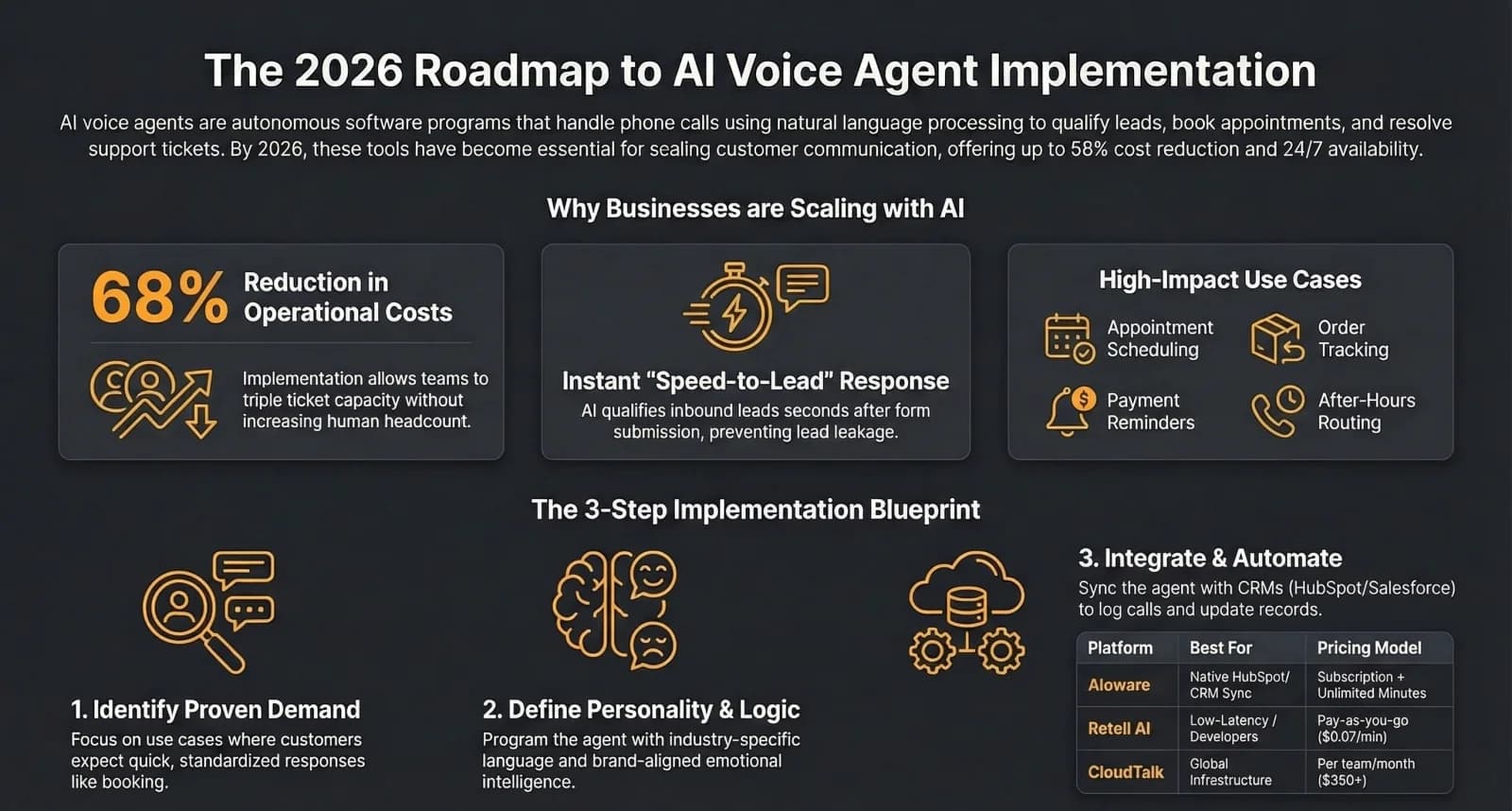
AI voice agents are software systems that use large language models and speech synthesis to handle phone calls autonomously. They answer questions, qualify leads, book appointments, and route callers — 24 hours a day, 7 days a week. Businesses using AI voice agents report 60-80% reductions in call handling costs and 3x faster lead response times.
Key Answers
- What is an AI voice agent?
- An AI voice agent is a software system that uses speech recognition, large language models, and text-to-speech to handle phone calls autonomously — answering questions, qualifying leads, and booking appointments without human intervention.
- How much do AI voice agents cost?
- AI voice agent platforms typically cost $0.07-$0.15 per minute of call time, plus a monthly platform fee of $30-$500. Most businesses spend $200-$1,000 per month depending on call volume.
- Can AI voice agents replace receptionists?
- AI voice agents handle 60-80% of routine inbound calls — appointment booking, FAQ answering, lead qualification, and call routing. Complex or emotional calls still need human agents.
- Which businesses benefit most from AI voice agents?
- Service businesses with high call volumes benefit most: medical practices, law firms, real estate agencies, home services, and any business where missed calls mean lost revenue.
Key Takeaways
- AI voice agents handle calls 24/7, eliminating the $3,000-$5,000 monthly cost of a full-time receptionist while answering within 1 second.
- Businesses using AI voice agents report 60-80% reduction in call handling costs and 3x faster lead response times.
- The technology stack combines speech-to-text, LLM reasoning, and text-to-speech to create natural conversations that most callers cannot distinguish from humans.
- Platform pricing ranges from $0.07-$0.15 per minute — a 10-minute call costs roughly $1 compared to $5-$8 for a human agent.
- Start with your highest-volume, lowest-complexity call type (appointment booking or FAQ answering) and expand from there.
What Are AI Voice Agents and How Do They Work?
AI voice agents are software systems that answer phone calls, understand spoken language, reason about the caller's intent, and respond with natural-sounding speech — all without human involvement.
The technology stack has three layers. First, automatic speech recognition (ASR) converts the caller's voice into text. Second, a large language model — typically GPT-4o, Claude, or a fine-tuned model — processes the text, understands context, and generates a response. Third, text-to-speech (TTS) engines like ElevenLabs or PlayHT convert that response back into natural-sounding audio. The entire loop takes 500-800 milliseconds, fast enough that conversations feel natural.
Unlike old IVR systems that forced callers through rigid menu trees ("press 1 for sales, press 2 for support"), AI voice agents engage in free-form conversations. A caller can say "I need to reschedule my appointment to sometime next Thursday afternoon" and the agent understands the intent, checks availability, and confirms the new time — all in a single fluid exchange.
Voice agents are one form of AI employee — a custom application that handles a specific business function autonomously. The difference is the interface: instead of processing emails, forms, or chat messages, voice agents operate on the phone channel where many businesses still receive the majority of their inbound leads.
Why Are Businesses Replacing Receptionists With AI Voice Agents?
Missed calls cost businesses an estimated $75 billion per year in the US alone. AI voice agents answer every call within 1 second, 24 hours a day, at a fraction of the cost of human staff.
A full-time receptionist costs $3,000-$5,000 per month including salary, benefits, and overhead. They work 8 hours a day, 5 days a week, and can handle one call at a time. An AI voice agent handles unlimited concurrent calls, never takes a sick day, and costs $200-$1,000 per month depending on volume. The math is straightforward.
Speed matters more than most businesses realize. Research shows that responding to a lead within 5 minutes makes you 21x more likely to qualify them. AI voice agents respond in under 1 second. For service businesses — medical practices, law firms, real estate agencies, home services — every missed or delayed call is a potential customer going to a competitor.
The business case extends beyond answering calls. AI voice agents integrate with CRMs, calendars, and ticketing systems to create complete automated follow-up workflows. A caller asks about pricing, the agent qualifies them, books an appointment, sends a confirmation email, and creates a CRM record — all in a single call.
What Can AI Voice Agents Do for Your Business Today?
AI voice agents handle six core functions: answering FAQs, qualifying leads, booking appointments, routing calls, processing simple orders, and conducting outbound follow-ups.
Appointment booking is the most common use case. Medical practices, dental offices, salons, and service businesses handle hundreds of scheduling calls per week. An AI voice agent checks real-time calendar availability, books the slot, sends confirmation via SMS or email, and handles rescheduling requests — eliminating 60-80% of routine calls that consume staff time.
Lead qualification is the second highest-value application. Instead of routing every caller directly to a sales rep, the AI voice agent asks qualifying questions — budget, timeline, specific needs — and scores the lead before transferring. Sales teams report 30-40% higher conversion rates because they only speak with pre-qualified prospects.
Industry-specific deployments are gaining traction. Real estate agencies use voice agents to handle property inquiries and schedule showings. Accounting firms use AI for client intake and tax season overflow. Home service companies use them for emergency dispatching and quote requests. The pattern is consistent: high call volume, predictable question types, and clear routing logic.
Which AI Voice Agent Platforms Should You Consider?
The market splits into three tiers: no-code platforms for quick setup, developer platforms for custom builds, and all-in-one CRM platforms with built-in voice AI.
For business owners who want to deploy quickly without technical expertise, platforms like My AI Front Desk and Goodcall offer plug-and-play solutions. You configure your business hours, common questions, and booking rules through a web interface. Setup takes 30-60 minutes. These platforms charge $50-$200 per month plus per-minute usage.
Developer platforms like Retell AI, Bland AI, and Vapi provide APIs and SDKs for building custom voice agents. These offer more control over the conversation flow, voice selection, LLM choice, and integrations. Retell AI supports interruption handling and emotional detection. Bland AI offers sub-500ms latency. Vapi provides a flexible pipeline architecture. Pricing is typically $0.07-$0.15 per minute.
All-in-one CRM platforms like GoHighLevel have added AI voice agents as a built-in feature. If you already use GoHighLevel for CRM, marketing, and pipeline management, their voice agent integrates natively with your existing workflows. The trade-off is less customization compared to dedicated voice platforms, but zero integration work.
How Much Do AI Voice Agents Cost?
Most businesses spend $200-$1,000 per month on AI voice agents, compared to $3,000-$5,000 for a full-time receptionist. Per-minute costs range from $0.07-$0.15.
The cost structure has three components: platform subscription ($30-$500/month), per-minute usage ($0.07-$0.15/minute), and telephony costs ($0.01-$0.03/minute via Twilio or similar). A business handling 500 minutes of calls per month would pay roughly $100-$200 in usage fees plus the platform subscription.
The ROI calculation is compelling. If you currently miss 20% of inbound calls and each call has a 10% chance of converting to a $500 job, recovering those calls at $200/month in AI costs generates thousands in recovered revenue. For high-value services like legal consultations or medical appointments, a single recovered lead can pay for months of AI voice agent costs.
Custom-built voice agents cost more upfront — $2,000-$10,000 for development — but offer lower per-minute costs and deeper integrations. This makes sense for businesses handling 2,000+ minutes per month or those needing complex multi-step workflows that off-the-shelf platforms cannot support.
How Do You Set Up an AI Voice Agent for Your Business?
Start with your highest-volume, lowest-complexity call type. Configure the knowledge base, set up call routing rules, test with 50-100 calls, then expand to more complex scenarios.
Step one is identifying your highest-impact call type. For most service businesses, this is appointment booking or FAQ answering. These calls follow predictable patterns, have clear success criteria, and represent the largest volume. Do not start with sales calls or complaint handling — those require nuance that current AI handles less reliably.
Step two is building the knowledge base. Upload your FAQ document, service list, pricing information, and business hours. The AI agent needs enough context to answer the top 20 questions callers ask. Record or transcribe 50 real calls to identify the exact questions and language your callers use — this dramatically improves accuracy.
Step three is configuring routing rules and fallbacks. Define when the agent should transfer to a human (angry caller, complex request, VIP client), what to do outside business hours (take message, book callback), and how to handle calls the agent cannot resolve. The best implementations have clear escalation paths — the worst ones leave callers stuck in an AI loop.
Step four is testing and iteration. Run the agent on a secondary phone number with 50-100 test calls before routing live traffic. Listen to call recordings, identify failure points, and refine the prompts. Most agents need 2-3 rounds of tuning before they handle 80%+ of calls correctly. If you are new to building AI systems, start with a no-code platform to validate the concept before investing in a custom build.
What Mistakes Should You Avoid When Deploying AI Voice Agents?
The three most common mistakes are trying to automate every call type at once, skipping the testing phase, and failing to set up proper human escalation paths.
Mistake one: automating too many call types at launch. Businesses that try to handle appointment booking, lead qualification, technical support, and complaint resolution simultaneously get mediocre results across the board. Start with one call type, perfect it, then expand. A voice agent that handles appointment booking flawlessly is worth more than one that handles five functions poorly.
Mistake two: not recording and reviewing calls. Every AI voice agent platform provides call recordings and transcripts. Review the first 100 calls manually. You will find patterns — specific questions the agent cannot answer, points where callers get frustrated, moments where the agent misunderstands intent. These insights drive the prompt refinements that separate an 80% success rate from a 95% one.
Mistake three: hiding the fact that it is AI. Some businesses try to pass off their voice agent as a human. This backfires when callers realize mid-conversation. Transparent disclosure — "Hi, this is an AI assistant from [Business Name], I can help you with scheduling and general questions" — sets proper expectations and actually increases caller satisfaction.
What Is the Bottom Line?
AI voice agents are the most practical AI automation most service businesses can deploy today. They solve a real problem — missed calls and slow response times — at 10-20% of the cost of human staff. Start with appointment booking or FAQ handling, prove the ROI on 500 calls, then expand.
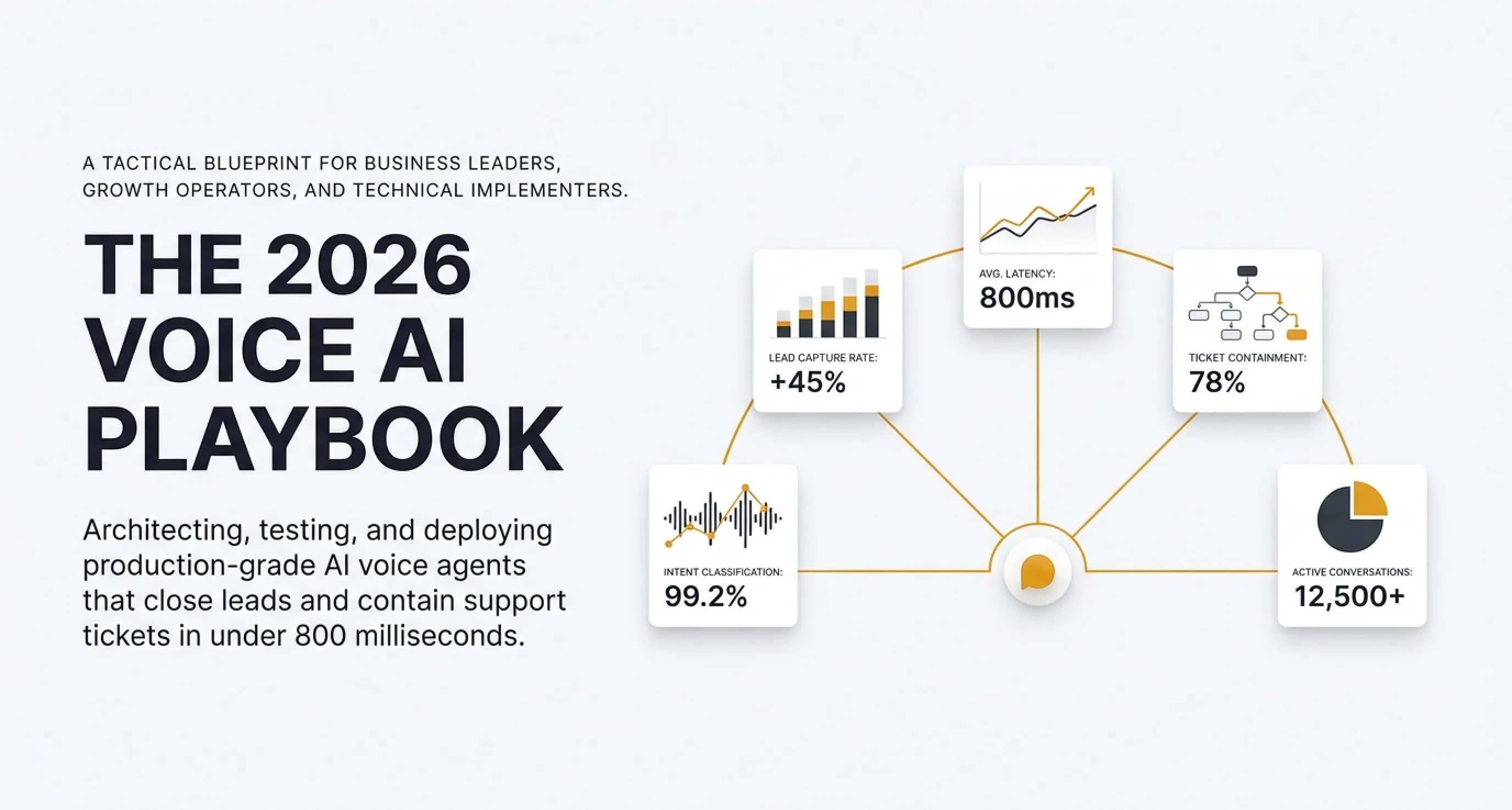
The technology matured rapidly in 2025-2026. Latency dropped below 800 milliseconds. Voice quality became nearly indistinguishable from humans. Platforms made setup accessible to non-technical business owners. The remaining gap is in complex emotional conversations and multi-step reasoning — tasks that still require human agents. For the 60-80% of calls that follow predictable patterns, AI voice agents deliver better consistency, faster response, and dramatically lower costs than any human alternative.
Research Data
Key strategies and factors based on original research
| Provider | Starting Price | Key Features | Best Use Case | Integrations | Setup Difficulty (Inferred) |
|---|---|---|---|---|---|
| Retell AI | $0.07/minute | Real-time low latency (<1s), LLM-powered agents, HIPAA-compliant options, and predictive intelligence. | Teams needing real-time phone agents with flexible telephony and transparent per-minute billing. | Twilio, SIP Trunks, Salesforce, HubSpot, and Vellum. | Moderate (Developer-first environment with a drag-and-drop builder). |
| Bland AI | $0.09/minute | 1M concurrent call scalability, voice cloning, API-based customization, and conversational pathways. | Developer teams and large enterprises needing high throughput and granular conversational control. | API-first; limited native CRM integrations. | High (Developer-focused platform requiring engineering resources). |
| Vapi AI | $0.05/minute + 3rd party costs | Open-source friendly, programmable workflows, multichannel API, and choose-your-own LLM. | Technical teams requiring modular architecture and programmable AI phone agents. | Multichannel API and various LLM providers. | High (Complex setup for non-technical teams; no visual builder). |
| Synthflow | $375/month | No-code visual builder, real-time call automation, and multilingual support. | Quick deployment for appointment scheduling and lead qualification without technical expertise. | Zapier and various CRM integrations. | Low (No-code visual builder for non-technical users). |
| My AI Front Desk | $250 - $500/month | Infinite lines, 24/7 digital receptionist, Zapier integration, and white-labeling options. | Small businesses (lawyers, real estate, therapy) needing after-hours coverage and lead qualification. | Zapier (9,000+ apps), CRMs, Slack, and Trello. | Low (Designed for ease of deployment for small business owners). |
| CloudTalk | $350/team/month | 24/7 AI agents, CRM syncing, AI call summary/tagging, sentiment analysis, and HIPAA compliance. | Repetitive, high-volume interactions like appointment scheduling and order status for sales and support. | HubSpot, Pipedrive, Zoho CRM, Salesforce, MS Dynamics, Zendesk, and Intercom. | Moderate (Requires 6-12 weeks implementation cycle and expert onboarding). |
| Aloware | $30/user/month | Native HubSpot integration, power dialer, AI SMS bot, and unlimited inbound/outbound agent minutes. | Sales and support teams needing deep CRM integration and all-in-one contact center capabilities. | HubSpot (Certified), Salesforce, Zoho, Pipedrive, GoHighLevel, Guesty, Zapier, and Gong. | Low (Described as no-code setup for SMBs). |
| Voiceflow | $60/editor/month | Drag-and-drop builder, multi-channel (voice/chat), and real-time collaboration tools. | Startups and design teams for prototyping and iterating on conversational experiences. | Technology agnostic (Any LLM, API, or backend). | Low (No-code drag-and-drop builder for rapid prototyping). |
| Lindy | $49/month | 3,000+ integrations, multi-agent orchestration, and task automation across phone and email. | Small businesses focused on task automation and scheduling. | 3,000+ apps (Zapier-style ecosystem). | Low (Automation-focused platform with high integration ease). |
| GoHighLevel (GHL) | $97/month | Inbound/outbound/widget AI, opt-out compliance bumpers, and voice background sounds. | Agencies and local businesses already using GHL for CRM and automation. | Native GHL CRM, Calendars, and Workflows. | Moderate (Requires configuring GHL workflows and knowledge bases). |
| Leaping AI | Custom (~$2,500/month) | Vertical-specific expertise, drag-and-drop interface, and custom voicemail detection. | Home improvement, insurance, and travel companies automating repetitive service calls. | API, SIP, and various CRMs. | Low (Simple setup for non-technical employees using plain language prompts). |
Original research by ManaTech
Frequently Asked Questions
Can callers tell they are speaking to an AI voice agent?
Modern AI voice agents use neural text-to-speech that closely mimics human speech patterns, including natural pauses and filler words. Studies show 60-70% of callers cannot distinguish AI agents from humans on routine calls. However, complex emotional conversations still reveal AI limitations.
Do AI voice agents work with my existing phone system?
Most AI voice agent platforms integrate with standard phone systems via SIP trunking or API forwarding. Platforms like Retell AI, Bland AI, and Vapi connect to Twilio, RingCentral, and other major providers. Setup typically takes 1-3 days for basic integration.
What happens when the AI voice agent cannot answer a question?
Well-configured AI voice agents have fallback rules — they transfer the call to a human agent, take a message with callback details, or offer to email information. The key is configuring clear escalation paths before going live.
How long does it take to set up an AI voice agent?
Basic setup on no-code platforms like GoHighLevel or My AI Front Desk takes 30-60 minutes. Custom-built voice agents with CRM integrations, appointment booking, and multi-step workflows typically take 1-2 weeks with a developer.
Are AI voice agents compliant with privacy regulations?
Reputable platforms comply with GDPR, CCPA, and HIPAA requirements. However, you must configure call recording disclosures, data retention policies, and consent mechanisms based on your jurisdiction and industry. Always verify compliance features before deploying.
Can AI voice agents handle multiple languages?
Leading platforms support 20-30 languages with varying quality. English voice quality is the most polished. For multilingual businesses, test the specific languages you need — quality drops significantly for less common languages.
Think You've Got It?
15 questions to test your understanding — instant feedback on every answer
Question 1 of 15
When configuring an AI voice agent's LLM temperature, what is the primary effect of setting the value to 0.0?
Question 2 of 15
According to the source material, what is the maximum latency threshold for a conversation to feel natural to a human caller?
Question 3 of 15
What is the primary distinction between a traditional IVR system and a modern AI Voice Agent (IVA)?
Question 4 of 15
Aloware is specifically recommended for sales teams that rely heavily on which CRM due to its 'certified partner' status?
Question 5 of 15
Which AI platform claims the ability to scale to as many as one million concurrent calls for enterprise-level throughput?
Question 6 of 15
In GoHighLevel (GHL) voice settings, what does the 'Idle Time' parameter control?
Question 7 of 15
According to the source material, why might an agent designer include 'Background Noise' like a coffee shop or call centre in the agent's settings?
Question 8 of 15
In the context of Retell AI, what is the purpose of the 'Speak during execution' function?
Question 9 of 15
What is the typical monthly price range mentioned for an agency to charge a small business for a managed AI voice receptionist service?
Question 10 of 15
When setting up a knowledge base for an AI agent, what is a common recommendation for reducing 'hallucinations'?
Question 11 of 15
In GoHighLevel's voice configuration, why might you intentionally misspell a business name in the greeting text?
Question 12 of 15
Which platform is specifically noted for being trained on over 600 million minutes of real sales calls to better understand buyer intent and cultural nuances?
Question 13 of 15
What is the function of 'Interruption Sensitivity' in an AI voice agent's configuration?
Question 14 of 15
According to the guide for small businesses, what is 'White Labelling' in the context of AI voice agents?
Question 15 of 15
Why is 'Speed-to-Lead' considered a critical crisis for small businesses that AI voice agents help solve?
Related Content
Building an AI Employee: Custom Applications That Replace Repetitive Tasks
How custom-built AI systems act as digital employees, handling meeting notes, inbox management, analytics, and onboarding so your team can focus on growth.
Read more →blogThe Rise of Agentic Development: How AI Agents Are Replacing Development Teams
The shift from writing code to orchestrating AI agents is redefining software development. What agentic development means for project timelines, costs, and the SMBs who need custom software.
Read more →blogClaude Code for Business Owners: Automate Your Business Without a Dev Team
Claude Code is an agentic coding tool that works autonomously for minutes or hours, not just completing code snippets. Nate Herk says he would teach a 10-year-old to build agentic workflows with it. Here is what business owners need to know.
Read more →blogWhen Should You Outgrow Zapier and Build a Custom Automation System?
Zapier is the right tool until it is not. When your automation bill exceeds $500-1,000 per month, workflows break at critical moments, or you need logic that a visual builder cannot express, it is time to consider a custom automation system. One company went from $600 per month on Zapier to $75 per month with a custom build.
Read more →blogChatGPT vs Claude vs Gemini for Small Business in 2026: A Practical Comparison
Most small business owners pick the first AI tool they try and stick with it. That is the most expensive mistake you can make in 2026. The three leading platforms — ChatGPT, Claude, and Gemini — are not interchangeable. Each one wins decisively for different tasks, and 70% of growing service firms now run all three concurrently for that exact reason.
Read more →Want to explore this topic further?
Book a free discovery call to discuss how ManaTech can help your business implement these ideas.
Book a Discovery Call