
How to Build AI Agents for Your Business Without Writing Code
Quick Answer
You can build functional AI agents for your business using no-code platforms like n8n, Make.com, and the ChatGPT Agent Builder without writing a single line of code. These tools let you connect AI models to your existing business systems — CRM, email, spreadsheets, databases — and create agents that handle multi-step tasks autonomously. The key difference between an AI agent and a chatbot is autonomy: agents plan their own approach, use tools, and take actions rather than simply responding to prompts. Start with a single workflow like lead qualification or email triage, prove it works, and expand from there.
Key Answers
- What is the difference between an AI agent and a chatbot?
- A chatbot responds to prompts with text. An AI agent plans its approach, calls external tools (APIs, databases, web searches), takes actions in your business systems, and self-corrects when something goes wrong. Agents complete multi-step workflows; chatbots answer questions.
- Which no-code platforms let you build AI agents?
- The top platforms in 2026 are n8n (open-source, self-hostable, AI Agent Tool Node), Make.com (visual builder with AI Agents feature), ChatGPT Agent Builder (simplest entry point, built into ChatGPT), and Zapier (AI-powered Copilot and Agents for non-technical users).
- What can a no-code AI agent actually do for a business?
- No-code AI agents can qualify leads from form submissions, triage and respond to customer emails, generate reports from multiple data sources, monitor competitors and summarise changes, reconcile invoices against purchase orders, and schedule meetings based on natural language requests.
- When do no-code AI agents hit their limits?
- No-code agents struggle with complex multi-system integrations, high-volume real-time processing, custom AI model fine-tuning, and workflows that require sub-second response times. When you hit these limits, you need custom-built agents — which is where professional development becomes worthwhile.
Key Takeaways
- AI agents differ from chatbots in one critical way: agents take autonomous actions across your business systems rather than simply generating text responses.
- IDC projects AI copilots will be embedded in 80% of enterprise workplace applications by 2026, making agent-building skills increasingly valuable.
- n8n 2.0 introduced the AI Agent Tool Node for multi-agent orchestration with native LangChain integration — the most powerful no-code agent builder available.
- The ChatGPT Agent Builder is the simplest entry point for business owners with zero technical experience, creating functional agents in under 30 minutes.
- No-code agents work well for 80% of business automation needs. The remaining 20% — complex integrations, high-volume processing, and custom models — requires professional development.

What Is an AI Agent and How Is It Different From a Chatbot?
A chatbot waits for your prompt and responds with text. An AI agent takes initiative, plans multi-step approaches, calls external tools, and takes real actions in your business systems. The distinction matters because agents solve business problems that chatbots cannot — they complete workflows end-to-end rather than answering one question at a time.
IBM describes an AI agent as a system capable of autonomously performing tasks by designing its own workflow and utilising available tools. Gartner predicts 40% of enterprise AI projects will involve agentic systems by 2027. The key capability is self-reflection — an agent can recognise when its approach is not working and adjust without human input. This is what makes agents fundamentally different from automation rules or chatbot scripts.
In practical terms: a chatbot can answer "What is our refund policy?" An agent can review a customer's order history, check the return window, calculate the refund amount, generate the credit note, send it to the customer, and update the CRM — all triggered by a single customer email. That is the difference between answering questions and completing work.
Which No-Code Platforms Let You Build AI Agents?
Four platforms dominate the no-code AI agent space in 2026. The ChatGPT Agent Builder is the simplest entry point — it is built into ChatGPT Plus and lets you create agents using natural language descriptions with no technical setup. n8n 2.0 is the most powerful option, with its AI Agent Tool Node enabling multi-agent orchestration and native LangChain integration. Make.com sits in the middle with a visual canvas builder and integrated AI Agents feature. Zapier offers AI-powered Copilot and Agents for users who want the simplest possible interface.
The right platform depends on your technical comfort and needs. If you have never built any automation, start with ChatGPT Agent Builder. If you want visual workflow design with moderate complexity, use Make.com. If you need maximum flexibility, self-hosting, and unlimited executions, choose n8n. All four connect to the major AI models — GPT-4, Claude, and Gemini — so your choice of platform does not lock you into a specific AI provider.
How Do You Build Your First AI Agent Without Code?
Start with a single, well-defined task. The best first agent for most businesses is an email triage agent that reads incoming messages, classifies them by type (sales inquiry, support request, invoice, spam), drafts appropriate responses, and routes them to the right person. This agent is simple enough to build in under 30 minutes, saves 1-2 hours per day, and does not touch sensitive financial systems.
The build process follows four steps regardless of platform. First, define the trigger — what event starts the agent (new email, form submission, scheduled time). Second, connect the AI model — tell the agent what to do with clear instructions including examples of correct outputs. Third, add actions — connect the tools the agent needs (email, CRM, spreadsheet, Slack). Fourth, test with real data — run 20-30 real examples through the agent and check accuracy before going live.
The most common mistake in agent building is writing vague instructions. "Handle customer emails" is too broad. "Read the incoming email. If it asks about pricing, draft a response using our pricing page content and include a link to schedule a call. If it is a support request, create a ticket in our help desk and reply confirming receipt with an estimated response time of 4 hours." Specificity is everything.
What Can AI Agents Actually Do for Your Business?
No-code AI agents handle a surprisingly wide range of business tasks. Lead qualification agents score incoming leads based on criteria you define and route hot leads to sales instantly. Content repurposing agents take a blog post and generate social media posts, email newsletter snippets, and tweet threads. Invoice processing agents extract data from PDF invoices, match them against purchase orders, and flag discrepancies for human review.
More advanced agents handle competitive monitoring (tracking competitor websites and summarising changes weekly), meeting preparation (pulling relevant CRM data, recent emails, and company news before each meeting), and automated reporting (generating weekly business reports from data spread across multiple tools). These agents run 24 hours a day, 7 days a week, and cost a fraction of a human assistant.
When Do No-Code AI Agents Hit Their Limits?
No-code agents work well for 80% of business automation needs. They handle single-purpose tasks, standard integrations, and moderate volume without issues. The limits appear when you need complex multi-system integrations with custom logic, real-time processing at high volume (hundreds of events per second), fine-tuned AI models trained on your proprietary data, or workflows that require sub-second response times.
When you hit these limits, the answer is not to abandon AI agents — it is to move from no-code to custom-built agents designed for your specific requirements. Custom agents use the same AI models but with purpose-built integrations, optimised prompts, and infrastructure that handles your exact workload. Think of no-code agents as proof of concept — they validate the business case before you invest in a production-grade solution.
What Is the Bottom Line?
Building AI agents without code is not just possible — it is the fastest way to prove that AI automation works for your specific business before investing in custom development. Start with an email triage or lead qualification agent on ChatGPT Agent Builder or n8n. Give it 30 minutes to build and 1 week to validate. If it saves even 1 hour per day, you have a business case for expanding. The tools are free or nearly free to start. The only cost of not trying is watching your competitors automate while you do it manually.
Research Data
Key strategies and factors based on original research
| platform name | pricing (free/paid tiers) | AI model support | key features | best for | learning curve | self-hosting option |
|---|---|---|---|---|---|---|
| n8n | Free (self-hosted); Paid cloud tiers available. | Model-agnostic (supports OpenAI, Claude, Gemini, and local models like Ollama). | LangChain/LangGraph integration, SSH node for local code execution, session ID management, and custom JSON/JavaScript logic nodes. | Complex multi-step workflows, technical users, and sovereign data environments. | Intermediate to Developer (requires understanding of nodes, JSON, and schemas). | Yes; can be self-hosted on VPS (Docker/Node.js) or local hardware (Raspberry Pi). |
| Aisera (now part of Automation Anywhere) | Paid/Custom; Enterprise-grade with custom pricing based on needs. | Model-agnostic; utilizes proprietary models, foundation models (FMs), and Enterprise LLMs (e.g., GPT-4o Mini, Claude 3.5 Sonnet, Gemini 1.5 Pro). | Learning agents, multi-agent orchestration, TRAPS (Security/Privacy), GenIQ, Hyperflows, AI Workflow Builder, and Model Context Protocol (MCP) support. | Enterprise domains including IT Service Management (ITSM), HR, Customer Service, and Supply Chain. | Intermediate to Developer (offers no-code visual builders like Hyperflows but targets complex enterprise architecture). | Yes; supports on-premises, private cloud, and hybrid deployments. |
| IBM watsonx Orchestrate | Paid/Custom Enterprise. | Model-agnostic (supports IBM models and third-party models like Llama/Granite). | Agentic RAG, AgentOps telemetry, human-in-the-loop governance, and pre-built industry skills. | Regulated industries (Banking, Government) and hybrid cloud estates. | Intermediate to Developer (Enterprise engineering focus). | Yes; supports hybrid estates and IBM Cloud deployments. |
| ChatGPT Agent Builder (OpenAI) | Free during beta; Plus/Pro/Team/Enterprise tiers for full access. | Specific to OpenAI models (GPT-4o, o3-mini, o1). | Visual flowchart builder (drag-and-drop), MCP support for Google/Microsoft apps, guardrails for PII protection, and multi-step logic (if/else). | Individual productivity, meeting prep, automated email drafting, and web research. | Non-technical (drag-and-drop, no coding required). | No (SaaS-based cloud only). |
| Zapier Central | Free tier available; Paid tiers for increased task volume/advanced features. | Model-agnostic via connected LLMs; uses GPT-4o by default for reasoning. | 2,000+ app integrations, AI co-pilot for natural language agent creation, and lead enrichment automation. | Simple to medium tasks, fast iteration, and sales lead qualification. | Non-technical (plug-and-play). | No (SaaS-based cloud). |
| StackAI | Free tools/tier available; Paid tiers for enterprise use. | Model-agnostic (LLM Leaderboard supports various models). | Hierarchical multi-agent workflows, internal Knowledge Bases, and standardized tool connectors. | Document-heavy processes, financial audits, and public sector compliance. | Intermediate (focuses on workflow architecture). | Not in source |
| Beam AI | Paid (Enterprise-focused). | Model-agnostic; connects to various base models. | Agentic memory, modular orchestration hub, and universal integration library for CRM/ITSM. | Standardizing agentic workflows across different enterprise departments. | Intermediate (Low-code capabilities). | Not in source |
Original research by ManaTech
Frequently Asked Questions
Do I need any technical skills to build an AI agent?
No. Platforms like ChatGPT Agent Builder and Zapier are designed for people with zero coding experience. You describe what you want the agent to do in plain English, connect your business tools, and test. More advanced platforms like n8n and Make.com have a learning curve of 2-4 hours but offer significantly more power and flexibility.
How much do no-code AI agent platforms cost?
ChatGPT Agent Builder is included with ChatGPT Plus ($20/month). n8n offers a free self-hosted option or cloud plans starting at $24/month. Make.com starts at $10.59/month for 10,000 operations. Zapier starts at $29.99/month. The AI model costs (API calls to GPT-4, Claude, or Gemini) are additional and typically range from $5-50 per month depending on usage volume.
Can AI agents access my business data securely?
Yes, when configured correctly. n8n offers full self-hosting so data never leaves your servers. Make.com and Zapier encrypt data in transit and at rest with SOC 2 compliance. The key security practice is to use API keys with minimal permissions — give the agent access only to the specific data and actions it needs, nothing more.
What is the best first AI agent to build for a small business?
An email triage agent that reads incoming emails, classifies them by type (sales inquiry, support request, invoice, spam), drafts appropriate responses, and routes them to the right person. This agent saves 1-2 hours per day, has clear accuracy metrics, and does not require integration with sensitive financial systems.
How reliable are no-code AI agents?
Reliability depends on the complexity of the task and the quality of your instructions. Simple agents (email classification, data extraction) achieve 90-95% accuracy. Complex agents (multi-step workflows with conditional logic) achieve 75-85% accuracy and need human review for edge cases. Always include a fallback for when the agent encounters something unexpected.
Think You've Got It?
10 questions to test your understanding — instant feedback on every answer
Question 1 of 10
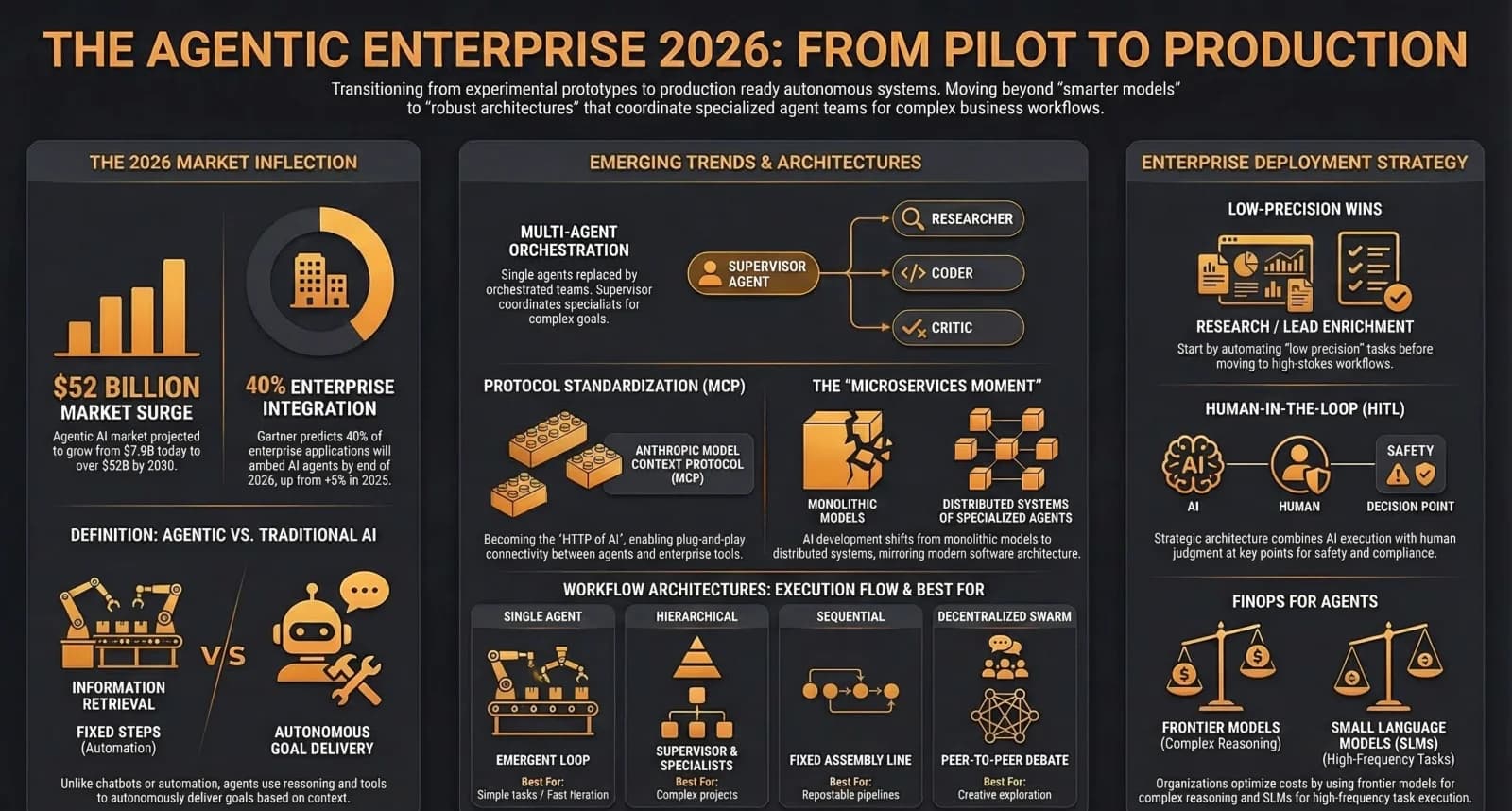
According to industry analysis, which specific trend is being described as the 'microservices moment' for artificial intelligence in 2026?
Question 2 of 10
What is the primary function of the Model Context Protocol (MCP) in the 2026 agentic ecosystem?
Question 3 of 10
When evaluating which business tasks to automate with agents, why is 'low precision' work considered the ideal starting point?
Question 4 of 10
In the context of 'FinOps for AI Agents', how does the 'Plan-and-Execute' pattern contribute to cost optimisation?
Question 5 of 10
Which architecture is most appropriate for a business process that is repeatable, follows a known path, and requires predictable output at each step?
Question 6 of 10
Vector databases typically store text as embeddings. According to the source material, how many dimensions are commonly used to balance semantic depth with computational efficiency?
Question 7 of 10
How does 'Agentic RAG' differ from traditional Retrieval-Augmented Generation?
Question 8 of 10
What is the significance of the EU AI Act scheduled for full application by mid-2026?
Question 9 of 10
In agent development, what is the 'Enterprise Scaling Gap' observed in 2026?
Question 10 of 10
What distinguishes 'Physical AI' from standard Large Language Models (LLMs) in the 2026 trends?
Related Content
Building an AI Employee: Custom Applications That Replace Repetitive Tasks
How custom-built AI systems act as digital employees, handling meeting notes, inbox management, analytics, and onboarding so your team can focus on growth.
Read more →blogThe Rise of Agentic Development: How AI Agents Are Replacing Development Teams
The shift from writing code to orchestrating AI agents is redefining software development. What agentic development means for project timelines, costs, and the SMBs who need custom software.
Read more →blogClaude Code for Business Owners: Automate Your Business Without a Dev Team
Claude Code is an agentic coding tool that works autonomously for minutes or hours, not just completing code snippets. Nate Herk says he would teach a 10-year-old to build agentic workflows with it. Here is what business owners need to know.
Read more →blogWhen Should You Outgrow Zapier and Build a Custom Automation System?
Zapier is the right tool until it is not. When your automation bill exceeds $500-1,000 per month, workflows break at critical moments, or you need logic that a visual builder cannot express, it is time to consider a custom automation system. One company went from $600 per month on Zapier to $75 per month with a custom build.
Read more →blogChatGPT vs Claude vs Gemini for Small Business in 2026: A Practical Comparison
Most small business owners pick the first AI tool they try and stick with it. That is the most expensive mistake you can make in 2026. The three leading platforms — ChatGPT, Claude, and Gemini — are not interchangeable. Each one wins decisively for different tasks, and 70% of growing service firms now run all three concurrently for that exact reason.
Read more →Want to explore this topic further?
Book a free discovery call to discuss how ManaTech can help your business implement these ideas.
Book a Discovery Call