
AI Automation for Accounting Firms: What to Automate First in 2026
Quick Answer
Accounting firms should start AI automation with reconciliation, document classification, and client communication — the three tasks that consume the most manual hours with the lowest error tolerance. The Thomson Reuters 2026 AI in Professional Services Report found that firms using advanced AI tools almost doubled year over year, and accountants using AI support 55% more clients per week. The best approach is to layer AI onto your existing tech stack (Xero, QuickBooks, or similar) rather than replacing it, starting with one workflow and expanding once ROI is proven.
Key Answers
- Which accounting tasks should you automate with AI first?
- Start with bank reconciliation, invoice categorisation, and email triage. These three tasks consume the most manual hours, have clear accuracy benchmarks, and deliver measurable time savings within 30 days of implementation.
- How much does AI automation cost an accounting firm?
- Entry-level AI tools like Dext and Vic.ai start at $50-200 per month. Custom AI integrations for mid-size firms typically cost $15,000-40,000 upfront with $1,000-2,000 per month in maintenance. Most firms see break-even within 4-6 months.
- What ROI can accounting firms expect from AI automation?
- Firms using AI tools support 55% more clients per week without adding staff. AI lowers the cost-to-serve per client by handling low-value manual work, enabling firms to shift from hourly billing to higher-margin advisory services.
- Will AI replace accountants?
- AI replaces tasks, not accountants. McKinsey estimates AI will replace 40% of work activities in accounting within 10 years — routine reconciliation, data entry, and compliance checks. The accountants who adopt AI tools move into advisory roles that command higher fees.
Key Takeaways
- 85% of accounting firms see AI as essential for competitiveness, but 45% have not started investing — creating a window for early adopters to gain market share.
- Accountants using AI tools support 55% more clients per week, with the biggest gains in reconciliation, categorisation, and client communication.
- Ernst & Young achieved its lowest US auditing shortfall rate in 16 years using AI tools that automate calculation validation and financial statement scanning.
- The most effective approach is layering AI onto existing platforms (Xero, QuickBooks) rather than replacing your entire tech stack.
- Firms that adopt AI shift from hourly billing to advisory services, increasing revenue per client by 30-50% while reducing manual workload.

Why Are Accounting Firms Investing in AI Automation in 2026?
The accounting profession is under more pressure than at any point in the last decade. Shrinking margins, growing client demands, and an escalating compliance burden have converged with a persistent staffing shortage. AI automation is the most practical response to all three problems simultaneously.
The Thomson Reuters 2026 AI in Professional Services Report found that the portion of professional service organisations using advanced AI tools almost doubled year over year. ICAEW data shows 85% of accounting firms see AI as key to staying competitive — yet 45% have not started investing. That gap is a window: firms that move now gain capacity and pricing power while competitors hesitate.
Ernst & Young is a leading example. EY is achieving its lowest US auditing shortfall rate in 16 years, driven by AI tools that automate calculation validation and scan financial statements hundreds of pages long. But AI is not just for Big Four firms — the most impactful tools are designed for small and mid-size practices that need to do more with fewer people.
Which Accounting Tasks Can AI Automate Today?
AI excels at high-volume, rules-based tasks where speed and accuracy matter more than judgment. In a well-run client accounting services practice, AI automates routine reconciliation and categorisation, flags exceptions, and generates dashboards and alerts rather than static monthly reports.
The highest-impact automation targets for accounting firms in 2026 are: bank reconciliation and transaction matching, invoice processing and categorisation, document classification and data extraction, email triage and client communication drafting, compliance monitoring and regulatory updates, and financial forecasting and cash flow projections. Each of these tasks currently consumes 5-15 hours per week of staff time in a typical 10-person firm.
The pattern is clear: AI handles the repetitive data processing while accountants focus on advisory services that generate higher revenue. Firms that make this shift report 30-50% increases in revenue per client because advisory work commands premium fees that hourly compliance work cannot match.
What Are the Best AI Tools for Accounting Firms in 2026?
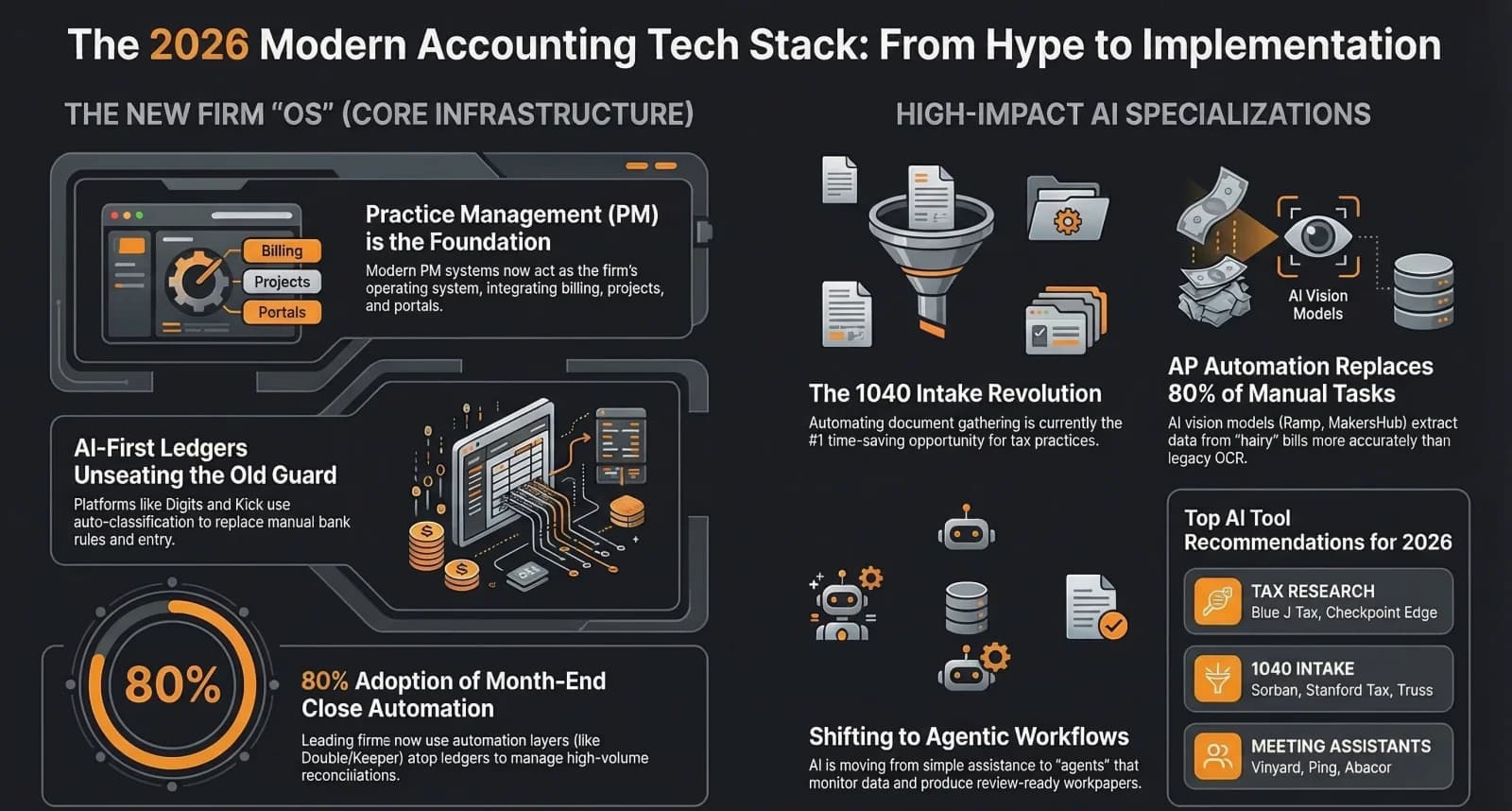
The AI accounting tool landscape in 2026 spans five categories: audit support (DataSnipper, Trullion, Auditor Intelligence), client accounting services (MakersHub.ai, Vic.ai, Botkeeper, Dext), financial reporting (Fathom, Syft Analytics), tax preparation (Thomson Reuters UltraTax with AI, Intuit ProConnect), and general-purpose AI (Claude, ChatGPT, Gemini for research, drafting, and analysis).
DataSnipper stands out for audit teams — it automates document matching, extraction, and cross-referencing across financial statements. Vic.ai leads in invoice processing with machine learning that improves accuracy over time. Dext is the entry point for small firms — it handles receipt capture, categorisation, and bank reconciliation at $50-100 per month.
The emerging category is ambient AI — tools that quietly handle document classification, task creation, and data consistency checks inside the firm's daily workflow without requiring explicit prompts. Accountants experience these as summaries that appear automatically, anomalies flagged before they are asked about, and draft client responses ready for review. This shift from tool-you-use to tool-that-works-for-you is the defining trend of accounting AI in 2026.
How Much Does AI Automation Cost an Accounting Firm?
AI automation costs for accounting firms fall into three tiers. Tier one is off-the-shelf AI tools: $50-500 per month for products like Dext, Botkeeper, or Fathom that plug into your existing stack. Tier two is platform-level AI: $500-2,000 per month for enterprise features in tools like Thomson Reuters Practice CS or Wolters Kluwer CCH with AI capabilities. Tier three is custom AI integrations: $15,000-40,000 upfront plus $1,000-2,000 per month for bespoke solutions that connect your specific systems and automate your unique workflows.
Most firms start at tier one, prove the value, and then move to tier three when they need integrations that off-the-shelf tools cannot provide. The break-even point for tier one tools is typically 1-2 months. For custom integrations, break-even ranges from 4-6 months depending on the firm's volume and the complexity of the workflow being automated.
How Do Accounting Firms Measure AI Automation ROI?
The primary ROI metric for accounting firms is clients served per staff member per week. Firms using AI tools support 55% more clients per week without adding headcount. Secondary metrics include hours saved per process (reconciliation time drops from 4 hours to 30 minutes per client), error rates (AI-assisted reconciliation typically reduces errors by 80-90%), and revenue per client (advisory services enabled by freed capacity command 2-3x the fees of compliance work).
Track these numbers before and after AI implementation. The most convincing metric for firm partners is cost-to-serve per client. When AI handles low-value manual work, the cost to serve each client drops while the capacity to serve more clients increases. This is how firms move away from hourly billing toward fixed-fee advisory engagements that are more profitable and more predictable.
What Are the Common Mistakes Firms Make When Adopting AI?
The first mistake is automating too many processes at once. Start with one workflow — typically bank reconciliation or document classification — and prove it works before expanding. The second mistake is choosing tools based on features rather than integration. An AI tool that does not connect to your practice management software, Xero, or QuickBooks creates more work, not less.
The third mistake is skipping the human-in-the-loop phase. Every AI tool needs a training period where staff verify outputs and correct errors. This phase typically lasts 60-90 days. Firms that skip it end up with AI that makes confident mistakes — which erodes trust and leads to abandonment. The fourth mistake is underinvesting in training. AI tools are only as effective as the people using them. Budget 10-20 hours per staff member for initial training and 2-4 hours per month for ongoing skill development.
What Is the Bottom Line?
AI automation is not optional for accounting firms that want to grow in 2026. The firms adopting AI now are handling 55% more clients, shifting to higher-margin advisory work, and reducing error rates by 80-90%. The firms that wait will compete on price for compliance work that AI is rapidly commoditising. Start with one high-volume task — reconciliation or document classification — prove the ROI in 30-60 days, and expand from there. The technology is ready. The only question is whether your firm will be an early adopter or a late follower.
Research Data
Key strategies and factors based on original research
| tool name | category (bookkeeping/audit/tax/reporting) | key features | pricing tier | best for which firm size | AI capabilities |
|---|---|---|---|---|---|
| Digits | bookkeeping | Full ground-up ledger; alternative to QuickBooks Online and Xero; integrated with practice management. | tiered | SMB firms | Three-layer auto-classification approach using client models, firm models, and global network data to code transactions. |
| Kick | bookkeeping | Self-driving bookkeeping; multi-entity handling in a single workspace; single subscription for multiple client entities. | tiered | SMB firms | AI-first ground-up ledger; agentic workflows for handling multi-entity money movements. |
| Sorban | tax | Automates 1040 intake; dynamic smart questionnaires; custom document request lists; data push to tax software. | public (tiered) | SMB firms | LLM-based ingestion to recognize files and automatically tick off checklist items based on document contents. |
| Blue J Tax | tax | AI tax research; verified answers to avoid staff errors; specialized for US tax specific search. | custom quote | mid-market | LLM-based ingestion of tax codes and regulations for specialized legal research; engineered to reduce hallucinations. |
| MakersHub | bookkeeping | Detailed extraction for complex accounts payable; supports project tracking, inventory, construction, and manufacturing. | custom quote | mid-market | AI vision models and LLM logic for detailed data extraction from complex, non-standard bills and invoices. |
| Xero | bookkeeping | JAX conversational AI assistant; secure bank connections; automated financial reporting; business health scores. | public (tiered) | SMB firms | JAX AI assistant for routine workflows; machine learning for bank reconciliation and categorization suggestions. |
| Campfire | reporting | Automated financial reporting; GL supports multi-entity and multi-currency consolidations; revenue automation. | custom quote | mid-market | AI-driven reporting and invoicing that unifies data across multiple sources; accelerates month-end close. |
| Spark AI | tax | Virtual assistant built into Rightworks; drafts emails; analyzes client data; spots growth opportunities. | public (tiered) | solo CPAs | Secure AI virtual assistant for accounting tasks, email drafting, and tax rule navigation. |
| Vic.ai | bookkeeping | Automates accounts payable; autonomous invoice processing; real-time financial insights; expense management. | custom quote | large enterprises | Machine learning for autonomous invoice processing and data extraction; eliminates the need for templates. |
| Ramp | bookkeeping | Finance operations platform; bill pay; expense management; automated accounting patterns; real-time tracking. | public (tiered) | SMB firms | AI-driven accounting automation; learns coding patterns to code transactions as they post; flags duplicate subscriptions. |
| QuickBooks Online Advanced | bookkeeping | Workflow automation; cash flow projections; invoicing; Intuit Assist; smart receipt scanning. | public (tiered) | SMB firms | Intuit Assist (AI assistant) for transaction categorization and predictive analytics for cash flow forecasting. |
| Rillet | reporting | AI-native ERP; automated revenue recognition; multi-entity consolidation; GAAP and SaaS metrics unification. | custom quote | mid-market | AI-embedded workflows for automated revenue recognition and complex multi-currency accounting. |
| Black Ore (Tax Autopilot) | tax | End-to-end tax preparation; focuses on intake, classification, and draft return preparation. | custom quote | mid-market | Agentic AI systems for automated tax document intake and draft work product generation. |
| Auditor Intelligence | audit | AI-based audit applications; highlights anomalies earlier in cycles; links source documents to workpapers. | custom quote | large enterprises | Predictive analytics and pattern recognition to identify high-risk anomalies and outliers in audit cycles. |
| Botkeeper | bookkeeping | Automated bookkeeping; transaction categorization; reconciliations; reporting; oversight maintenance. | public (tiered) | SMB firms | Machine learning for automated bookkeeping workflows and real-time transaction processing. |
Original research by ManaTech
Frequently Asked Questions
Can AI handle tax preparation for accounting firms?
AI can automate 60-70% of tax preparation tasks — data extraction from source documents, categorisation of deductions, preliminary return calculations, and compliance checks against current regulations. A human CPA still reviews and signs off on every return, but the preparation time drops from hours to minutes for standard returns.
What is the biggest mistake firms make when adopting AI?
Trying to automate everything at once. The firms that succeed start with a single high-volume, low-complexity task — typically bank reconciliation or document classification. They prove the ROI on that one workflow, train the team, and then expand to the next process. The firms that fail try to implement AI across five workflows simultaneously.
How do you ensure AI accuracy in accounting?
Set up a human-in-the-loop review for the first 90 days. AI tools like DataSnipper and Trullion flag exceptions and confidence scores on every output. Start by having staff verify 100% of AI outputs, then gradually reduce to spot checks as accuracy benchmarks are met. Most tools reach 95-98% accuracy within 60 days of training on your specific data.
Is client data safe with AI accounting tools?
Reputable AI accounting tools like DataSnipper, Vic.ai, and Botkeeper are SOC 2 Type II certified and encrypt data in transit and at rest. Many offer on-premise deployment options for firms with strict data sovereignty requirements. Always verify the vendor's compliance certifications and data retention policies before onboarding.
Do small firms benefit from AI or is it only for large practices?
Small firms often benefit more because AI eliminates the bottleneck of limited staff. A sole practitioner using AI for reconciliation and document processing can handle the client load of a 3-person team. Entry-level tools like Dext start at $50 per month — accessible even for firms with 20 or fewer clients.
Think You've Got It?
10 questions to test your understanding — instant feedback on every answer
Question 1 of 10
Digits uses a three-layer approach to auto-classify transactions. If a transaction has never been seen by a specific client or the accounting firm before, which model does the software fall back on?
Question 2 of 10
According to the source material, what is the primary advantage of the 'Kick' accounting ledger for clients with complex structures?
Question 3 of 10
What is the recommended version of ChatGPT for accounting firms to ensure sensitive client data is protected?
Question 4 of 10
Which category of AI tools is described as the 'biggest change to bookkeeping tech in over a decade' due to its ability to manage tasks across multiple ledgers?
Question 5 of 10
When implementing AI tools in an accounting firm, what does Randy Johnston recommend to avoid 'single exposure person risk'?
Question 6 of 10
In the context of the 'Next Generation' of AI, what defines an 'Agentic' system?
Question 7 of 10
Why is it often recommended for firms to start their digital transformation with the 'workflow layer' rather than a new Practice Management (PM) system?
Question 8 of 10
Which non-accounting AI tool is highlighted for its ability to create 11-minute 'audio overviews' of financial statements for clients?
Question 9 of 10
What significant change in hardware is predicted for 2026 to better support AI in professional environments?
Question 10 of 10
According to the source, why is AI-driven 'Accounts Payable' (AP) seen as more effective than traditional OCR technology?
Related Content
Building an AI Employee: Custom Applications That Replace Repetitive Tasks
How custom-built AI systems act as digital employees, handling meeting notes, inbox management, analytics, and onboarding so your team can focus on growth.
Read more →blogWhen Should You Outgrow Zapier and Build a Custom Automation System?
Zapier is the right tool until it is not. When your automation bill exceeds $500-1,000 per month, workflows break at critical moments, or you need logic that a visual builder cannot express, it is time to consider a custom automation system. One company went from $600 per month on Zapier to $75 per month with a custom build.
Read more →blogHow to Build AI Agents for Your Business Without Writing Code
AI agents go beyond chatbots — they take actions, make decisions, and complete multi-step workflows autonomously. IDC expects AI copilots embedded in 80% of enterprise apps by 2026. Here is how to build your first AI agent without code.
Read more →blogAI Voice Agents for Business: The Complete 2026 Guide
AI voice agents handle inbound calls, qualify leads, and book appointments 24/7 — without hiring staff. This guide covers what they are, what they cost, and how to deploy one for your business.
Read more →blog5 Revenue-Generating AI Automations Every Growing Business Needs
Five high-ROI AI automations that directly impact revenue, from intelligent lead scoring to automated analytics reporting. Each one pays for itself within weeks.
Read more →Want to explore this topic further?
Book a free discovery call to discuss how ManaTech can help your business implement these ideas.
Book a Discovery Call