
ChatGPT vs Claude vs Gemini for Small Business in 2026: A Practical Comparison
Quick Answer
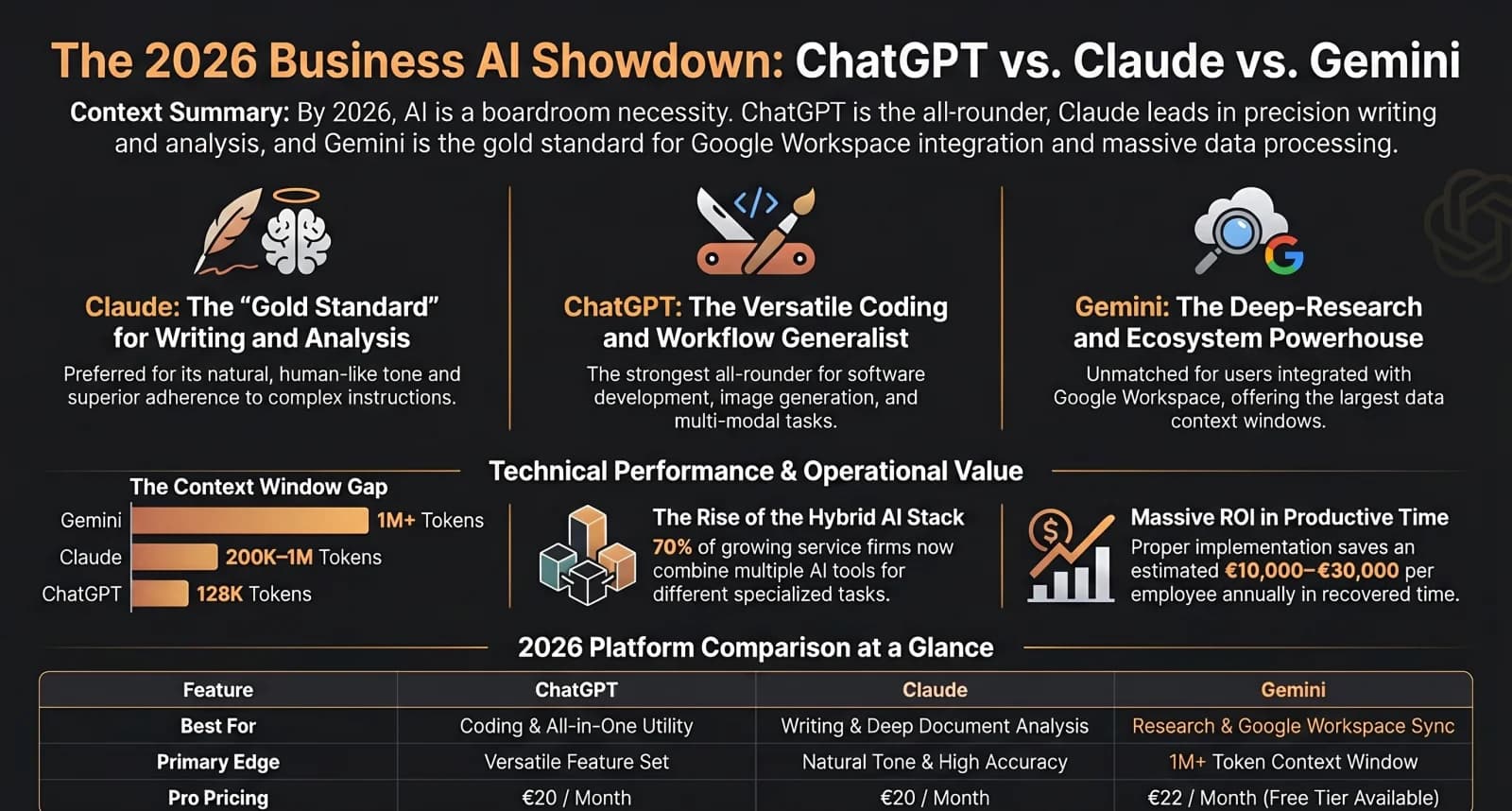
ChatGPT, Claude, and Gemini all cost around $20 per month and look similar from the outside, but they are not interchangeable. Claude wins for writing, document analysis, and coding. ChatGPT wins for image generation, plugins, and general versatility. Gemini wins for anyone already on Google Workspace and for processing massive datasets up to 1 million tokens. The single biggest mistake is picking one and stopping there — 70% of small agencies and 81% of Global 2000 companies now use a hybrid stack of three or more models, paying around $60 per month per person and recovering $10,000–$30,000 in productive time per year.
Key Answers
- Which AI is best for small business in 2026 — ChatGPT, Claude, or Gemini?
- There is no single winner. Claude is best for writing, contracts, and coding. ChatGPT is best for image generation and general versatility. Gemini is best for Google Workspace users and very large documents. Most growing businesses run all three.
- How much does ChatGPT, Claude, or Gemini cost for small business?
- All three start at around $20 per user per month for the standalone Pro/Plus tiers and scale to $25–$30 per user per month on the Team and Business tiers, which add the crucial guarantee that your data is never used to train the underlying model.
- Is Claude better than ChatGPT for business writing?
- Yes. Claude consistently produces more natural prose and follows brand voice instructions more reliably than ChatGPT. Claude also has a 200,000-token context window — large enough to load an entire brand guideline document, past content library, and the new brief in a single prompt.
- Should I use Gemini if my business runs on Google Workspace?
- Yes. Gemini is embedded directly into Gmail, Docs, Sheets, Slides, and Meet, with native access to your Google data. No competitor matches the in-context awareness of your existing emails, calendar, and documents that Gemini gets for free inside Workspace.
- Can a small business actually save money by using all three AI tools?
- Yes — counter-intuitive but well documented. A hybrid stack of all three costs around $60 per month per person and delivers 20–30% productivity gains. Conservative estimates put recovered productive time at $10,000–$30,000 per employee per year, with payback inside two months.
Key Takeaways
- ChatGPT, Claude, and Gemini all start at $20/month per user — pricing is not the deciding factor for small business AI in 2026.
- Claude holds 54% of the enterprise coding market and is the choice for writing, legal documents, and brand-aligned content because of its Constitutional AI approach.
- Gemini owns the largest context window at 1 million-plus tokens and is the only AI natively embedded in Gmail, Docs, Sheets, Slides, and Meet for Google Workspace customers.
- 70% of small agencies and 81% of Global 2000 companies now run a hybrid AI stack of three or more models concurrently, routing tasks to the tool best suited for the bottleneck.
- Pharmaceutical company Novo Nordisk reduced regulatory clinical-report drafting from 10 weeks to 10 minutes using Claude — a 99.9% reduction in human time on a single high-value workflow.
Why Should a Small Business Care About Picking the Right AI in 2026?
Because the gap between using AI badly and using it well is now the difference between a business that compounds and one that does not. The tool you pick decides which side of that gap you land on.
In 2024 the conversation was "should we use AI?" In 2026 the conversation is "which AI for which task, and how do we route the work intelligently?" The market has consolidated around four primary ecosystems — OpenAI ChatGPT, Anthropic Claude, Google Gemini, and Microsoft Copilot — and the productivity delta between picking the right tool for a task and picking the wrong one is no longer a rounding error. It is the difference between an automation that recovers 5 hours per week and one that recovers 25.
The 2026 enterprise data is unambiguous on this. According to Menlo Ventures and IntuitionLabs analysis, 70% of small agencies and 81% of Global 2000 companies now run three or more model families concurrently. They are not doing this because they cannot decide. They are doing it because each model has carved out a specialty, the marginal cost of a second subscription is around $20 per month, and the recovered productive time on a single well-routed workflow easily exceeds the entire subscription bill for the year.
For a small business owner, this is great news. You do not need a six-figure budget or a data science team to access the best AI on the planet — a $60-per-month hybrid stack puts the same models that pharmaceutical giants and global consultancies use directly on your desktop. The only real risk is treating AI like a single product instead of a toolkit. Our breakdown of AI quick wins any business can implement this quarter shows what those routed workflows look like in practice.
What Are the Real Differences Between ChatGPT, Claude, and Gemini in 2026?
Different context windows, different model personalities, and very different ecosystems. ChatGPT is the generalist, Claude is the writer and coder, Gemini is the Google-native research powerhouse.
ChatGPT is the most versatile. The flagship GPT-5.5 model handles text, images, audio, and code in a single interface, with native tools for web search, image generation through DALL-E and Sora, code interpretation, and an extensive plugin ecosystem connecting to Slack, HubSpot, Zapier, and Google Drive. Its context window now reaches 400,000 tokens. The downside is that ChatGPT is not the best at any single task — it is the second-best at almost everything, which makes it a strong default choice but a weak choice if you have a specific bottleneck to solve.
Claude is the specialist. Anthropic built Claude on a Constitutional AI framework, which produces visibly more careful, more honest, and more brand-aligned output than the alternatives. Claude Sonnet 4.6 and Opus 4.7 lead the field on long-document analysis (200K-token context standard, with Opus going to 1 million), on coding benchmarks like Terminal-Bench, and on tasks where hallucinations are unacceptable — legal review, regulatory writing, financial analysis, healthcare documentation. Claude has carved out 54% of the enterprise coding market, and 70% of professional developers surveyed in 2026 say they prefer it for coding work.
Gemini is the ecosystem play. With Gemini 3.1 Pro, Google ships a 1 million-plus token context window — the largest in the industry — and embeds the model natively into Gmail, Docs, Sheets, Slides, Meet, and Google Search. For a Google Workspace customer, Gemini sits one click away from every email, every document, and every spreadsheet you already use. Its Deep Research feature scours Google Search results and returns synthesised reports with sources, which is a workflow no other tool can match. The trade-off is writing tone (functional but dry) and slightly higher hallucination rates outside the Google ecosystem.
For a deeper look at the latest Gemini release, our complete business guide to Gemini 3.1 Pro breaks down the new agent capabilities and the specific Workspace integrations small businesses can use today.
Which AI Tool Wins for Each Specific Business Task?
Marketing copy and contracts go to Claude. Image generation and plugin-heavy automations go to ChatGPT. Spreadsheet work and Workspace-native tasks go to Gemini. The rule is task to tool, not tool to everything.
For marketing and content, Claude is the clear winner. Anonymous content marketers in the 2026 surveys describe Claude as writing "like a smart person on your team" — it varies sentence structure, holds brand voice across long pieces, and produces drafts that need light editing rather than a full rewrite. ChatGPT is faster for quick drafts but tends toward generic phrasing. For visual content, the order flips: ChatGPT wins because DALL-E and Sora are integrated directly into the chat, while Claude has no native image generation.
For document analysis, Claude wins decisively. The 200K-token context window means a 200-page contract, a year of board minutes, or a full client onboarding pack fits in a single prompt. Anthropic case studies report pharmaceutical company Novo Nordisk reducing regulatory clinical-report drafting from 10 weeks to 10 minutes using Claude — a 90% productivity gain on what used to be a multi-employee workflow. For raw scale, Gemini's 1 million-token window pulls ahead for tasks like analysing entire codebases or full year financial filings, but Claude's instruction-following on long documents is more reliable.
For coding, Claude has become the developer default. Claude Code (the CLI agent) and Claude Cowork (which interacts with local files) lead the agentic coding category, and Claude Opus 4.6 was the first model to reach human parity on the OSWorld computer-use benchmark. ChatGPT remains strong for pair-programming inside an IDE through Codex integration, particularly for debugging and code review. For data analysis and Excel work, ChatGPT's Advanced Data Analysis is faster than either competitor.
For research, Gemini's Deep Research feature is the standout. It runs autonomous multi-source research across Google Search, returns a structured report with citations, and handles topics that span dozens of sources. ChatGPT and Claude both ship competing research agents, but neither matches Gemini for breadth on real-time web research. For internal research — searching across your own documents, emails, and past work — Claude's Projects feature and Gemini's Vault both work well, with the choice usually decided by which ecosystem you already store data in.
What Does a Hybrid AI Stack Actually Look Like for a Small Business?
Three subscriptions, one router. You pay around $60 per person per month, decide upfront which tool gets which task, and stop fighting the tools to do work they were not built for.
A practical small business stack in 2026 looks like this. Claude Pro at $20 per month for content, contracts, and client-facing writing. ChatGPT Plus at $20 per month for image generation, plugin-driven automations, and quick research. Gemini Advanced at $22 per month (or included with Google Workspace Business) for everything that touches Gmail, Docs, Sheets, and Calendar. Total cost: around $60 per person per month. Conservative estimates put recovered productive time at $10,000–$30,000 per employee per year — a 14x to 42x return on the subscription cost.
The hybrid stack only works if you decide upfront which tool gets which task. Without a routing rule, people default to whatever they used last, and the productivity gain disappears in tool-switching overhead. A simple way to set the rule: write a one-page document called "AI by task" that lists your top 20 recurring workflows and which AI handles each one. Email drafting goes to Gemini (Gmail integration). Long-form writing goes to Claude. Image creation goes to ChatGPT. Spreadsheet formulas go to Gemini. Code review goes to Claude. Stick the document where the team can see it.
A more advanced version of the same idea wraps the routing logic into an AI Operating System that decides automatically which underlying model to call for which task. The user just describes what they want done. The system picks the model. This is the direction the market is heading — context once, model per task — and small businesses can implement it without writing custom code by combining Claude Code, Cowork, and Workspace integrations.
How Do You Pick the Right Subscription Tier Without Wasting Money?
Skip free tiers for business work. Pay for at least one Pro/Plus account per primary user. Move to Team or Business tier the moment you have two people on the same workflow.
Free tiers are a trap for business use. They throttle you to older models, restrict the context window, and explicitly use your prompts to train the next generation of the model. For confidential business data — client lists, financial records, contracts, internal strategy — that is not acceptable. The Pro and Plus tiers ($20 per user per month) lift the throttling, give access to the flagship reasoning models, and provide stronger privacy guarantees. For any business owner doing real work, the $20 is the bare minimum.
The jump from Pro/Plus to Team or Business ($25–$30 per user per month) is the single highest-ROI subscription move a growing business can make. The Team tiers from OpenAI, Anthropic, and Google all include the same critical guarantee: your data is never used to train the underlying model. They also add admin controls, shared workspaces, and persistent context that makes onboarding new staff dramatically faster. The cost difference between Pro and Team is $5–$10 per user per month. The privacy difference is the line between "AI is a tool" and "AI is a compliance risk."
The Enterprise tiers — Claude Enterprise, ChatGPT Enterprise, Gemini Enterprise — only make sense at 50+ seats or when you have specific compliance requirements (HIPAA, FedRAMP, SOC 2 Type II audits). For a small business under 50 staff, the Team tier covers every realistic use case. Anthropic's pricing for Claude Enterprise is custom and slow to negotiate, while ChatGPT Enterprise is published. Most growing businesses will not benefit from Enterprise pricing until they cross the 100-seat threshold.
Where Does Microsoft Copilot Fit in This Picture?
Copilot is the Gemini-equivalent for Microsoft 365 customers — deeply integrated, compliance-aware, and the obvious starting point if your business already runs on Word, Excel, Teams, and Outlook.
Microsoft Copilot runs on a GPT-5.2 derivative model from OpenAI, but the user experience is fundamentally different from ChatGPT. Copilot lives inside Word, Excel, Teams, Outlook, and SharePoint. It has direct access to the documents, spreadsheets, and chats inside your Microsoft 365 tenant. It inherits enterprise compliance — including HIPAA, FedRAMP, and SOC 2 — because it never leaves the tenant boundary. For organisations already standardised on Microsoft 365, Copilot is often the first AI deployed because the security review is essentially free.
Pricing is structured as an add-on: $30 per user per month on top of the existing Microsoft 365 Business Premium ($22 per user per month) — so $52 total. That is more expensive than running ChatGPT Plus, Claude Pro, or Gemini Advanced standalone, but the integration into Excel, PowerPoint, and Teams meeting summaries delivers value that no external tool can match. Most Microsoft-shop small businesses end up running Copilot for native productivity tasks and Claude Pro for high-quality writing or analysis where Copilot underperforms.
The decision tree is simple. If you are on Google Workspace, your starting point is Gemini Advanced. If you are on Microsoft 365, your starting point is Copilot. If you are on neither (you run a Mac, you use mostly Apple, you live in Notion or Slack), your starting point is Claude Pro. From any of those starting points, the second tool — usually Claude — comes in within 90 days as you discover the gaps.
How Should You Pilot These Tools in Your Business in 90 Days?
Days 1–30: solo pilot with one tool on one recurring task. Days 31–60: bring in a teammate and measure the time saved. Days 61–90: add a second tool to plug the gaps you actually hit, not the gaps you imagined.
Phase 1, days 1–30, is the solo pilot. Pick one tool — the one closest to your existing stack — and use it for one recurring task that takes more than two hours per week. Email drafts, weekly reports, sales call prep, content drafts, contract review. Track the time saved. The 2026 data shows 30–90% time reduction on research and writing tasks within the first month, which means a single workflow shift typically pays for the subscription in under two weeks.
Phase 2, days 31–60, is the team test. Bring in one colleague and have both of you use the same tool for the same workflow. The goal is not to convert anyone — it is to validate that the time saving holds up when the workflow is shared. This phase exposes the rough edges: missing context, inconsistent prompting, weak outputs on edge cases. Document what works and what does not. By day 60, you should have a clear answer to "is this tool worth keeping?" — and a written list of the specific tasks where it underperforms.
Phase 3, days 61–90, is expansion. The list of underperforming tasks from phase 2 tells you exactly which second tool to add. If the gap is content quality, add Claude. If the gap is image generation, add ChatGPT. If the gap is large-document analysis, add Gemini. By day 90, you have a two- or three-tool stack with a documented routing rule, real productivity data, and a clear sense of whether to go further. If a particular workflow keeps hitting the limits of every off-the-shelf tool, that is also the signal that a custom-built application would outperform the SaaS stack.
What Is the Bottom Line?
Stop treating ChatGPT, Claude, and Gemini as competitors. Treat them as a toolkit. Pick the one closest to where you already work, add a second tool inside 90 days, and route tasks to whichever model is best for each.
The "single AI to rule them all" narrative was true for about 18 months. It stopped being true the moment Claude pulled ahead on writing and coding, Gemini pulled ahead on context length and Workspace integration, and ChatGPT held the line on multimodal versatility and plugin breadth. In 2026, every serious business AI workflow is a routing decision, and the businesses that route well will compound faster than the ones that pick a tool and freeze. The good news is that this is one of the cheapest competitive advantages available — three subscriptions, one routing document, and a 90-day pilot is enough to put a small business ahead of competitors still arguing about which AI is best.
Research Data
Key strategies and factors based on original research
| ChatGPT | Claude | Gemini | Price per month | Context window size | Key strengths | Key weaknesses | Native integrations | Best use case for small business | Free tier availability |
|---|---|---|---|---|---|---|---|---|---|
| ChatGPT | Not in source | Not in source | $20/month | 128K - 400K tokens | Versatility (text, images, audio), coding support, strong reasoning models (o1/o3), and deep ecosystem of third-party plugins. | Instruction-following on long tasks, inconsistent output style, and context window is smaller than Gemini's. | Microsoft 365 (via Copilot), Slack, HubSpot, Zapier, and Google Drive. | General-purpose 'jack-of-all-trades' workflows, software development/coding, and creating custom GPTs for specific team tasks. | Yes (limited access to flagship models) |
| Not in source | Claude | Not in source | $20/month | 200K - 1M tokens | Superior writing quality/natural tone, complex document analysis (legal/contracts), and high adherence to instructions. | No native image generation, limited multimodal capabilities (no audio/video), and smaller plugin ecosystem. | Notion, Slack, Google Drive, and AWS Bedrock. | Marketing content creation, legal document/contract review, and industries requiring high compliance and data safety (Constitutional AI). | Yes (usage limits on Sonnet model) |
| Not in source | Not in source | Gemini | $20 - $22/month | 1M+ tokens | Massive context window for huge datasets, native multimodal design (video/audio/text), and deep Google ecosystem integration. | Writing tone can be functional/dry, higher hallucination reports, and less effective outside the Google ecosystem. | Gmail, Google Docs, Sheets, Slides, Meet, and Salesforce. | Large-scale research, deep data synthesis from extensive records, and teams already heavily invested in Google Workspace. | Yes (Gemini 1.5 Flash/Standard) |
Original research by ManaTech
Frequently Asked Questions
What is the easiest way for a non-technical small business owner to choose between ChatGPT, Claude, and Gemini?
Start with the tool that lives where you already work. If you are on Google Workspace, start with Gemini Advanced because it is one click away inside Gmail and Docs. If you are on Microsoft 365, start with Microsoft Copilot for the same reason. If you are platform-neutral and your main use case is content, marketing, or document analysis, start with Claude Pro. Add a second tool only when you hit a clear gap, not before.
Are the free versions of ChatGPT, Claude, and Gemini enough for a small business?
For occasional individual use, yes. For business use, no. The free tiers throttle access to flagship models, restrict the context window, and explicitly use your prompts for training. Paid plans on Team or Business tiers ($25–$30 per user per month) lock down data privacy, raise context limits, and give access to the strongest reasoning models. The cost difference is marginal next to the productivity gain.
How does Microsoft Copilot fit into the ChatGPT vs Claude vs Gemini comparison?
Copilot is a fourth option, not a replacement for the others. It runs on a GPT-derivative model from OpenAI but is deeply embedded in Word, Excel, Teams, and Outlook. For organisations already standardised on Microsoft 365, Copilot is often the first tool to deploy because it inherits enterprise compliance, FedRAMP, and HIPAA from the underlying tenant. Most businesses still add a second tool — typically Claude — for tasks where Copilot underperforms.
Which AI tool produces the best business writing — ChatGPT or Claude?
Claude. ChatGPT produces serviceable output, but its default style is generic and often relies on stock phrases. Claude produces prose with what writers call tonal nuance — sentence variety, brand voice fidelity, and significantly fewer cliches. The 2026 enterprise data shows Claude leading in marketing, legal, and content workflows across every industry surveyed.
Is Claude really better than ChatGPT for coding?
In 2026, yes — by a meaningful margin. Claude Opus 4.6 leads on Terminal-Bench benchmarks and holds 54% of the enterprise coding market versus 21% for OpenAI. Anonymous developers consistently report that Claude writes cleaner code, handles multi-file projects more reliably, and is more honest about what it does not know. About 70% of professional developers in the 2026 surveys said they prefer Claude for coding tasks.
How fast can a small business see ROI from one of these AI tools?
Most teams see payback inside two months on a $20-per-user subscription. The first month is setup and learning. By month two, automating routine research, drafting, and analysis recovers 5–15 hours per person per week — far more than the subscription cost. Conservative annual estimates put recovered productive time at $10,000–$30,000 per employee per year.
Think You've Got It?
11 questions to test your understanding — instant feedback on every answer
Question 1 of 11
By 2026, which AI platform is generally recognised as having the largest context window, often reaching or exceeding 1 million tokens for business users?
Question 2 of 11
Which specific strategy is reported to be adopted by 70% of small agencies in 2026 to handle diverse business tasks?
Question 3 of 11
What unique feature in Anthropic's Claude allows developers and non-coders to view and interact with generated websites or apps in a dedicated side window?
Question 4 of 11
Which AI tool is particularly noted for its 'Deep Research' feature, which scours Google Search results to provide a synthesized report with sources?
Question 5 of 11
For a business dealing with sensitive client data, what is the primary privacy advantage of using 'Enterprise' or 'Team' tiers of ChatGPT and Claude?
Question 6 of 11
In the 2026 landscape, which tool's 'agentic' feature, known as Cowork, can interact directly with files and folders on a user's local computer?
Question 7 of 11
According to the 2026 benchmark data, which model reached functional parity with human performance for the first time on the OSWorld computer use test?
Question 8 of 11
OpenAI's 'Atlas' is described as an AI-first tool for which specific purpose in 2026?
Question 9 of 11
Which AI platform is recommended for content creators who need a tool with 'tonal nuance' and a style that feels like a 'smart person on your team'?
Question 10 of 11
The pharmaceutical giant Novo Nordisk used Claude to automate regulatory clinical reports, reducing the labor time from 10 weeks to how long?
Question 11 of 11
Which 2026 AI tool acts as a 'personal AI encyclopedia' that can summarize YouTube videos, podcasts, and articles with one click?
Related Content
The Rise of Agentic Development: How AI Agents Are Replacing Development Teams
The shift from writing code to orchestrating AI agents is redefining software development. What agentic development means for project timelines, costs, and the SMBs who need custom software.
Read more →blogClaude Code for Business Owners: Automate Your Business Without a Dev Team
Claude Code is an agentic coding tool that works autonomously for minutes or hours, not just completing code snippets. Nate Herk says he would teach a 10-year-old to build agentic workflows with it. Here is what business owners need to know.
Read more →blogWhat Is MCP (Model Context Protocol) and How Can It Transform Your Business?
Model Context Protocol (MCP) is the open standard that lets AI assistants connect to your business tools — databases, CRMs, file systems, and APIs — without custom integration code. With 18,000+ MCP servers available and backing from Anthropic, OpenAI, Google, and Microsoft, MCP is becoming the USB-C of AI.
Read more →blogClaude Skills: The Complete Guide to Building AI Workflows That Actually Work
Most people use Claude like a chatbot. Skills turn it into a reliable system that follows your exact process every time — without re-prompting, without token bloat, and without inconsistent outputs. Here is how they work and how to build your own.
Read more →blogWhat Is Google Gemini 3.1 Pro and How Can Your Business Use It?
Google Gemini 3.1 Pro is Google DeepMind's most advanced AI model, released in February 2026. It doubles reasoning performance over its predecessor, processes 1 million tokens of context, and costs 7.5x less than Claude Opus 4.6 on input tokens. Here is what it means for your business.
Read more →Want to explore this topic further?
Book a free discovery call to discuss how ManaTech can help your business implement these ideas.
Book a Discovery Call