
Is Your Business Paying for SaaS You Could Replace with a Custom Build?
Quick Answer
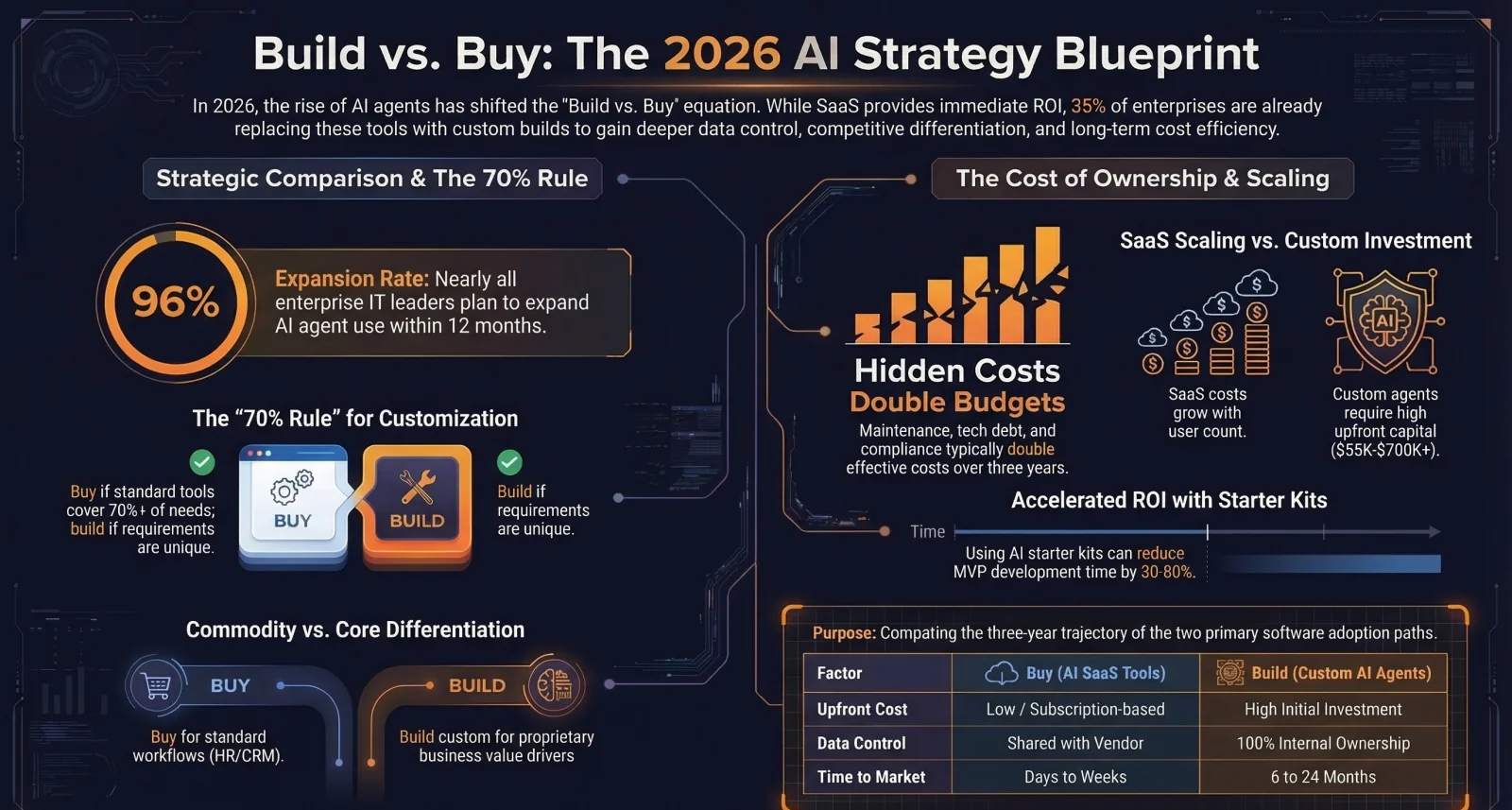
Most businesses are overpaying for SaaS tools that do not fit their workflows. The Retool 2026 State of Internal Tools report found that 35% of engineering teams have already replaced SaaS products with custom-built alternatives, and 78% plan to replace more. The financial tipping point typically occurs when SaaS costs exceed $500-1,000 per month for a single tool, you are paying for features you do not use, or you need integrations that require expensive middleware like Zapier. Custom builds break even at around 33 months on average and cost less than SaaS over a 5-year horizon.
Key Answers
- When should I replace SaaS with a custom build?
- Replace SaaS when annual costs exceed $6,000-12,000 per tool, you use less than 30% of the features, integration with other systems requires paid middleware, or the tool forces your team to work around limitations rather than through them.
- How much does custom software cost compared to SaaS?
- A custom application typically costs $15,000-50,000 upfront with $1,000-2,000 per month in maintenance. SaaS alternatives cost $50-200 per user per month with no upfront investment. Custom becomes cheaper at the 33-month mark on average for teams of 10 or more.
- What percentage of companies are replacing SaaS with custom builds?
- According to Retool's 2026 report, 35% of engineering teams have already replaced at least one SaaS product with a custom-built tool. 78% plan to replace more SaaS with custom builds in the next 12 months.
- Which SaaS tools are most commonly replaced?
- CRMs, internal dashboards, approval workflows, invoicing systems, and project management tools are the most commonly replaced SaaS products. These are tools where business processes are unique enough that generic features create friction.
Key Takeaways
- The average company spends $758 per employee per month on SaaS subscriptions, with most employees using less than 30% of available features.
- Retool's 2026 report shows 35% of teams have replaced SaaS with custom builds, and 78% plan to replace more in the next year.
- Custom software breaks even with SaaS at approximately 33 months. Over 5 years, SaaS spending exceeds custom development costs by 72%.
- The strongest candidates for replacement are tools costing over $500/month where your team regularly works around limitations or uses middleware to connect systems.
- A phased approach — replacing one tool at a time, starting with the highest-cost or worst-fit SaaS — reduces risk and delivers measurable ROI within 90 days.

How Much Is Your Business Actually Spending on SaaS?
The average employee costs their company $758 per month in SaaS subscriptions. For a team of 20, that is over $180,000 per year — and most of those features go unused. The problem is not SaaS itself. SaaS tools are excellent for getting started quickly. The problem is that businesses rarely reassess whether a subscription still makes sense once they have outgrown it.
Retool's 2026 State of Internal Tools report found that 35% of engineering teams have already replaced at least one SaaS product with a custom-built alternative. More striking: 78% plan to replace even more in the next 12 months. The shift is not theoretical — it is happening across industries, driven by cost pressure, workflow friction, and the reality that most SaaS tools are designed for the average customer, not your specific business.
Over a 5-year period, SaaS spending typically exceeds the cost of custom application development by 72%. That gap widens as your team grows because SaaS pricing scales per user while custom software does not.
What Are the Signs a SaaS Tool Should Be Replaced?
Not every SaaS tool should be replaced. Email, cloud storage, and video conferencing are commodities — use the best product and move on. The tools worth replacing are those where your business processes are unique enough that the SaaS product creates friction rather than removing it.
The clearest signals are: your team spends more time working around the tool than working in it; you are paying $500 or more per month and using less than 30% of the features; you need integrations that require paid middleware like Zapier or Make; you have built an unofficial shadow system in spreadsheets because the SaaS tool cannot handle your actual workflow; or the vendor's pricing is increasing faster than the value you receive.
CRMs, internal dashboards, approval workflows, invoicing systems, and project management tools are the most commonly replaced categories. These are domains where every business has slightly different processes, and generic solutions always leave gaps.
When Does Custom Software Become Cheaper Than SaaS?
The break-even point for custom versus SaaS is approximately 33 months for most business applications. A custom application typically costs $15,000-50,000 upfront with $1,000-2,000 per month in ongoing maintenance. A SaaS alternative for a 15-person team typically costs $50-200 per user per month — $750-3,000 per month before counting middleware, integrations, and the time your team wastes on workarounds.
The hidden costs of SaaS are what make the comparison misleading at first glance. Zapier plans for connecting SaaS tools can easily reach $200-600 per month. Employee time spent on manual workarounds — copying data between systems, reformatting exports, handling edge cases the SaaS tool does not support — typically adds 5-10 hours per week across a team. At $50 per hour, that is $1,000-2,000 per month in invisible cost.
The real acceleration happens when your team grows. Adding 10 users to Salesforce Enterprise costs an additional $1,650 per month. Adding 10 users to a custom CRM costs nothing. This is why SaaS spending exceeds custom development costs by 72% over 5 years — the per-user pricing model that makes SaaS accessible at small scale becomes punitive at growth scale.
Which SaaS Tool Should You Replace First?
Start with the tool that scores highest on two dimensions: cost (monthly spend) and friction (how much time your team wastes working around it). Map each SaaS tool in your stack against these criteria. The tool with the highest combined score is your first replacement candidate.
A common pattern we see at ManaTech is businesses replacing a CRM that does not fit their sales process. They signed up for HubSpot or Salesforce, customised it as much as the platform allows, and still need spreadsheets for the parts of their process that the CRM cannot handle. A custom CRM built for their exact workflow — with unlimited users and no per-seat pricing — often costs less within 18 months.
Do not try to replace everything at once. The highest-ROI approach is to replace one tool at a time, validate the savings, and use that success to justify the next replacement. Each replacement builds internal confidence and reduces overall SaaS spend incrementally.
Should You Go Fully Custom or Use a Hybrid Approach?
Full custom replacement makes sense for tools at the core of your operations — CRMs, internal workflow systems, and client-facing portals. For peripheral tools like accounting, email marketing, and analytics, a hybrid approach is usually smarter: keep the SaaS tool for what it does well and build custom connectors or front-ends for the gaps.
For example, one property management company kept Xero for general ledger and tax reporting but built a custom invoicing front-end with AI data extraction and three-way matching. The custom layer handles the complex workflow; Xero handles the accounting. The result was a 75% reduction in invoice processing time at a lower total cost than their previous all-SaaS stack.
How Do You Start Replacing SaaS with Custom Software?
Step one is an audit. List every SaaS tool your team uses, what it costs, how many people use it, and how much of the tool you actually use. Most businesses are surprised to find 3-5 tools that cost over $300 per month each with utilisation under 40%.
Step two is prioritisation. Score each tool on cost, friction, and strategic importance. The tool with the highest cost-friction score and moderate strategic importance is your best first candidate — high savings potential with manageable complexity.
Step three is scoping. Define the minimum viable replacement — the smallest custom build that handles 80% of what your team does in the SaaS tool every day. This is typically 6-8 weeks of development. Build that, validate it, then iterate. Do not try to match every feature of the SaaS tool on day one. Match your workflow, not their feature list.
Research Data
Key strategies and factors based on original research
| Solution Type | Team Size Category | Time Horizon | Upfront Development Cost | Annual Ongoing Expenses | Time to Market | Customization & Control Level | Estimated 3-Year TCO (Inferred) |
|---|---|---|---|---|---|---|---|
| Custom AI Agent / Software | Enterprise (16+ devs) | 12-24+ months | $380,000 - $700,000+ | 20-30% annual DevOps overhead | 12 to 24 months | Total ownership; Compliance-ready | $1,000,000 - $1,750,000+ |
| Custom AI Agent / Software | Scaling SaaS (6-15 devs) | 12-24 months | $145,000 - $290,000 | $45,000 - $100,000+ | 6 to 12 months | Complete; Scalability focused | $300,000 - $650,000 |
| Custom AI Agent / Software | Early-Stage Startup (2-5 devs) | 12-18 months | $55,000 - $115,000 | 15-25% of initial cost ($10,000-$30,000) | 3 to 6 months | Complete; Strategic differentiation | $100,000 - $250,000 |
| SaaS Starter Kit (Hybrid) | Small to Medium | 2 to 12 months | $5,000 - $50,000 | $10,000 - $30,000 | 2 to 8 weeks | High; Full code ownership | $35,000 - $140,000 |
| Off-the-shelf SaaS | Small (2-5 developers) | Immediate to 3 months | $0 - $10,000 | $12,000 - $120,000 | Hours to Days | Minimal; Vendor-controlled | $36,000 - $370,000+ |
| No-Code Platform | Small Team / Non-Engineers | 1 to 6 months | $0 - $20,000 | $6,000 - $60,000 | 1 to 4 weeks | Limited; Vendor ecosystem lock-in | $18,000 - $200,000 |
Original research by ManaTech
Frequently Asked Questions
Is it risky to replace proven SaaS with custom software?
The risk is manageable with the right approach. Start with a single tool replacement, not a full migration. Build an MVP that covers your core workflow in 6-8 weeks, run it alongside the SaaS product for 2-4 weeks, and only cut over when the custom tool handles 100% of your daily use cases. The biggest risk is building too much too soon — scope the first version tightly.
What about updates and security patches with custom software?
Custom software requires ongoing maintenance — typically $1,000-2,000 per month for a retainer covering updates, security patches, and minor feature additions. This is comparable to what many businesses pay for premium SaaS tiers. The difference is that every improvement is tailored to your workflow, not a generic feature roadmap.
How do I calculate the total cost of ownership for SaaS vs custom?
For SaaS: monthly subscription multiplied by users multiplied by 60 months, plus middleware costs (Zapier, integrations), plus time spent on workarounds valued at employee hourly rates. For custom: upfront build cost plus monthly maintenance multiplied by 60 months. Most businesses underestimate the hidden costs of SaaS — workarounds, middleware, and feature bloat that slows teams down.
Can I replace just part of a SaaS tool with custom software?
Yes, and this is often the best strategy. Keep the SaaS tool for what it does well and build custom components for the gaps. For example, keep Xero for accounting but build a custom invoicing front-end with AI data extraction and three-way matching. This hybrid approach gives you the best of both worlds.
What if my business grows and needs change?
This is where custom software has its biggest advantage. SaaS tools force you onto their upgrade path — often at significantly higher per-user pricing. Custom software scales with your business at a predictable cost. Adding 50 users to a custom build costs nothing; adding 50 users to Salesforce costs $4,000-8,250 per month.
Think You've Got It?
15 questions to test your understanding — instant feedback on every answer
Question 1 of 15
According to the Clustox guide, which layer of a custom AI agent architecture is responsible for managing task planning, multi-agent coordination, and error handling?
Question 2 of 15
What is the estimated annual maintenance cost for a custom SaaS product as a percentage of its initial development investment?
Question 3 of 15
Why did Netflix choose to build its own content delivery network (CDN), known as 'Open Connect', instead of buying a commercial solution?
Question 4 of 15
A 2026 Retool report indicates that 'Shadow IT' is widespread. What percentage of respondents reported building software outside of official IT oversight in the past year?
Question 5 of 15
According to the DesignRevision framework, when is the 'Build' option recommended for a business?
Question 6 of 15
What is the typical timeframe for an enterprise to see a Return on Investment (ROI) from an AI SaaS deployment?
Question 7 of 15
How much can a 'SaaS starter kit' (199–499) typically save a business in development costs for 'boilerplate' code?
Question 8 of 15
By what percentage does 'technical debt' or rushed code typically slow down future feature development?
Question 9 of 15
Which factor makes the 'Build' option specifically more attractive for enterprises in regulated industries like healthcare or banking?
Question 10 of 15
According to the Retool report, what is the 'vibe coding' phenomenon's impact on enterprise software?
Question 11 of 15
What is a primary risk associated with choosing the 'Buy' option for core business software?
Question 12 of 15
In the context of custom AI agent development, what is the role of the 'Memory & Vector DB Layer'?
Question 13 of 15
For a 'Scaling SaaS Company', what is the estimated annual total cost for subscribing to and integrating AI SaaS tools?
Question 14 of 15
What does the 'Hybrid Build + Buy' model involve in modern software strategy?
Question 15 of 15
Which of the following is described as a 'hidden cost' of building custom AI agents?
Related Content
When Should You Outgrow Zapier and Build a Custom Automation System?
Zapier is the right tool until it is not. When your automation bill exceeds $500-1,000 per month, workflows break at critical moments, or you need logic that a visual builder cannot express, it is time to consider a custom automation system. One company went from $600 per month on Zapier to $75 per month with a custom build.
Read more →blogThe Hidden Cost of SaaS Sprawl: Why Your $200/Month Tool Stack Actually Costs $2,000
The average small business pays for over 15 SaaS subscriptions and wastes 30% of that spend on unused seats, duplicate tools, and integration middleware. Here is a framework for calculating your real SaaS cost — and what to do when it crosses the line.
Read more →compareSalesforce vs HubSpot vs Custom CRM
A custom CRM makes sense when your team spends more time working around Salesforce or HubSpot than working in it. If your sales process involves multi-step approvals, industry-specific data, or deep integration with proprietary systems, a custom build eliminates the friction and often costs less over 3 years.
Read more →compareQuickBooks Online vs Xero vs Custom Invoicing
QuickBooks and Xero are excellent general accounting tools. When invoice volume exceeds 300/month or your process requires multi-entity reconciliation, custom approval workflows, or three-way PO matching, a custom invoicing system delivers dramatically better efficiency and accuracy.
Read more →compareAsana vs Monday.com vs Custom PM Tool
Asana and Monday.com work well for generic project tracking. When you need a client-facing portal, integrated time tracking with billing, or workflows that match your specific delivery process, a custom tool eliminates the gap between how your team works and what the software supports.
Read more →Want to explore this topic further?
Book a free discovery call to discuss how ManaTech can help your business implement these ideas.
Book a Discovery Call