
AI Search Sends Businesses 10x More Revenue Per Click
Quick Answer
AI search traffic accounts for less than 1% of website visits but generates 9.7% of revenue for B2B and 11.4% for B2C companies, making each AI-referred click worth roughly 10 to 15 times more than a traditional search click due to higher purchase intent.
Key Answers
- How much more revenue does AI search traffic generate per click?
- Each AI-referred visitor generates 10 to 15 times more revenue than a traditional search visitor, with AI traffic driving up to 11.4% of total revenue from less than 1% of visits.
- Why do AI search visitors convert at higher rates?
- AI visitors arrive with purchase intent already formed. The AI has done the comparison work, so 14% proceed to purchase versus 2-3% from organic search.
- Can small businesses compete in AI search?
- Yes. Leadspot, a 3-person company, achieved 1,500% growth in ChatGPT clicks by creating structured, question-answering content. Quality matters more than domain authority.
- What happens if I delay optimizing for AI search?
- Competitors build compounding citation authority over time. AI models reinforce patterns, making it progressively harder for late entrants to gain visibility.
Key Takeaways
- AI-referred visitors generate 10 to 15 times more revenue per click than traditional search visitors, with AI traffic driving 9.7% of B2B revenue and 11.4% of B2C revenue despite representing less than 1% of total visits.
- 14% of users who research a product through an AI assistant proceed directly to purchase, compared to the 2-3% conversion rate from organic search traffic.
- AI search creates a winner-takes-most market where only 3 to 5 cited businesses capture the majority of traffic, unlike traditional search which returns 10 results on page one.
- Small businesses can compete effectively in AI search, as demonstrated by Leadspot, a 3-person company that achieved 1,500% growth in ChatGPT clicks through structured, question-answering content.
- Each AI citation reinforces future citation likelihood, creating a compounding advantage where early movers build authority that becomes increasingly difficult for competitors to displace.
How Much More Revenue Does AI Search Traffic Generate?
AI traffic represents less than 1% of total visits but generates 9.7% of B2B revenue and 11.4% of B2C revenue, making each AI-referred click worth 10 to 15 times more than traditional search.
The numbers do not make sense at first glance. AI-driven traffic represents less than 1% of total website visits for most businesses. You would expect it to generate a proportionally small slice of revenue. But the data tells a different story. For B2B companies, AI traffic generates 9.7% of total revenue despite that tiny traffic share. For B2C companies, the figure is 11.4%. Each AI-referred visitor is worth roughly 10 to 15 times more than a visitor from traditional search. This is not a rounding error. It is a fundamental shift in how high-intent buyers find and evaluate businesses online.
Why Do AI Search Visitors Convert at Higher Rates?
AI visitors arrive with purchase intent already formed. The AI has done the comparison work for them, so 14% proceed to purchase versus only 2-3% from organic search.
When someone searches Google, they are often in research mode. They click through multiple results, compare options, and leave without buying. AI search works differently. The user asks a specific question and receives a curated answer with a short list of recommended options. They click through with purchase intent already formed. Research shows that 14% of users who use an LLM to research a product proceed directly to purchase. Compare that to the 2-3% conversion rate for organic search traffic. The AI has already done the comparison work for the user. By the time they land on your site, they are validating a decision they have largely already made. This pre-qualification is what makes AI referral traffic so disproportionately valuable.
How Did a 3-Person Company Achieve 1,500% Growth in AI Clicks?
Leadspot, a small B2B company with three employees, created structured content that directly answered customer questions. They achieved 1,500% growth in ChatGPT clicks over six months without ads.
Leadspot is a small B2B lead generation company with just three employees. They tracked a 1,500% increase in clicks from ChatGPT over a six-month period. They did not run ads. They did not hire an SEO agency. They focused on creating content that directly answered questions their target customers were asking AI assistants. Their content was structured with clear headings, specific data points, and direct answers at the top of each page. The result was consistent citation by ChatGPT and Perplexity. This demonstrates that small businesses with the right content structure can capture outsized value from AI search.
Why Do AI Citations Create a Winner-Takes-Most Market?
AI search returns a synthesized answer citing only 3 to 5 sources, unlike Google which shows 10 results. Businesses not cited do not just rank lower. They do not exist in that interaction.
Traditional search returns 10 blue links on page one. AI search returns a synthesized answer citing 3 to 5 sources. That compression means the top-cited brands capture a dramatically larger share of traffic and revenue. When a user asks an AI assistant to recommend a custom software development company, the AI names a handful. If your business is in that handful, you win. If it is not, you do not exist in that interaction at all. This winner-takes-most dynamic makes AI search optimization one of the highest-leverage activities a business can invest in right now.
What Can You Do Today to Capture AI Search Revenue?
Start by checking your analytics for AI referral traffic. If the number is zero, audit your server-side rendering, robots.txt, and content structure immediately.
Start by measuring your AI referral traffic. Check your analytics for referrals from chat.openai.com, perplexity.ai, and similar domains. If the number is zero, your site is likely invisible to AI crawlers. Next, audit your content. AI models prefer content that directly answers specific questions with concrete data points. Rewrite your top landing pages with a direct answer in the first paragraph, followed by supporting evidence. Ensure your site uses server-side rendering so AI crawlers can read your pages. Add an llms.txt file to your root domain. These steps are not complex, but they compound quickly.
What Is the Bottom Line?
AI search traffic converts at 10 to 15 times the rate of traditional search. Delaying optimization means competitors build compounding citation authority that becomes harder to displace.
Every month you delay optimizing for AI search, your competitors build citation authority that becomes harder to displace. AI models learn from patterns. If a competitor is consistently cited, that pattern reinforces itself over time. The businesses that move first establish themselves as the authoritative sources AI systems default to. At ManaTech, we build applications optimized for AI discoverability from the ground up. The revenue-per-click data makes the case clear: AI search is a current revenue driver that most businesses are ignoring.
Research Data
Key strategies and factors based on original research
| Strategy or Concept | Metric or KPI | Platform Target | Implementation Tactic | Key Conversion/Traffic Stat | Content Structure Best Practices |
|---|---|---|---|---|---|
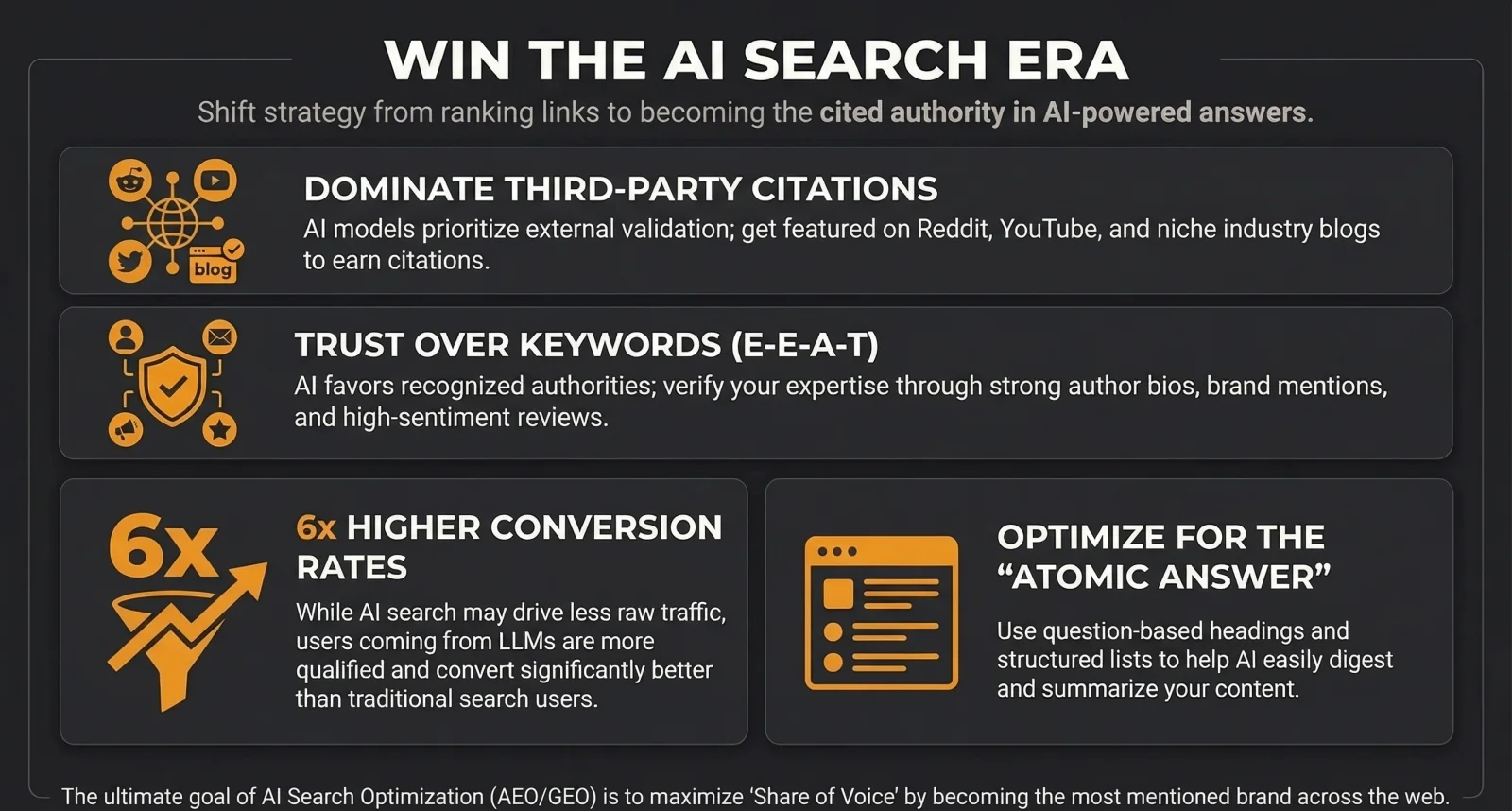
| Answer Engine Optimization (AEO) | AI Visibility Score / Share of Voice | ChatGPT, Claude, Gemini, Perplexity | Structure content to directly answer user questions; use question-based headings and atomic answers. | LLM traffic exhibits a 6\times higher conversion rate compared to traditional Google search traffic. | Use the BLUFF method (Bottom Line Up Front) and 'Atomic Content' that provides standalone value. |
| Generative Engine Optimization (GEO) | Citation Share / Brand Mentions | Google AI Overviews, SearchGPT | Focus on securing citations over traditional links; prioritize facts, statistics, and unique research data. | AI platforms account for 9.7% of revenue in B2B sectors and 11.4% in B2C sectors. | Structure for scanners: use short paragraphs, bullet points, and optimized subheadings (H1-H3). |
| Brand Authority and E-E-A-T | Branded Search Volume / Sentiment | Cross-platform (Google, LLMs) | Earn mentions on podcasts, news outlets, and niche blogs; ensure author bios are consistent across all platforms. | 50% of all Google searches are branded; high brand trust reduces perceived risk for AI platforms. | Incorporate author credentials, firsthand narratives, and case studies to demonstrate expertise. |
| Citation Group Strategy (Off-site) | Mention Frequency in LLM Summaries | Reddit, YouTube, Industry Blogs | Participate authentically in Reddit communities; create YouTube tutorials with timestamps and keyword-rich titles. | YouTube and Reddit are ranked as the 2nd and 3rd most cited domains in LLMs and AI Overviews. | Address specific long-tail questions on community platforms that are missing from traditional search. |
| Long-tail Question Mining | Answer Tracking Variance | LLM Long-tail | Mine sales calls, support tickets, and Reddit for specific queries; convert paid search terms into questions. | The average Perplexity query is \sim 25 words compared to \sim 6 words for Google; long-tail intent is higher in chat. | Develop dedicated landing pages targeting high-LTV, specific long-tail keywords. |
| Entity Data & Local Visibility | Google Business Profile Score (15/16) | Google Maps, Apple Maps, Yelp | Claim and optimize Google Business Profiles; execute 'Review Blasts' to improve review velocity and sentiment. | Review engagement is the primary signal used by AI tools to determine business trustworthiness. | Maintain strict Name, Address, and Phone (NAP) consistency across all directory listings. |
Original research by ManaTech
Frequently Asked Questions
How much revenue does AI search traffic generate compared to Google?
AI search traffic generates disproportionately high revenue relative to its volume. For B2B companies, AI traffic accounts for less than 1% of visits but drives 9.7% of total revenue. For B2C companies, the figure is 11.4%. This means each AI-referred visitor is worth 10 to 15 times more than a traditional search visitor.
Why do AI search visitors convert at higher rates?
AI search visitors arrive with purchase intent already formed. The AI assistant has done the comparison and evaluation work, presenting a curated recommendation rather than a list of options. Research shows 14% of users who research a product through an AI assistant proceed to purchase, versus 2-3% from organic search.
How do I track AI referral traffic to my website?
Check your web analytics for referral traffic from chat.openai.com, perplexity.ai, gemini.google.com, and similar AI platform domains. If the number is zero, your site is likely invisible to AI crawlers and you should audit your server-side rendering, robots.txt, and content structure.
Can small businesses compete with large companies in AI search?
Yes. AI search has its own ranking logic that does not simply mirror Google results. Leadspot, a 3-person B2B company, achieved 1,500% growth in ChatGPT clicks by creating well-structured content that directly answered questions their customers were asking AI assistants. Content quality and structure matter more than domain authority.
What happens if I wait to optimize for AI search?
Delaying creates a compounding disadvantage. AI models learn from patterns, so competitors who are consistently cited build reinforcing authority over time. The winner-takes-most dynamic of AI search means early movers establish themselves as default recommendations, making it progressively harder for late entrants to gain citations.
Think You've Got It?
10 questions to test your understanding — instant feedback on every answer
Question 1 of 10
In the context of modern search strategies, what does the acronym AEO specifically stand for?
Question 2 of 10
According to research presented by Neil Patel, which factor has become a stronger on-page ranking signal than keyword density?
Question 3 of 10
What is the primary objective of the 'BLUF' method in content writing for AI search?
Question 4 of 10
Based on the Webflow case study, how did conversion rates for LLM-driven traffic compare to traditional Google search traffic?
Question 5 of 10
Which two external platforms are identified as the second and third most cited domains in AI overviews and LLMs?
Question 6 of 10
What is the specific risk associated with 'Model Collapse' in the development of AI search tools?
Question 7 of 10
Ahrefs suggests that content should be fresher than the current average to be preferred by AI platforms. By what percentage does content need to be 'fresher'?
Question 8 of 10
What is the 'Head' strategy for winning in AI search responses for highly competitive queries like 'best website builder'?
Question 9 of 10
Why does Neil Patel recommend using schema markup, specifically FAQ and review schema, for AI search visibility?
Question 10 of 10
For a local business looking to improve AI visibility, which metric is considered an open-source form of 'trustworthiness'?
Related Content
Your Website Is Invisible to AI Search — Here Is How to Fix It
AI search engines like ChatGPT, Perplexity, and Gemini cannot read most business websites. If your site relies on client-side JavaScript rendering, you are invisible to the fastest-growing traffic source on the web.
Read more →blogHow to Get Your Business Cited by ChatGPT
AI citations are the new backlinks. Branded web mentions correlate more strongly with AI visibility than traditional SEO signals. Here are 7 practical steps to get your business into AI answers.
Read more →blogWhat Every Business Needs to Know About llms.txt
The llms.txt standard is how forward-thinking businesses communicate directly with AI search engines. Early adopters report a 30% increase in AI traffic and 25% higher click-through rates.
Read more →Want to explore this topic further?
Book a free discovery call to discuss how ManaTech can help your business implement these ideas.
Book a Discovery Call