
Your Website Is Invisible to AI Search — Here Is How to Fix It
Quick Answer
Most business websites are invisible to AI search engines because AI crawlers cannot execute client-side JavaScript. The fix is server-side rendering (SSR) using frameworks like Next.js, combined with an llms.txt file, unblocked AI crawlers in robots.txt, fast page loads, and structured data markup.
Key Answers
- Why can't AI search engines see my website?
- AI crawlers do not execute JavaScript. If your site renders content client-side using React, Vue, or Angular, the crawler sees an empty HTML shell and moves on.
- What is the main fix for AI search visibility?
- Switch to server-side rendering with frameworks like Next.js, Nuxt, or SvelteKit so full HTML is delivered before JavaScript loads.
- What is llms.txt and should I add one?
- The llms.txt file is a structured summary placed at your root domain that helps AI models understand your business and cite the right pages.
- Does optimizing for AI search hurt Google rankings?
- No. Server-side rendering, structured data, and fast page loads are also Google SEO best practices. Both channels benefit simultaneously.
Key Takeaways
- AI referral traffic to business websites grew 360% year over year in 2025, making AI search the fastest-growing discovery channel for businesses.
- AI crawlers do not execute JavaScript, so websites built with client-side frameworks like React or Vue appear as blank pages to ChatGPT, Perplexity, and Gemini.
- Server-side rendering (SSR) with frameworks like Next.js, Nuxt, or SvelteKit is the primary technical fix to make your site readable by AI search engines.
- Adding an llms.txt file to your root domain gives AI systems a structured summary of your site, improving the accuracy and likelihood of citations.
- Updating robots.txt to allow GPTBot, ClaudeBot, and PerplexityBot, combined with JSON-LD structured data, ensures AI crawlers can access and understand your content.

Why Can't AI Search Engines See Your Website?
Most business websites use JavaScript frameworks that render content client-side. AI crawlers do not execute JavaScript, so they see an empty page and move on.
AI referral traffic grew 360% year over year in 2025. ChatGPT, Perplexity, Gemini, and Claude are how people now find and compare businesses. But most business websites are built with JavaScript frameworks like React or Vue that render content in the browser. AI crawlers do not execute JavaScript. They see an empty page. Your pricing tables, case studies, product descriptions, and blog posts do not exist to these systems. If an AI search engine cannot read your content, it cannot cite your business. Increasingly, that AI answer is the only thing a potential customer ever sees.
How Do AI Search Engines Find and Retrieve Content?
AI search engines use Retrieval-Augmented Generation (RAG) to fetch, chunk, and score web content in real time rather than relying on a static index like Google.
When a user asks a question, the AI sends out web crawlers to fetch fresh content. It breaks that content into chunks and scores each chunk for relevance. Then it synthesizes an answer from the top results. Some systems use fanout searches, querying multiple sources in parallel. Only 12% of pages cited by ChatGPT come from the top-10 Google results. AI search has its own ranking logic. It favors content that is well-structured, directly answers questions, and comes from pages it can actually parse. If your HTML is a shell that loads content via JavaScript, the crawler retrieves nothing useful.
What Are the 5 Technical Fixes to Make Your Site AI-Readable?
The five fixes are server-side rendering, adding an llms.txt file, unblocking AI crawlers in robots.txt, optimizing page speed under 3 seconds, and implementing JSON-LD structured data.
First, switch to server-side rendering. Frameworks like Next.js, Nuxt, and SvelteKit generate full HTML on the server before sending it to the browser. AI crawlers see your complete content without executing JavaScript. Second, add an llms.txt file to your root domain. This emerging standard gives AI systems a structured summary of your site and your key pages. Third, update your robots.txt to explicitly allow AI crawlers. Many sites inadvertently block GPTBot, ClaudeBot, and PerplexityBot. Fourth, optimize for speed. AI crawlers have strict timeout limits. If your page takes more than 3 seconds to respond, the crawler abandons it. Fifth, implement structured data using JSON-LD schema markup. FAQ schema, product schema, and organization schema help AI systems extract precise answers.
Why Does AI Search Visibility Matter for Your Business?
AI search is growing rapidly while traditional search declines. Businesses cited by AI capture the majority of inquiries, and each citation reinforces future visibility.
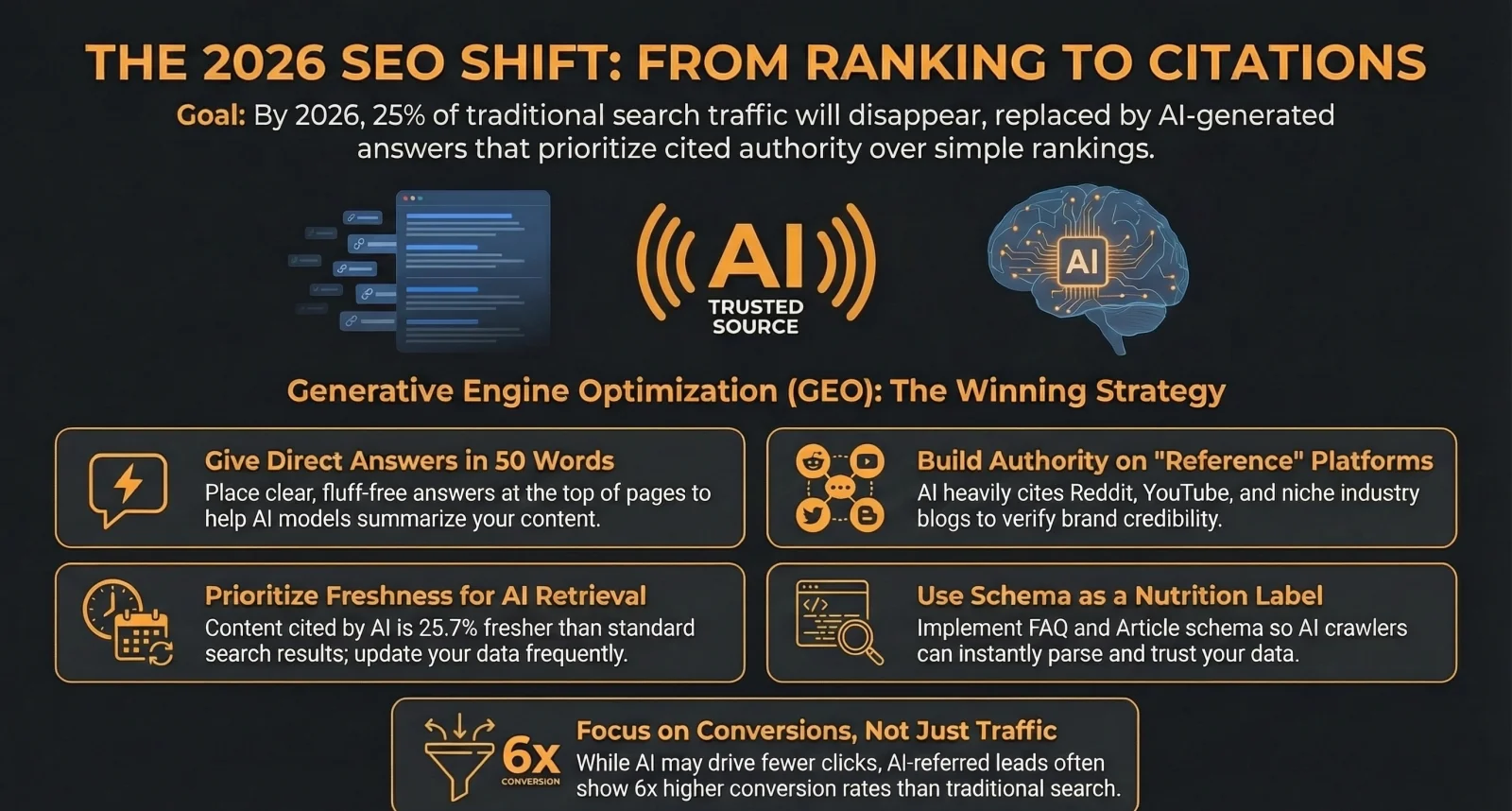
The shift to AI search is happening right now. Gartner projects that traditional search volume will drop 25% by 2026 as users migrate to AI-powered alternatives. When someone asks ChatGPT to recommend a custom software development company, the AI cites 3 to 5 businesses. Those businesses capture the majority of that inquiry. Everyone else is invisible. Each citation reinforces the AI model that your brand is authoritative. This makes future citations more likely. Businesses that optimize now build a moat that late movers will struggle to cross.
What Is the Bottom Line?
If AI search engines cannot read your website, they will cite your competitors instead. The technical fixes are straightforward and also improve traditional SEO.
Your website was built for human visitors using Google. The next generation of visitors will never see your site directly. They will ask an AI, and the AI will either cite you or cite your competitor. The technical fixes are straightforward: server-side rendering, llms.txt, unblocked crawlers, fast page loads, and structured data. At ManaTech, every application we build is AI-ready from day one. If your current site is invisible to AI search, that is a problem worth solving now.
Research Data
Key strategies and factors based on original research
| Strategy/Factor | Description | Key Tactics | Primary Goal | Platform Impact | Inferred Importance |
|---|---|---|---|---|---|
| Author and Brand Authority (E-E-A-T) | Building trust by proving the source of information is a recognized expert or verified brand to reduce platform risk. | Add detailed author bios and credentials; share firsthand stories and case studies; earn mentions on podcasts, news outlets, and industry blogs. | Establish credibility so AI platforms feel confident quoting and recommending the source as a reliable authority. | ChatGPT, Perplexity, Google AI Overviews | Critical |
| Branded Mentions and Citations | Ensuring the brand name appears frequently on credible, third-party sites to associate the brand with specific topics. | Execute PR campaigns; guest on YouTube; participate in Reddit threads; secure listings on review sites like G2 or Trustpilot. | Train LLMs to associate the brand with a subject through consistent, high-authority mentions across the web. | ChatGPT, Perplexity, Google AI Overviews | Critical |
| Optimization for Summarization | Formatting content specifically to be easily parsed, processed, and lifted by AI for conversational search results. | Write direct answers to questions; use short paragraphs, bullet points, and subheadings; target People Also Ask queries. | Increase the likelihood of being the cited source in an AI-generated summary to drive high-intent conversions. | ChatGPT, Perplexity, Google AI Overviews | High |
| Structured Data and Schema Markup | Providing a nutrition label for content that helps machines read, digest, and recommend material with high confidence. | Implement FAQ, How-to, and Review schema; use JSON-LD markup; tag headlines, authors, and publish dates. | Ensure AI instantly knows what the content represents and improve technical crawlability for LLM agents. | Google Search, LLMs, AI Crawlers | High |
| Entities and Topical Depth | Focusing on how ideas connect and relate rather than keyword frequency to establish comprehensive topical authority. | Create pillar pages with interlinking to subtopics; use semantic variety and NLP tools to weave in related concepts, locations, and people. | Demonstrate genuine expertise and understanding to move beyond surface-level keyword matching. | Google Search, Google AI Overviews | High |
| Information Gain and Unique Research | Adding new, non-typical data to the conversation to avoid being filtered as a derivative or rewritten source. | Conduct original surveys and benchmark reports; utilize a contrarian angle; cite unique proprietary research data. | Provide Information Gain that prevents model collapse and ensures content is seen as a distinct, valuable source. | ChatGPT, Claude, Google Search | High |
| Content Freshness | Regularly updating information to serve as a retrieval signal for Retrieval-Augmented Generation (RAG) based AI systems. | Add latest update sections; refresh facts, statistics, and quotes; re-date posts when meaningful changes are made. | Stay relevant for AI assistants that prioritize newer information (cited AI content is roughly 26\% fresher). | ChatGPT, Perplexity, Google AI Overviews | High |
| Comparison and Listicle Strategy | Leveraging high-intent comparison queries to get mentioned alongside established competitors in AI responses. | Create Alternative style pages; use 3-way listicles; target niche comparisons (e.g., for graphic designers). | Support the AI's reasoning journey in generating recommendations for users in the active buying stage. | ChatGPT, Gemini, Perplexity | High |
| Longtail and Complex Query Targeting | Focusing on niche, specific, and conversational queries that AI assistants fan out into multiple sub-queries. | Create content clusters covering full topic depth; answer complex questions (averaging 25 words vs. 6 for traditional search). | Capture visibility in the detailed follow-up questions common in conversational AI search journeys. | Perplexity, ChatGPT, Google AI Overviews | Medium-High |
| Multimodal Data Integration | Including various media types to signal depth and clarity to AI platforms that prefer diverse data formats. | Embed videos, charts, data visualizations, and images within blog posts and landing pages. | Increase the citation rate; content with images and video are cited significantly more often by AI engines. | Google AI Overviews, Perplexity | Medium |
Original research by ManaTech
Frequently Asked Questions
Why is my website invisible to AI search engines like ChatGPT?
If your website uses client-side JavaScript rendering (common with React, Vue, or Angular), AI crawlers see an empty HTML shell because they do not execute JavaScript. Only 12% of links cited by AI models come from the top-10 Google results, so traditional SEO rankings do not guarantee AI visibility.
What is the best way to make my website visible to AI search?
Switch to server-side rendering using a framework like Next.js, Nuxt, or SvelteKit so that full HTML is delivered before JavaScript loads. Additionally, add an llms.txt file to your root domain, allow AI crawlers in your robots.txt, optimize page speed to under 3 seconds, and implement JSON-LD structured data.
What is llms.txt and do I need one?
The llms.txt file is an emerging web standard that provides AI search engines with a structured summary of your site, your key pages, and your preferred citation format. It sits at your root domain and helps AI models understand your business without crawling every page. Early adopters report measurably higher AI referral traffic.
How does AI search ranking differ from Google ranking?
AI search uses Retrieval-Augmented Generation (RAG), fetching and scoring content in real time rather than relying on a static index. Only 12% of AI-cited links come from Google top-10 results. AI favors well-structured, directly answerable, and fast-loading content from pages it can actually parse.
Will optimizing for AI search hurt my Google rankings?
No. The technical fixes for AI visibility, including server-side rendering, structured data, and fast page loads, are also Google SEO best practices. Optimizing for AI search engines improves your traditional search performance simultaneously.
Think You've Got It?
10 questions to test your understanding — instant feedback on every answer
Question 1 of 10
According to the Neil Patel source material, what does a recent study suggest about the correlation between keyword density and ranking?
Question 2 of 10
Which on-page ranking factor is now considered the strongest, outperforming domain traffic?
Question 3 of 10
By 2026, Gartner predicts that what percentage of traditional search traffic will disappear, to be replaced by AI-generated answers?
Question 4 of 10
In the context of GEO (Generative Engine Optimisation), what is the 'answer-first' restructuring strategy?
Question 5 of 10
Which metric showed the strongest correlation with visibility in Google's AI overviews according to Ahrefs' research?
Question 6 of 10
What does the 'RAG' acronym stand for in the functioning of AI assistants?
Question 7 of 10
According to Ethan Smith (Graphite), how did the conversion rate for Webflow's LLM traffic compare to its Google search traffic?
Question 8 of 10
Why is 'citation optimisation' particularly effective for early-stage companies compared to traditional SEO?
Question 9 of 10
What is the primary risk associated with 'model collapse' in AI search?
Question 10 of 10
For B2B companies, which technical structural change is recommended for Help Centres to improve AI search performance?
Related Content
AI Search Sends Businesses 10x More Revenue Per Click
AI-driven traffic accounts for less than 1% of visits but generates up to 11.4% of revenue. The data shows that every AI click is worth dramatically more than a traditional search click.
Read more →blogHow to Get Your Business Cited by ChatGPT
AI citations are the new backlinks. Branded web mentions correlate more strongly with AI visibility than traditional SEO signals. Here are 7 practical steps to get your business into AI answers.
Read more →blogWhat Every Business Needs to Know About llms.txt
The llms.txt standard is how forward-thinking businesses communicate directly with AI search engines. Early adopters report a 30% increase in AI traffic and 25% higher click-through rates.
Read more →Want to explore this topic further?
Book a free discovery call to discuss how ManaTech can help your business implement these ideas.
Book a Discovery Call