
AI for NZ Cafes & Restaurants: What to Automate First in 2026
Quick Answer
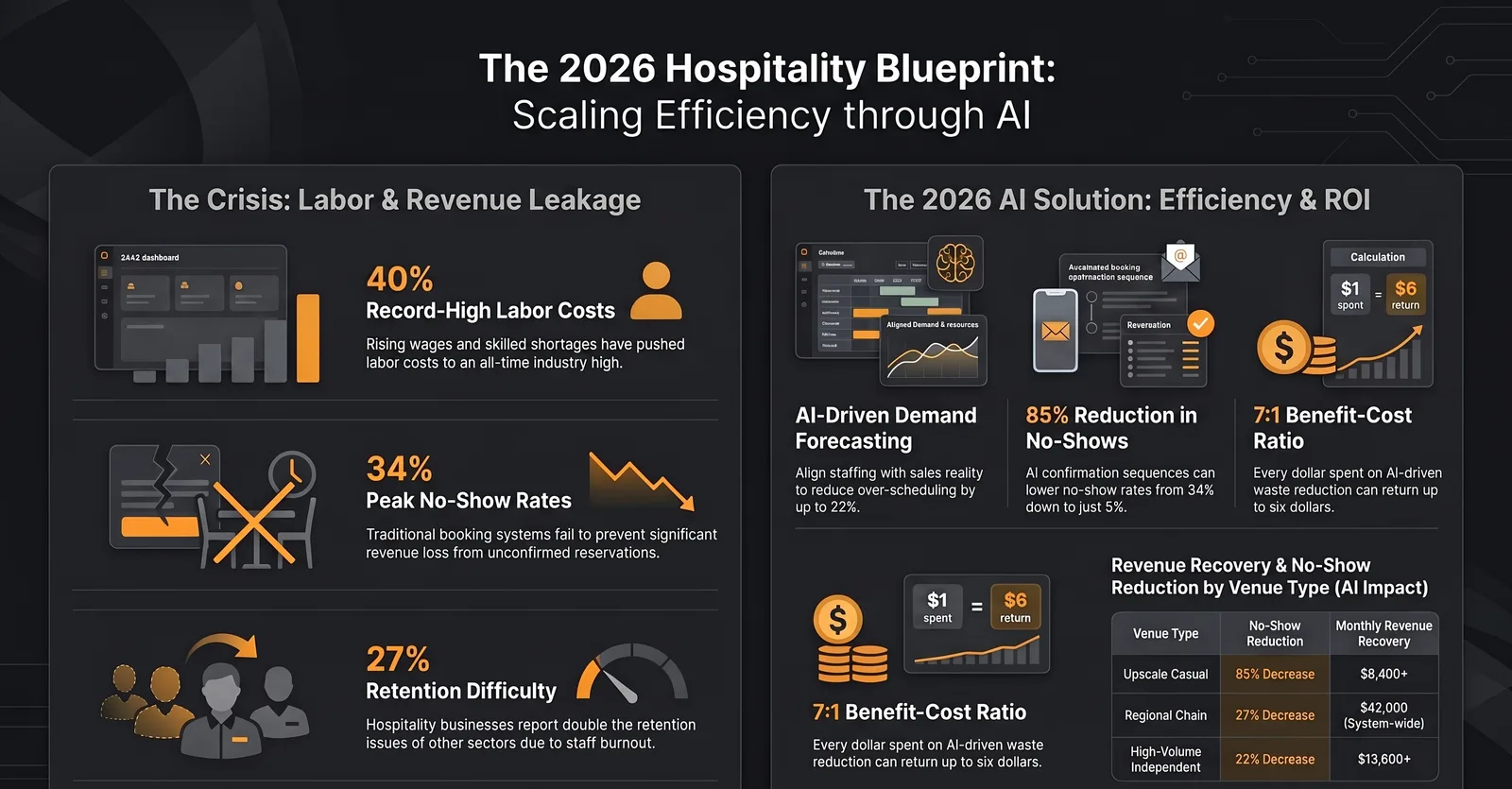
For most NZ cafes and restaurants in 2026, the highest-return place to start with AI is the one that attacks your biggest fixed cost. With labour now averaging a record 40% of revenue and food price inflation at 4.6%, the three use cases with the clearest payback are AI labour forecasting (which cuts over-scheduling by up to 22%), AI inventory and ordering (which trims food waste of 4%–10% of purchased food by 15%–25%), and AI phone or reservation handling (which reclaims NZD 3,000–18,000 a month in missed-call orders and drops no-shows from as high as 34% to around 5%). Pick one high-cost problem, run a 90-day pilot in a single daypart, and only scale once the numbers move.
Key Answers
- What should an NZ cafe or restaurant automate with AI first?
- Start with the use case that attacks your biggest cost. For most venues that is labour forecasting or inventory, because labour now runs at a record 40% of revenue. AI scheduling cuts over-scheduling by up to 22%; AI inventory cuts food waste by 15%–25%.
- How much can AI actually save a NZ hospitality business?
- The biggest documented wins are 5%–12% reductions in labour overspend, 15%–25% less food waste, and NZD 3,000–18,000 a month per location in reclaimed phone orders. The size of the win depends on which cost you target first, not the tool.
- Does AI reduce restaurant no-shows?
- Yes. Predictive no-show scoring plus automated SMS confirmation sequences have cut no-shows from as high as 34% down to around 5% in documented cases, with most venues seeing a 15%–30% improvement in table yield within 90 days.
- Should AI answer the phone at my restaurant?
- For busy venues, yes — missed calls during a rush are lost revenue. AI voice tools handle routine orders and bookings, reclaiming NZD 3,000–18,000 a month per location and lifting phone bookings by up to 150%. Keep a human path for complex requests.
- What will AI not fix in a cafe or restaurant?
- AI cannot set your culture, coach a struggling team member, or create hospitality. It is documentation and prediction infrastructure that frees managers to be on the floor — not a replacement for the human relationship that brings guests back.
Key Takeaways
- NZ hospitality recorded NZD 15.99 billion in annual sales to mid-2025, yet cafés and restaurants grew sales just 0.3% while labour costs hit an all-time high of 40% of revenue — the squeeze, not the AI hype, is what makes automation worth the effort.
- AI labour forecasting improves scheduling accuracy by around 20% and cuts over-scheduling by up to 22%, moving rosters off "gut feel" and onto historical sales and demand signals like weather.
- AI inventory and ordering reduces food waste — which runs at 4%–10% of purchased food — by 15%–25%, with operators reporting up to a six-to-one return on every dollar spent.
- Predictive no-show scoring plus multi-touch SMS confirmations have cut no-shows from 34% to 5% in documented venues, directly recovering covers that were previously lost revenue.
- AI is best treated as a workflow change, not a software purchase: the venues that win pick one high-cost problem, run a 90-day pilot in a single location or daypart, and scale only after the KPIs move.
Why Are NZ Cafes and Restaurants Turning to AI in 2026?
Because the margin squeeze is structural, not temporary. Record sales are being eaten by record costs — labour at 40% of revenue, food inflation at 4.6% — and AI is the most practical lever an owner has left to protect profit.
New Zealand hospitality is living a two-speed reality. Annual sales reached a record NZD 15.99 billion in the year to mid-2025, which on paper looks like a sector in recovery. Underneath that headline, cafés and restaurants grew sales just 0.3%, food price inflation ran at 4.6%, and the 2025 Remuneration Survey recorded an average labour cost of 40% of revenue — the highest on record. Record top line, record cost base, thinner margin than ever. That is the squeeze every owner feels and no price rise has fully fixed.
Marisa Bidois, CEO of the Restaurant Association of New Zealand, put the numbers plainly: "Every dollar of the 1.4 percent sales growth over the past year has been earned against substantial cost increases that continue to pressure margins across the sector." The growth is real but it is not landing in the bank. At the same time the market is splitting by geography — tourism-driven regions like Nelson and Queenstown are posting double-digit growth, while Auckland and Wellington CBDs struggle as office occupancy sits 35%–40% below pre-pandemic levels and diners trade full-service meals for cheaper takeaway "affordable luxuries."
In that environment, AI has shifted from novelty to necessity. The 2026 industry framing is that AI should feel "like electricity: expected, embedded, and invisible when it’s done right" — not a sci-fi add-on but quiet infrastructure that takes cost out of the operation. For a NZ cafe or restaurant, the value is concrete: less food waste, tighter rosters, fewer missed calls, fewer no-shows. The same pattern of starting with the automations that protect revenue, covered in our guide to revenue-generating AI automations, applies directly to hospitality — the difference is which costs you target first.
What Can AI Actually Automate in a Cafe or Restaurant?
Six things, ranked roughly by payback: inventory and ordering, labour forecasting, phone handling, no-show prevention, guest messaging, and table management. Each targets a specific cost or lost-revenue leak.
The mistake is treating "AI for restaurants" as one thing. It is a set of distinct, narrow tools, each pointed at a different line on your P&L. AI inventory management turns sales patterns into smarter pars, prep, and ordering, and monitors stock in real time to flag what is about to expire. AI labour forecasting predicts demand by daypart to build rosters off data instead of gut feel. AI voice handling answers the phone, takes orders, and books tables when the floor is slammed. Predictive no-show scoring flags risky bookings and triggers confirmations. Automated guest communications handle routine FAQs across SMS, WhatsApp, and Instagram. Dynamic table management paces reservations by predicting how long each table will actually turn.
The data table accompanying this article breaks each use case down by what it automates, the typical saving, the tool category, and the venue size it suits best. The pattern worth noting: the highest-return use cases are the unglamorous ones. Inventory and labour are your two largest controllable costs, so a 15%–25% cut in food waste or a 22% cut in over-scheduling moves more money than a flashier guest-facing feature. Start where the cost is biggest, not where the technology is most exciting.
How Much Can AI Save a NZ Hospitality Business?
The headline numbers: 5%–12% off labour overspend, 15%–25% less food waste, and NZD 3,000–18,000 a month in reclaimed phone orders per location. The actual figure depends on which cost you attack first.
Take labour first, because at 40% of revenue it is the heaviest lever. AI-driven workforce management improves scheduling accuracy by around 20%, reduces over-scheduling by up to 22%, and cuts overall labour overspend by 5%–12% by aligning shifts to forecast demand rather than to a manager’s best guess. The standard target for a healthy venue is labour at 25%–35% of sales; AI forecasting is the tool that keeps you from drifting above it through overstaffing, while avoiding the lost sales that come from understaffing a busy Saturday.
Food cost is the second lever. Waste typically accounts for 4%–10% of purchased food, and AI inventory tools reduce that by 15%–25% by turning historical sales into demand-based prep and ordering, then alerting staff to stock nearing expiry. Operators report that a dollar spent on AI inventory can return up to six dollars through waste reduction and fewer emergency top-up orders. The third lever is recovered revenue: AI voice phone handling reclaims an estimated NZD 3,000–18,000 a month per location by capturing the orders and bookings that currently vanish into the "black hole" of missed calls during a rush, with documented venues seeing phone bookings climb by up to 150%.
A note on where these figures come from: many of the dollar-value case studies are US deployments, so treat the precise amounts as directional rather than a NZ guarantee. The percentages — waste reduction, scheduling accuracy, no-show drops — travel more reliably across markets because they describe the efficiency gain, not a currency. For a NZ owner, the honest way to read this is: the mechanism is proven, the magnitude depends on how big your specific leak is today. A venue with 9% food waste has far more to gain from AI inventory than one already running a tight 4%.
Can AI Stop No-Shows From Killing Your Margins?
Yes — this is one of AI’s clearest wins. No-shows typically run 5%–20% of bookings, and predictive scoring plus automated confirmations have cut them from as high as 34% to around 5% in documented venues.
No-shows are silent profit killers because the cost is invisible until close — a held table that never converts is lost margin you cannot recover that night. The mechanism AI adds is prediction. Modern reservation systems score each booking’s no-show risk using guest history, the channel the booking came through, party size, and even weather, then trigger a graduated confirmation sequence — typically a 24-hour, 4-hour, and 1-hour SMS touch. Bella Vista Bistro, a 120-seat venue, cut its no-show rate from 34% to 5% with this approach and recovered roughly USD 8,400 a month in reclaimed covers within three weeks.
Two refinements make the difference between a modest and a strong result. First, personalisation: confirmation messages that reference the guest’s name or a previous visit lift response rates by 23%–31% over generic broadcasts. Second, dynamic overbooking — once the system can score risk reliably, it can recommend a safe level of over-booking that fills the tables a predicted no-show would have left empty, without the guest-frustration risk of blind overbooking. Across a broad base of AI-handled calls, venues see a 15%–30% improvement in table yield within 90 days. For a NZ restaurant running on a thin margin, recovering even a handful of covers a night is the difference between a profitable and a break-even service.
Should AI Answer Your Restaurant’s Phone?
For any busy venue, yes — missed calls during a rush are pure lost revenue. AI voice agents handle routine orders and bookings around the clock, but keep a clear human path for anything complex or sensitive.
The phone is where revenue quietly leaks. During the lunch or dinner rush, the same staff taking care of a full floor cannot answer every call, and each unanswered call is a takeaway order or booking that goes to the venue down the road. AI voice agents use natural language understanding to take phone orders, answer routine questions about hours and menu, and book reservations directly into the system — then hand off to a human for anything outside their lane. Documented deployments report a 150% increase in over-the-phone bookings, with one venue’s AI handling 84% of incoming calls. The same shift from human receptionist to AI front line we cover in our guide to AI voice agents maps cleanly onto a hospitality phone line.
Phone handling extends naturally into broader guest messaging. Automated guest communication tools unify WhatsApp, Instagram, and SMS into a single AI-managed inbox that answers routine inquiries — opening hours, waitlist updates, dietary questions — and drops first-response time from hours to seconds, with 2x–4x higher conversion than a broadcast email blast. The strategic point is the same as with the phone: AI absorbs the high-volume, low-complexity contact so your team can pour their attention into the in-person experience. The guardrail is also the same — every AI channel needs a visible, easy path to a human the moment a guest has a complaint, an allergy concern, or a special occasion that deserves a person.
What Will AI Not Fix in Your Cafe or Restaurant?
AI will not set your culture, coach a struggling team member, or create hospitality. Treating it as a replacement for people — rather than a tool that frees them — is the single most common way these projects fail.
The honest counterweight to every figure above is this: AI is augmentation, not replacement. The 2026 industry guidance is blunt about it — "AI can summarize trends, flag issues, and suggest actions. It cannot set culture, coach performance, or create hospitality." The "replace the manager" fantasy is where money gets wasted. The right outcome is the opposite: AI takes the roster maths, the stock counts, and the missed calls off the manager’s plate so they spend more time on the floor with guests and team, which is the work that actually drives repeat visits.
AI also will not fix a staffing crisis on its own, and NZ hospitality has a deep one. In Australia and New Zealand, 67% of chefs work more than 38 hours a week, 60% of hospitality workers report experiencing bullying or harassment, and 72% of businesses report extreme difficulty filling senior front-of-house and kitchen roles. Retention problems are twice as common in hospitality as in other sectors (27% versus 13%). AI can ease the load that drives burnout — transparent mobile scheduling alone measurably reduces the anxiety of not knowing your shifts — but the underlying work of culture, fair pay, and a humane roster is human work. AI buys your managers the time to do it; it does not do it for them.
Finally, AI will not fix dirty data. A forecasting model trained on inconsistent item names, unstandardised recipes, and sloppy job codes produces unreliable output — and an owner who acts on a bad forecast is worse off than one who trusted their gut. This is why the rollout sequence matters more than the tool choice, and why "buy five AI tools at once" is the fastest route to a failed project. Disconnected point solutions that never share data create more admin, not less.
How Should a NZ Cafe Start With AI in 2026?
Run a 90-day plan: spend the first two weeks picking one high-cost problem and 3–5 KPIs, the next month cleaning your data, then pilot in a single daypart and scale only once the numbers move.
The proven sequence is deliberately narrow. Days 1–15: identify pain points. Choose one high-cost problem — food waste, overtime, or missed calls — and define 3–5 KPIs you will actually measure, such as food-cost percentage, labour percentage, or no-show rate. Days 16–45: data hygiene. Standardise your recipes, prep yields, item naming, and job codes so the AI has clean inputs. This is the unglamorous step everyone wants to skip and the one that decides whether the pilot works. Days 46–90: pilot and scale. Run the tool in one location or one daypart, watch the KPIs, and expand only after you see measurable movement.
One procurement discipline protects the whole exercise. Hospitality venues already pay for a POS, a booking system, payroll, and a stack of digital subscriptions, so every new AI tool should be judged against the whole stack, not against zero. The right question is not "can we afford another subscription?" but "which existing tool does this AI replace, or which cost does it remove, and is that worth the integration overhead?" Our breakdown of how to cut SaaS sprawl applies directly: a unified AI layer that consolidates several point tools beats five disconnected apps that each solve a sliver of the problem.
Hospitality is not the only NZ sector running this playbook — the same "pick one bottleneck, pilot it, scale it" approach is working for trades, professional services, and healthcare. If you run a multi-trade operation as well as a venue, our guide to AI for NZ tradies covers the same starting logic for a different cost base. The constant across every vertical is that the winners treat AI as an operational change they manage, not a product they buy and forget.
What Is the Bottom Line?
AI for NZ cafes and restaurants in 2026 is a margin tool, not a gadget. Pick the one cost bleeding hardest, pilot a single use case over 90 days, keep your people on the floor, and scale only once the numbers move.
The NZ hospitality squeeze is not going to ease on its own — labour at 40% of revenue, food inflation at 4.6%, and customers resisting another price rise are the conditions for the next several years, not a passing storm. AI is the most practical lever an independent operator has to protect margin without cutting the quality that brings guests back. The venues that win will not be the ones that buy the most AI; they will be the ones that pick one high-cost problem, clean their data, pilot in a single daypart, and use the time AI gives back to put their best people in front of guests. The technology is proven. The discipline of how you roll it out is what decides whether it shows up in your margin or just on your subscription bill.
Research Data
Key strategies and factors based on original research
| use case | what it automates | typical time or cost saved | example tool category | best-fit business size |
|---|---|---|---|---|
| Inventory Management | Turns sales patterns into smarter pars, prep, and ordering; monitors stock in real-time to alert for expiration. | 15-25% decrease in food waste; $1 spent can return up to $6. | AI-powered inventory solutions (e.g., MacromatiX, BlueCart, WISK.ai) | Independent venues and QSR chains |
| Labor Forecasting + Scheduling | Predicts customer demand by daypart to build optimized shift structures and rosters. | 20% improvement in scheduling accuracy; 22% reduction in over-scheduling; 5-12% reduction in labor overspend. | AI-driven workforce management (e.g., Fourth iQ, HotSchedules) | Mid-sized cafes to large enterprise hospitality groups |
| AI Voice Phone Handling | Processes phone orders and reservations using Natural Language Understanding and transcribes interactions. | Reclaims $3,000 to $18,000 per month per location; 150% increase in phone bookings. | Voice AI/Virtual Hostess (e.g., Kea.ai, DineLine AI, Hostie) | Busy venues and independent operators |
| Predictive No-Show Scoring | Analyzes historical guest behavior and external factors to predict no-show probability and trigger confirmations. | Reduces no-shows from 34% to 5%; 15-30% improvement in table yield. | AI Reservation Systems (e.g., ResPhone, HostieAI, Loman AI) | Independent venues and regional chains |
| Automated Guest Communications | Handles routine inquiries (FAQs, hours, waitlist updates) across WhatsApp, SMS, and Instagram. | Reduces first-response time from hours to seconds; 2-4x higher conversion than broadcast emails. | Unified AI messaging/inbox (e.g., Navi Host, Popmenu) | Independent restaurants and hospitality groups |
| Dynamic Table Management | Predicts turn times based on party composition and service patterns to pace reservations. | 35-minute wait times reduced to 18 minutes; 30% increase in walk-in conversions. | Table management platforms (e.g., Eat App, SevenRooms, ResyOS) | Independent venues and hospitality groups |
Original research by ManaTech
Frequently Asked Questions
Is AI affordable for an independent NZ cafe, or only for big chains?
It is now accessible to independents. Enterprise-grade AI for inventory, scheduling, no-show prediction, and phone handling used to be the exclusive domain of chains like McDonald’s, but the same capability is now sold as monthly subscriptions that a single-site cafe can adopt. The deciding factor is not budget but data hygiene — AI needs clean recipes, item names, and job codes to produce good output.
Which AI use case has the fastest payback for a small venue?
For a venue losing money on missed calls during the rush, AI phone handling pays back fastest because every recovered order is direct revenue — documented at NZD 3,000–18,000 a month per location. For a venue with high food costs, AI inventory pays back fastest through waste reduction. Start by identifying which cost is bleeding hardest, then match the tool to it.
Will AI replace my front-of-house staff?
No, and chasing that outcome is the most common way these projects fail. The realistic model is augmentation: AI handles the routine, repetitive load — missed calls, FAQ messages, roster maths, stock counts — so your people spend more time on the guest experience that actually drives repeat visits. AI "cannot set culture, coach performance, or create hospitality," in the words of the 2026 industry guidance.
How do I stop an AI rollout from failing?
Avoid two traps. The first is "point solutions" — buying five disconnected tools that never talk to each other. The second is skipping data hygiene; AI trained on messy item names and inconsistent recipes produces unreliable output. Standardise your data first, pilot one use case in one daypart, define 3–5 KPIs up front, and only scale after you see measurable movement.
Is the NZ hospitality market actually strong enough to invest right now?
It is a two-speed market. Tourism-driven regions like Nelson and Queenstown are seeing double-digit growth, while Auckland and Wellington CBDs struggle as office occupancy sits 35%–40% below pre-pandemic levels and diners trade full-service meals for takeaway. In that environment, the venues that protect margin through automation are better positioned than those relying on price rises customers are already resisting.
What is the difference between AI and the booking software I already use?
Your current booking or POS system records what happened. AI predicts what is about to happen and acts on it — scoring which bookings are likely to no-show and triggering confirmations, forecasting Saturday’s covers to build the roster, or recommending how much to over-book. The shift is from a system of record to a system that makes a recommendation or takes an action before the problem lands.
Think You've Got It?
10 questions to test your understanding — instant feedback on every answer
Question 1 of 10
According to the 2025 Restaurant Finance & Development Conference survey, what percentage of restaurant franchise leaders identified a shrinking labour pool as their primary concern for the upcoming year?
Question 2 of 10
In the context of Australian industry labour agreements, which of the following is a criterion for a venue to be classified as a 'premium dining restaurant' for sponsoring overseas workers?
Question 3 of 10
Which area is identified as a 'high-ROI' use case for AI in restaurants because it helps turn sales patterns into smarter prep and ordering?
Question 4 of 10
A restaurant generates 1,000,000 in total sales and spends \300,000 on total labour costs. Using the provided industry formula, what is their labour cost percentage?
Question 5 of 10
Which specific AI functionality is described as moving from 'predictive' to 'agentic' by drafting campaigns and preparing review responses for operator approval?
Question 6 of 10
In the case study of Bella Vista Bistro, what was the primary SMS touchpoint strategy that helped reduce no-shows from 34 % to 5 %?
Question 7 of 10
True or False: According to New Zealand's 2025 Hospitality Report, Auckland's city centre experienced significantly higher growth than its suburban counterparts due to office workers returning to CBDs.
Question 8 of 10
What is identified as the 'silent profit killer' that can account for 5 to 20 % of restaurant bookings and result in wasted prep and overstaffing costs?
Question 9 of 10
Which regional concept is noted by operators as having high potential for growth in 2026, alongside chicken and coffee?
Question 10 of 10
According to the Synergy Consultants roadmap, how many days should a 'practical' AI rollout plan take to move from picking a problem to scaling the solution?
Related Content
Your Website Is Invisible to AI Search — Here Is How to Fix It
AI search engines like ChatGPT, Perplexity, and Gemini cannot read most business websites. If your site relies on client-side JavaScript rendering, you are invisible to the fastest-growing traffic source on the web.
Read more →blogAI Search Sends Businesses 10x More Revenue Per Click
AI-driven traffic accounts for less than 1% of visits but generates up to 11.4% of revenue. The data shows that every AI click is worth dramatically more than a traditional search click.
Read more →blogHow to Get Your Business Cited by ChatGPT
AI citations are the new backlinks. Branded web mentions correlate more strongly with AI visibility than traditional SEO signals. Here are 7 practical steps to get your business into AI answers.
Read more →Want to explore this topic further?
Book a free discovery call to discuss how ManaTech can help your business implement these ideas.
Book a Discovery Call