
AI for NZ Tradies: How to Save 10 Hours a Week Without Buying More Software
Quick Answer
NZ tradies should automate four things first: voice-to-quote conversion from site visits, photo-based job documentation, automated invoice chasing, and weekly job pipeline forecasting. Most trade businesses already have the tools (Tradify, ServiceM8, simPRO, Fergus, Xero) — AI is a $200-$1,500/month layer on top, not a replacement. Typical NZ trade businesses (3-15 staff) recover 8-12 hours per owner per week and pay back the build inside 90 days.
Key Answers
- What is the easiest AI win for an NZ tradie?
- Voice-to-quote. Speak the scope into your phone after a site visit; AI drafts the formal quote against your standard pricing book in under 60 seconds. Saves 30-90 minutes per quote and gets the quote out same-day, which is the single biggest factor in win rate.
- Do AI tools work with Tradify, ServiceM8, simPRO, or Fergus?
- Yes — all four have APIs that custom AI agents can read and write to. Most NZ trade businesses keep their existing job management tool and add an AI layer for quoting, invoicing chase, and reporting on top.
- How much does AI cost for a small NZ trade business?
- A focused custom AI build for one workflow (e.g. voice-to-quote) runs $5,000-$10,000 NZD plus a $200-$500/month support retainer. A practice-wide setup with 3-4 workflows runs $15,000-$30,000 NZD. Most owner-operators see payback inside the first 3 months.
- Can AI handle gas, electrical, or building compliance certificates?
- AI prepares the certificate from job data and photos, but a licensed person still signs. The win is removing the 30-45 minutes of admin from filling out the COC/PS3 — not removing the human accountability. Compliance still requires a registered tradesperson.
- Will AI replace estimators or admin staff at a trade business?
- No. AI removes the most-disliked parts of admin and estimating work (data entry, formatting, chase emails) and frees those staff to do higher-value work — site supervision, customer relationships, accurate scoping. Most trade businesses report retaining staff and growing capacity rather than cutting headcount.
Key Takeaways
- NZ tradies typically lose 10-15 hours per week to admin work that AI can do reliably in 2026 — quoting, invoicing chase, job documentation, and pipeline reporting.
- AI is a layer on top of Tradify, ServiceM8, simPRO, or Fergus — not a replacement. The job management tool stays; the admin friction goes.
- Voice-to-quote is the fastest win. Speak the scope into a phone after a site visit, get a formal quote out same-day, and watch your win rate climb because you are first on the bid.
- Custom AI builds for trades start at $5,000 NZD for a single workflow with a 3-month payback. Practice-wide setups run $15,000-$30,000 with payback inside 6 months.
- Compliance work (gas/electrical/building certs) still requires a licensed signature — AI prepares the paperwork, the registered person signs it. The win is removing admin friction, not removing accountability.
Why NZ Tradies Are the Single Best AI Use Case Right Now
Trade businesses are an unusual fit for AI for a counter-intuitive reason: most of the highest-leverage automation targets are not technical, they are administrative. The senior tradie or owner-operator is the bottleneck on quoting, invoicing chase, job documentation, and weekly reporting. Every hour they spend at the kitchen table at 8pm doing paperwork is an hour not spent on a tool, on a site, or with their family. That is the hour AI takes back.
NZ has the additional advantage that its trade software ecosystem (Tradify, ServiceM8, simPRO, Fergus) is mature, API-friendly, and Xero-connected. The data already lives in the right systems — it just is not being acted on at the speed AI now makes possible. A trade business in 2026 that adds AI on top of its existing tools usually sees results in the first week. A trade business that ignores AI for another 12 months is gifting market share to competitors who quote same-day instead of same-week.
The 5 Highest-ROI AI Automations for an NZ Trade Business
Site visit ends. Walk to the truck. Open the phone, hit record, speak the scope: "Two coats premium acrylic on the lounge ceiling, repair the gib crack on the south wall, supply and install three GPOs in the kitchen, allow half a day for cleanup." 60 seconds later, AI emails the customer a formal quote on your letterhead, line-itemed against your saved pricing book, marked up to your standard percentage. You scan it on the phone, hit send. Customer reads it in their car park before driving home. Same-day quote response rate is 3-4x higher than three-day quote response rate, every study agrees on this. Voice-to-quote is the single highest-ROI lever a trade business has access to in 2026.
Most NZ trade businesses run debtors days at 45-60 days because chasing invoices is the job nobody wants to do. AI reads your debtors list from Xero, drafts a polite, job-specific SMS or email per overdue client, and sends on a cadence you set: 7 days post-due, 14 days, 21 days, escalate to phone call. Each message references the specific job and amount, so it does not feel like spam. The owner approves outgoing messages until they trust the system; then it runs autonomously for routine reminders. Average days-to-pay typically drops by 15-25 days inside the first 90 days. For a $1.5M-revenue trade business, that is $60-100k of cash freed up.
Every site visit should produce 5-10 photos that get tagged to the job, dated, and described. Almost nobody does this consistently because the friction is too high — typing descriptions, attaching to the right job, organising on Google Drive. AI removes the friction: photos upload from the phone, AI generates a written description, tags to the job in Tradify or ServiceM8, attaches to the job record. Two minutes on site → fully documented job file. When a warranty claim or dispute comes up six months later, you have the photo trail and the written record. Saves hours and prevents thousands in disputed billings every year.
Gas certs, electrical certificates of compliance, building consent paperwork — every NZ trade has a compliance regime, and the paperwork takes longer than the actual work in many cases. AI cannot sign these (a licensed person must), but it can prepare them. AI reads job data, photo evidence, and product spec sheets, fills out the certificate template, and presents the licensed tradesperson with a sign-off-ready document. The licensed person reviews, signs, and lodges. 30-45 minutes of admin becomes 5 minutes of review. Multiply by the number of certs your business issues per week and the time saved is significant.
Most NZ trade businesses run blind on cash flow forecasting because the data is scattered across Tradify, Xero, and the owner's head. AI can pull job pipeline (quoted, in progress, due to invoice), debtors, and creditors into a single weekly view: "This week you have $42,000 of work due to invoice, $18,000 of debtors over 30 days, and three jobs at risk of slipping. Top three priorities for the week are X, Y, Z." That report lands in the owner's inbox every Monday morning, automatically. Replaces 2-3 hours of weekly reporting prep and surfaces problems before they become cash flow crises.
NZ-Specific Tools and Integrations
The integration surface for an NZ trade AI build is well-defined: Tradify (most common for residential), ServiceM8 (popular for service trades like plumbing and electrical), simPRO and Fergus (commercial and larger residential), and Xero underneath all of them for the financial layer. AI agents read job data, customer records, and pricing books from these tools and write back quotes, invoices, certificates, and notes. The integrations are mature in 2026 — every one of those platforms has a documented API and most have webhook support, so AI can react to events in near-real-time.
For voice-to-quote specifically, the tooling stack is your phone's voice recorder + a transcription model (Whisper or equivalent) + an AI agent that has access to your pricing book + your existing quoting tool. Total integration time is typically 4-8 weeks for a polished build, with a usable beta in 2-3 weeks.
What Does It Actually Cost an NZ Trade Business?
A focused custom AI build for one workflow (e.g. just voice-to-quote, or just invoice chase) runs $5,000-$10,000 NZD plus a $200-$500 monthly support retainer. A multi-workflow build covering 3-4 of the use cases above runs $15,000-$30,000 NZD plus $500-$1,200/month. Generic SaaS AI add-ons (Tradify's built-in AI features, ServiceM8's AI assistants) sit underneath those numbers and are worth using as a starting point — but they are generic, and most growing trade businesses outgrow them within 12-18 months.
The maths on payback is straightforward. A trade business owner who recovers 10 hours per week at an effective hourly rate of $80-$150 per hour saves $40,000-$75,000 per year of their own time. A focused $8,000 build pays back in 2-3 months on the time saved by the owner alone, before counting the win-rate uplift from same-day quoting and the cash-flow improvement from automated invoice chase.
How to Get Started
Pick the most painful workflow first — almost always either quoting (because it gates new revenue) or invoice chase (because it gates cash flow). Build that one workflow well. Get it in the owner's hands inside 4-6 weeks. Measure the time recovered. Then add the next one. The trade businesses that stall on AI typically stalled because they tried to do everything at once and got overwhelmed by change management. The trade businesses that win pick one workflow, prove the ROI in 90 days, and expand from there.
Match the build to the size of the business. If you are a 1-2 person trade business, the off-the-shelf AI features inside Tradify or ServiceM8 are probably enough for now — start there. If you are 5-15 staff and the senior tradie or owner is doing 10+ hours of admin per week, a focused custom build pays back faster than any SaaS upgrade. Above 15 staff, a practice-wide AI Operating System is usually the right move because the per-staff savings multiply across the team.
If you are running an NZ trade business and want to talk through which workflow to automate first for your specific operation, book a 30-minute discovery call. We will look at your current Tradify or ServiceM8 setup, identify the highest-leverage workflow, and give you a realistic cost and timeline — or, if there is a SaaS feature that does the job, tell you to use that instead.
Research Data
Key strategies and factors based on original research
| tool name | best for | key AI features | NZ pricing | integration with Xero |
|---|---|---|---|---|
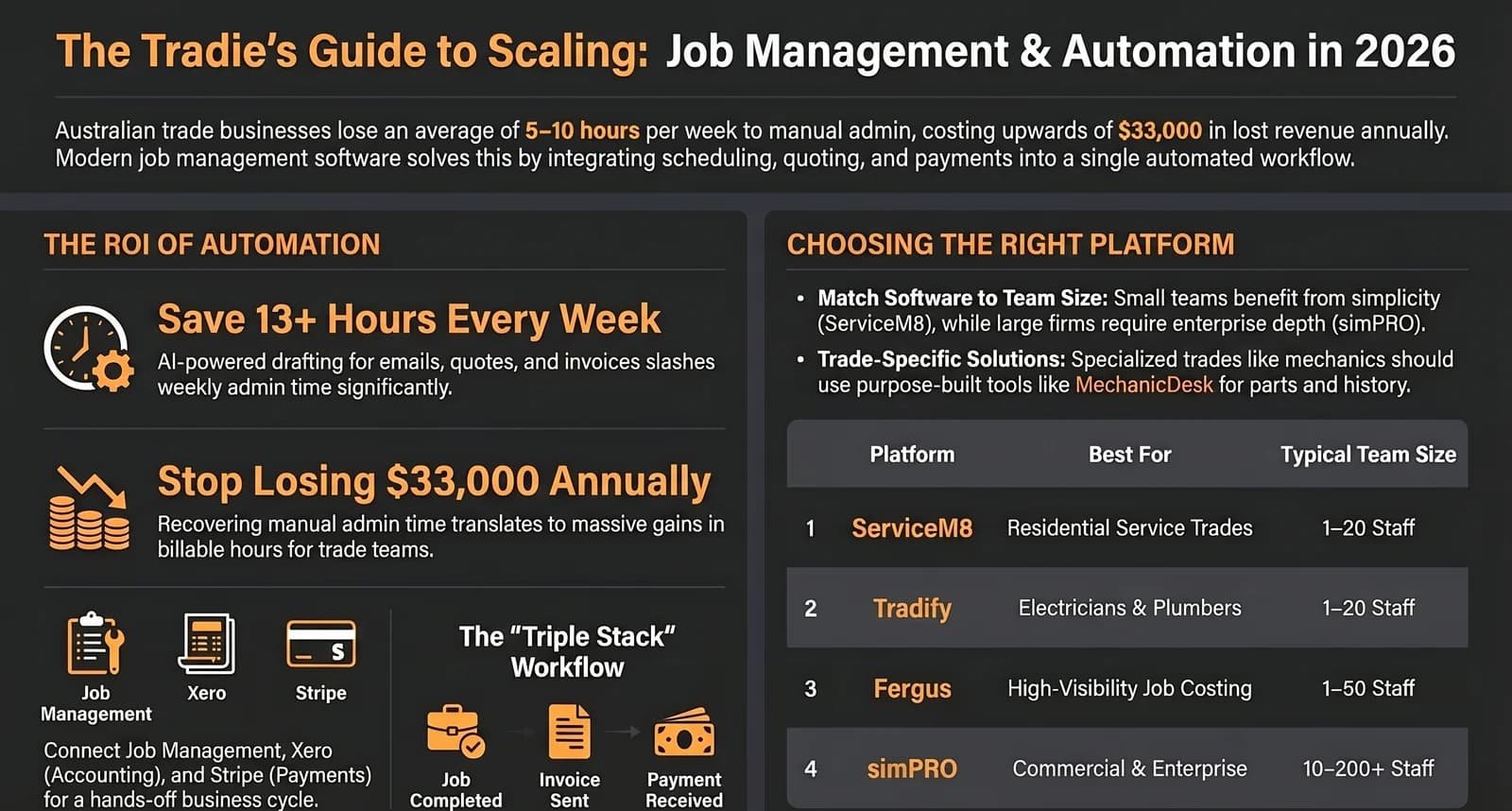
| ServiceM8 | Small field service teams (plumbers, electricians, cleaners) with 1-20 staff | AI Phone Receptionist, Automated Quoting, AI Invoicing, Smart Scheduling, AI writing assistant, AI voice-activated CRM assistant (ServiceM8 Chat), Smart Report Helper | Free plan (0), Starter (29/mo), Growing (79/mo), Premium (149/mo), Premium Plus ($349/mo) | Yes |
| Tradify | Small trade teams (electricians and plumbers) with 1-20 staff | AI Answer tool, AI scheduling, and AI quoting | From $35/user/mo (indicative AUD) | Yes |
| Fergus | Plumbing and electrical contractors, builders and renovators with 1-50 staff | Not in source | From 30–55/user/mo (indicative AUD) | Yes |
| simPRO | Large trade businesses (commercial electrical, plumbing, HVAC, fire) with 10-200+ staff | Advanced project management and field service AI | Custom | Yes |
| AroFlo | Field service, facilities management, and HVAC with 10-200+ staff | Asset management and preventative maintenance AI | Custom | Yes |
| MechanicDesk | Automotive workshops with 1-30 staff | Not in source | From $59/mo (indicative AUD) | Yes |
| Jobber | Tradies wanting a premium-looking client experience | Automated follow-ups and scheduling | From $60/mo (indicative AUD) | Not in source |
Original research by ManaTech
Frequently Asked Questions
Which trade tools are NZ tradies actually using AI with in 2026?
Tradify and ServiceM8 are the most common starting points for residential trades because they have the largest NZ user base and good API access. simPRO and Fergus dominate the commercial and larger-residential segment. Xero sits underneath all of them for invoicing. Custom AI agents typically read job data from one of those tools, do the AI work, and write results back. Most builds touch 2-3 systems.
How does AI quoting actually work for a tradie on site?
On the way back to the truck, you open a voice memo or a phone app, speak the scope: "Replace the gib in the master bedroom, paint and reskim the lounge ceiling, supply and install three new GPOs." AI parses that into line items, prices each one against your saved pricing book, applies your standard markup, and emails the formal quote in your branded template — usually within 60-90 seconds. You review on phone, send. Same-day quotes win materially more work than 3-day quotes.
Can AI chase overdue invoices without sounding like a robot?
Yes — and this is where most trade businesses see the biggest cash-flow improvement. AI reads your debtors list from Xero, prioritises by age and amount, drafts a personalised SMS or email referencing the specific job and client, and sends on a schedule you set. You approve outgoing messages until you trust it; then it runs autonomously for routine reminders, escalating to human attention only when a client responds with a problem. Most NZ trade businesses cut average days-to-pay by 15-25 days.
What about photo-based job documentation? How does that help?
Site photos are the single biggest dispute-prevention tool a tradie has, and almost nobody does them well because organising them is annoying. AI can take photos uploaded from a phone, tag them by job and date, generate a written description ("kitchen splashback 80% complete, GIB sanded and primed"), and attach them to the job record in Tradify or ServiceM8. Two minutes on site → a fully documented job file. Saves hours when a dispute or warranty claim comes up six months later.
Is voice input accurate enough for trade pricing?
Yes, in 2026 — accuracy on tradesman-spoken English in NZ accents is now in the 95%+ range for the leading transcription models. The trick is feeding the AI your specific pricing book and product list so it picks the right line items. Generic AI without your pricing data will guess; AI with your saved templates will match. The first 1-2 weeks of use train the system on your phrasing.
My team is older and not tech-savvy. Can they actually use this?
Yes — and they often adopt AI faster than younger staff because the wins are immediately obvious. Voice input means no typing. Photo documentation means no forms. Approval-by-SMS means no logging into anything. The right AI build for a trade business hides the technology under tools the team already uses (camera, voice memo, SMS) rather than adding a new app to learn.
Think You've Got It?
12 questions to test your understanding — instant feedback on every answer
Question 1 of 12
According to the ServiceM8 feature descriptions, approximately how many hours per week can a small business save by using the AI-powered Smart Writing Helper?
Question 2 of 12
When choosing between simPRO and AroFlo for a large-scale trade business, which factor would most likely lead a company to select AroFlo?
Question 3 of 12
What is the recommended minimum number of completed jobs in a ServiceM8 account before the Auto Quote and Auto Invoice features can generate reasonable results?
Question 4 of 12
A trade business owner wants a platform that provides deep visibility into job costs and profit margins to see if they are actually making money on every job. Which software is specifically recommended for this 'profitability' focus?
Question 5 of 12
In the context of the ServiceM8 Phone Agent, how does the AI assistant help a business owner manage their incoming calls?
Question 6 of 12
Which of the following is described as the 'typical tradie software stack' for successful Australian trade businesses?
Question 7 of 12
ServiceM8 Chat allows staff to interact with job cards using voice commands. Which command would be used to initiate this through an iOS device?
Question 8 of 12
For an automotive workshop in 2026, why is MechanicDesk recommended over general platforms like ServiceM8 or Tradify?
Question 9 of 12
What happens to the automation workflow when a customer pays an invoice via a Stripe link attached to a Xero invoice?
Question 10 of 12
According to 'The Best Booking Tools for Tradies in 2026', which tool is recommended for 'emergency tradies' like locksmiths or plumbers who need to capture leads instantly?
Question 11 of 12
On the ServiceM8 'Starter' plan, what is the limitation regarding the number of jobs per month?
Question 12 of 12
The ServiceM8 AI scheduling feature suggests booking times based on which primary criteria?
Related Content
Building an AI Employee: Custom Applications That Replace Repetitive Tasks
How custom-built AI systems act as digital employees, handling meeting notes, inbox management, analytics, and onboarding so your team can focus on growth.
Read more →blogWhen Should You Outgrow Zapier and Build a Custom Automation System?
Zapier is the right tool until it is not. When your automation bill exceeds $500-1,000 per month, workflows break at critical moments, or you need logic that a visual builder cannot express, it is time to consider a custom automation system. One company went from $600 per month on Zapier to $75 per month with a custom build.
Read more →blogHow to Build AI Agents for Your Business Without Writing Code
AI agents go beyond chatbots — they take actions, make decisions, and complete multi-step workflows autonomously. IDC expects AI copilots embedded in 80% of enterprise apps by 2026. Here is how to build your first AI agent without code.
Read more →blogAI Voice Agents for Business: The Complete 2026 Guide
AI voice agents handle inbound calls, qualify leads, and book appointments 24/7 — without hiring staff. This guide covers what they are, what they cost, and how to deploy one for your business.
Read more →blogHow to Measure the ROI of AI Automation in Your Business
AI automation delivers measurable returns in 90-180 days when scoped correctly — but 95% of AI projects fail because businesses skip baseline measurement. Here is a practical framework for measuring AI ROI across efficiency, revenue, and cost reduction.
Read more →Want to explore this topic further?
Book a free discovery call to discuss how ManaTech can help your business implement these ideas.
Book a Discovery Call