
The Hidden Cost of SaaS Sprawl: Why Your $200/Month Tool Stack Actually Costs $2,000
Quick Answer
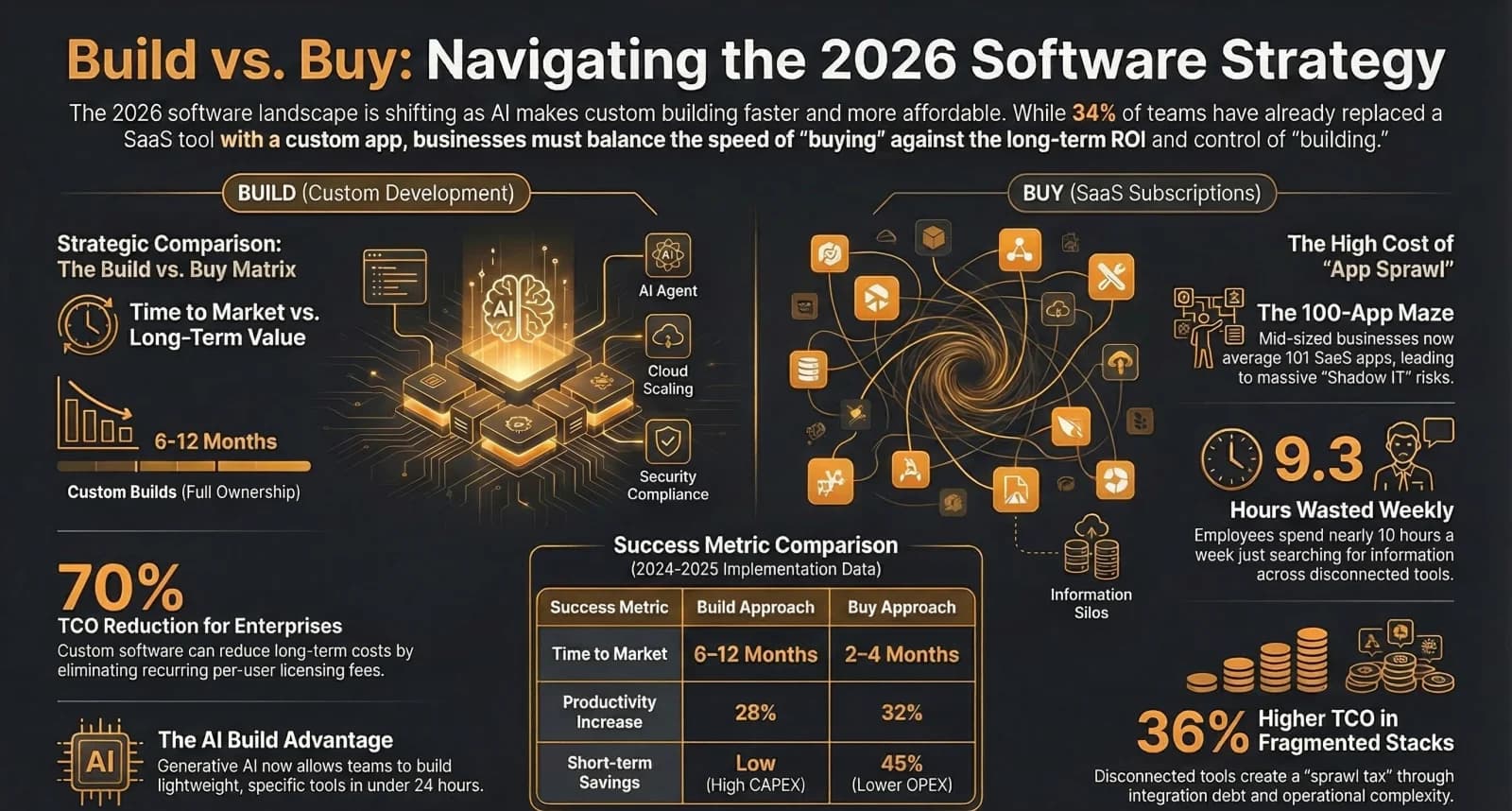
Most small businesses underestimate their SaaS spending by 50-70%. A Gartner analysis found that organisations routinely overlook half to two-thirds of total software costs when they only count subscription fees. The real cost includes unused seats (30% of licences go idle), middleware to connect disconnected tools (Zapier, Make, custom integrations), productivity loss from context-switching between 15+ platforms, security risk from ungoverned tool sprawl, and data reconciliation labour averaging 25 hours per week. When you add these hidden costs, a tool stack that looks like $200 per month on paper often runs $1,500-2,000 per month in true total cost of ownership.
Key Answers
- How much does the average small business waste on unused SaaS?
- Businesses waste approximately 30% of their SaaS budget on unused or underutilised licences. For a company spending $3,000 per month on subscriptions, that is $900 per month or $10,800 per year in pure shelfware — software that is paid for but barely touched.
- What are the hidden costs of SaaS beyond subscription fees?
- Hidden costs include middleware and integration tools ($50-500/month), context-switching productivity loss (estimated at 25 hours per week of data reconciliation), security and compliance risk from ungoverned tools, training and onboarding time for each new platform, and vendor lock-in costs when you eventually need to migrate data.
- When should a business consolidate SaaS tools into custom software?
- Consolidation makes financial sense when your total SaaS spend exceeds $1,500 per month for overlapping tools, when you are paying for middleware like Zapier to connect systems that should share data natively, or when your team spends more time working around tool limitations than working in them.
- How many SaaS tools does the average small business use?
- The average small business in 2026 pays for over 15 different SaaS subscriptions. Larger SMBs with 50-200 employees typically run 80-120 tools. Many of these overlap in functionality, creating duplicate costs and fragmented workflows.
Key Takeaways
- Gartner research shows organisations overlook 50-70% of total software costs when they only count subscription fees — the real cost includes integration, training, productivity loss, and security governance.
- The average small business wastes 30% of its SaaS budget on unused seats and shelfware, equivalent to $900 per month for a business spending $3,000 on subscriptions.
- Teams spend an estimated 25 hours per week reconciling data across disconnected SaaS platforms — a hidden labour cost that rarely appears in any budget line.
- The SaaS-to-custom crossover point occurs at 18-36 months for core business applications, according to Forrester Research — after which custom software costs remain flat while SaaS compounds.
- The fastest wins come from three actions: reclaiming unused seats, cancelling duplicate tools, and consolidating the 2-3 highest-cost SaaS products into a single custom-built application.
Why Does Your SaaS Tool Stack Cost More Than You Think?
Because subscription fees represent only 30-50% of the true cost. Integration middleware, productivity loss from context-switching, unused licences, security governance, and data reconciliation labour make up the rest — and most businesses never track them.
Gartner's comprehensive total cost of ownership analysis reveals that organisations routinely overlook 50-70% of total costs when calculating software ownership expenses. That figure is not a rounding error — it means a tool stack that shows $2,400 per year on your P&L actually costs $4,800-8,000 when you account for everything.
The problem is structural. Each SaaS product is designed as a standalone system. When you stack 15 of them together — which is the average for small businesses in 2026 — you inherit 15 different data formats, 15 login credentials, 15 billing cycles, and zero native communication between any of them. The cost of bridging those gaps is where the real money goes.
What Is SaaS Sprawl and How Does It Happen?
SaaS sprawl is the uncontrolled accumulation of software subscriptions across a business, where tools are added faster than they are audited, consolidated, or cancelled. It happens incrementally — one tool at a time — until the stack becomes unmanageable.
The pattern is predictable. A team member signs up for a free trial to solve an immediate problem. The trial converts to a paid plan. Six months later, another team member signs up for a competing tool because they did not know the first one existed. Both stay active. Neither gets fully adopted. The business now pays for two tools that each do 60% of what is needed and 40% of what is not.
Shopify's enterprise research found that SaaS sprawl creates four compounding problems: financial waste from duplicate subscriptions and unused licences, operational friction from fragmented workflows, security vulnerabilities from ungoverned access, and data silos that prevent a unified view of the business. These problems reinforce each other — fragmented data requires more tools to analyse, which creates more fragmentation.
What Are the 5 Hidden Costs of SaaS Sprawl?
The five hidden costs are shelfware (unused licences), integration middleware, context-switching labour, security governance, and vendor lock-in. Together, these typically double or triple the visible subscription cost.
The first and most obvious hidden cost is shelfware — paid licences that go unused. Industry data consistently shows that 25-30% of SaaS licences are underutilised. For a business spending $3,000 per month on subscriptions, that is $900 per month in pure waste. The fix is straightforward: audit login frequency quarterly and cancel anything with fewer than 5 active logins per month.
The second cost is integration middleware. When SaaS tools do not talk to each other natively, businesses pay $50-500 per month for connectors like Zapier, Make, or custom API integrations. These tools become load-bearing infrastructure — if Zapier goes down, your invoice-to-CRM pipeline stops. As usage scales, businesses often outgrow Zapier entirely and face a costly migration to custom integrations or a unified platform.
The third cost is context-switching labour. ClickUp's research estimates that teams spend 25 hours per week reconciling data across disconnected apps. Every time an employee copies data from one system to another, checks a second tool to verify what was entered in a first, or re-enters the same information across platforms — that is labour that produces zero output. At $30 per hour, that is $3,000 per month in hidden payroll cost for a small team.
The fourth cost is security governance. Each SaaS tool is an attack surface. Gartner predicts organisations that do not centrally manage their SaaS lifecycle will be five times more susceptible to data loss or cyber incidents by 2027. A single compromised password on a forgotten, ungoverned tool can expose client data, financial records, or intellectual property. The cost of a breach dwarfs years of subscription savings.
The fifth cost is vendor lock-in. Your data lives in 15 proprietary formats across 15 platforms. When you eventually need to consolidate, migrate, or switch providers, the extraction cost is enormous — both in direct migration fees and in lost productivity during the transition. The longer sprawl continues, the more expensive it becomes to escape.
How Do You Calculate Your True SaaS Cost?
Add four numbers: subscription fees, middleware costs, labour for workarounds (hours per week multiplied by hourly rate), and estimated cost of one data breach. The total is your true SaaS cost of ownership.
Here is a practical framework for a 10-person business. Start with your visible monthly SaaS spend — pull 12 months of credit card statements and tag every recurring software charge. A typical 10-person SMB runs $2,000-4,000 per month in subscriptions across 15-20 tools.
Next, add middleware costs. If you use Zapier, Make, or any integration platform, add that monthly fee. If you have custom API integrations maintained by a developer, add the maintenance hours. Typical range: $100-500 per month.
Then estimate workaround labour. Ask your team: how many hours per week do you spend copying data between tools, checking one system against another, or working around a tool's limitations? Multiply those hours by your average hourly cost. Even 10 hours per week at $30 per hour adds $1,200 per month — more than most individual SaaS subscriptions.
When your total — subscriptions plus middleware plus labour — exceeds $1,500 per month for overlapping tools, it is worth evaluating whether replacing SaaS with a custom build makes financial sense. The crossover point where custom becomes cheaper than SaaS typically occurs between 18 and 36 months for core business applications, according to Forrester Research.
When Does SaaS Sprawl Cross the Line Into a Real Problem?
When you recognise three or more of these signals: team members use spreadsheets alongside paid tools, you pay for middleware to connect tools that should share data, you have duplicate tools doing the same job, and new hires take weeks to learn the tool stack.
The most reliable signal is the spreadsheet test. If your team maintains spreadsheets alongside paid SaaS tools — tracking data the tool should handle, building reports it cannot produce, or reconciling numbers between systems — then the tools are not serving the business. They are creating work.
Another signal is onboarding friction. When new employees need weeks to learn a stack of 15 disconnected tools — each with its own interface, logic, and login — that is a direct cost to productivity. A unified system with consistent design patterns cuts onboarding time by 60-80% because there is one interface to learn, not fifteen.
The Fireship analysis of how AI is disrupting the SaaS model points to a structural shift: AI makes it dramatically cheaper and faster to build custom alternatives. What previously required a six-month, $100,000 development project can now be built in 6-10 weeks for $15,000-30,000. This changes the economics of the build-versus-buy decision fundamentally — consolidation is no longer prohibitively expensive.
What Are the Three Fastest Ways to Reduce SaaS Sprawl?
Reclaim unused seats, cancel duplicate tools, and consolidate the 2-3 highest-cost overlapping SaaS products into a single custom-built application. These three actions typically recover 30-50% of total SaaS spend within 90 days.
Action one is the shelfware audit. Pull login frequency data for every SaaS tool and cancel or downgrade anything with fewer than 5 active users per month. This is the easiest money you will ever save — no migration required, no replacement needed, just stop paying for what you do not use. Most businesses recover 15-20% of SaaS spend in this step alone.
Action two is duplicate elimination. Map every tool to its primary function and identify overlaps. Do you have both Asana and Monday.com? Both HubSpot and Mailchimp? Both Google Workspace and Microsoft 365? Pick one and migrate. The migration cost is a one-time expense that eliminates a permanent recurring cost.
Action three is strategic consolidation. Identify the 2-3 SaaS products where your team spends the most time working around limitations, and evaluate whether a custom application could replace all three. A custom CRM that replaces HubSpot, a scheduling tool, and a follow-up email tool — all connected natively — eliminates middleware costs, reduces context-switching, and gives you automated CRM follow-ups that would require expensive premium tiers in any SaaS product.
How Does AI Change the Build-Versus-Buy Equation?
AI-powered development has reduced custom software costs by 60-80% and timelines by 50-70% since 2024. What previously made SaaS the default choice for SMBs — the prohibitive cost of custom builds — is rapidly disappearing.
The economics of custom software have shifted dramatically. Agentic development tools now enable a single developer to build in weeks what previously took a team months. McKinsey research found that companies investing in strategic technology — including custom-built tools — achieve 20% higher revenue growth than peers who rely on off-the-shelf solutions.
This matters because the original argument for SaaS was economic: why build when buying is cheaper? That argument held when custom development cost $100,000+ and took 6-12 months. It collapses when the same result costs $15,000-30,000 and takes 6-10 weeks. The Forrester crossover point — 18-36 months — means custom software starts saving money before most SaaS contracts even come up for renewal.
The most powerful version of this approach is building a single AI-powered application that handles multiple business functions — replacing 3-5 SaaS tools with one unified system that shares data natively, learns from usage patterns, and automates decisions that currently require human intervention across multiple platforms.
What Is the Bottom Line?
SaaS sprawl is a slow-moving cost crisis that most businesses do not recognise until they audit the true total. The visible subscription fee is only 30-50% of the real cost — the rest hides in integration middleware, context-switching labour, security risk, and vendor lock-in. In 2026, AI-powered custom development has made consolidation affordable for businesses of every size.
The action plan is three steps: audit your stack to find shelfware and duplicates, calculate your true total cost of ownership using the framework above, and evaluate whether your 2-3 highest-cost overlapping tools are candidates for consolidation into a custom-built application. The businesses that act on this — rather than continuing to accumulate tools — will operate leaner, move faster, and spend less on software by the end of the year.
Research Data
Key strategies and factors based on original research
| Business Tool Category | per-user monthly SaaS cost | total annual SaaS spend for a 10-person team | custom build cost | annual maintenance | cumulative 5-year total for each approach |
|---|---|---|---|---|---|
| CRM & Sales Tools | \$20 to \$500+ | \$2,400 to \$60,000+ | \$50,000 to \$300,000+ | \$10,000 to \$60,000 (15-20\% of build) | SaaS Total: \$12,000 - \$300,000 | Custom Total: \$100,000 - \$600,000 |
| Invoicing & Accounting | \$20 to \$500 | \$2,400 to \$60,000 | \$50,000 to \$150,000 | \$7,500 to \$30,000 (15-20\% of build) | SaaS Total: \$12,000 - \$300,000 | Custom Total: \$87,500 - \$300,000 |
| Project Management | \$20 to \$ 500 | \$ 2,400 to \$ 60,000 | \$ 50,000 to \$ 200,000 | \$ 10,000 to \$ 40,000 (15-20\% of build) | SaaS Total: \$12,000 - \$300,000 | Custom Total: \$100,000 - \$400,000 |
| Internal Dashboards (BI) | \$83 to \$416 | \$10,000 to \$50,000 | \$150,000 to \$300,000 | \$22,500 to \$60,000 (15-20\% of build) | SaaS Total: \$50,000 - \$250,000 | Custom Total: \$262,500 - \$600,000 |
Original research by ManaTech
Frequently Asked Questions
Is SaaS sprawl only a problem for large companies?
No. SaaS sprawl affects businesses of every size. A 10-person company with 15 subscriptions faces the same fragmentation, context-switching, and integration challenges as a 500-person company with 120 tools. The difference is that smaller businesses feel the cost proportionally more — a $1,000 per month waste is background noise for a large enterprise but material for an SMB.
How do I audit my current SaaS spend?
Start with three steps. First, pull 12 months of credit card and bank statements and tag every recurring software charge. Second, survey your team — ask each person which tools they use daily, weekly, and never. Third, check login frequency on each platform. Tools with fewer than 5 logins per month per seat are candidates for immediate cancellation or downgrade.
What is shelfware and how much does it cost?
Shelfware is paid software that is barely or never used. Industry data suggests 25-30% of SaaS licences qualify as shelfware. For a business paying $36,000 per year in total SaaS subscriptions, that represents $9,000-10,800 per year in wasted spend — often the easiest savings opportunity because it requires no migration or replacement, just cancellation.
Does consolidating tools into custom software create vendor lock-in?
Custom software you own creates less lock-in than SaaS, not more. With SaaS, your data lives on someone else's servers in a proprietary format, and migration is costly and time-consuming. With custom software, you own the code, the data, and the infrastructure. You can modify, extend, or migrate at any time without paying exit fees or waiting for vendor support.
How long does it take to replace multiple SaaS tools with one custom application?
A focused custom build that replaces 2-3 overlapping SaaS tools typically takes 6-10 weeks for an MVP and 12-16 weeks for a production-ready system. The key is phased replacement — build the custom tool, run it alongside the SaaS products for 2-4 weeks, then cut over one tool at a time. This reduces risk and delivers measurable ROI within 90 days.
What are the security risks of SaaS sprawl?
Gartner predicts that organisations not centrally managing their SaaS lifecycle will be five times more susceptible to data loss or cyber incidents by 2027. Each ungoverned SaaS tool is a potential attack surface — a compromised employee password on one forgotten tool can expose sensitive business data. Consolidating into fewer, better-managed systems dramatically reduces this risk.
Think You've Got It?
12 questions to test your understanding — instant feedback on every answer
Question 1 of 12
According to the Retool report, which category of business intelligence (BI) is considered most 'ripe for replacement' by custom-built apps?
Question 2 of 12
In the context of the 2026 'Build vs Buy' debate, how is the financial treatment of custom software development usually classified compared to SaaS?
Question 3 of 12
What is described as the 'Inaction Tax' in the Shopify guide to SaaS sprawl?
Question 4 of 12
According to ClickUp, what is 'Context Sprawl' and how does it affect employee productivity?
Question 5 of 12
Why did Netflix decide to build its own content delivery network (Open Connect) rather than continue 'buying' commercial services?
Question 6 of 12
In the 2025 technical decision framework, which of the following represents a 'Modern Requirement' for security assessments compared to traditional approaches?
Question 7 of 12
How does the 'SaaS Apocalypse' thesis presented by Retool explain the shift toward custom software?
Question 8 of 12
According to the Fireship report, what is the 'Codeex' app for macOS designed to handle?
Question 9 of 12
What is 'Integration Debt', as described in the Shopify source material?
Question 10 of 12
When comparing 'Build vs Buy' for a startup, why is 'Buying' often the recommended initial strategy?
Question 11 of 12
What hidden cost associated with SaaS scaling is highlighted by Carney Technologies?
Question 12 of 12
In the 'Build vs Buy' decision matrix, which factor is a major 'Trade-Off' for choosing to build custom software?
Related Content
Is Your Business Paying for SaaS You Could Replace with a Custom Build?
The average employee costs their company $758 per month in SaaS subscriptions. Over 5 years, SaaS spending exceeds custom development costs by 72%. Here is how to identify which tools are worth replacing and when a custom build makes financial sense.
Read more →blogWhen Should You Outgrow Zapier and Build a Custom Automation System?
Zapier is the right tool until it is not. When your automation bill exceeds $500-1,000 per month, workflows break at critical moments, or you need logic that a visual builder cannot express, it is time to consider a custom automation system. One company went from $600 per month on Zapier to $75 per month with a custom build.
Read more →compareSalesforce vs HubSpot vs Custom CRM
A custom CRM makes sense when your team spends more time working around Salesforce or HubSpot than working in it. If your sales process involves multi-step approvals, industry-specific data, or deep integration with proprietary systems, a custom build eliminates the friction and often costs less over 3 years.
Read more →compareQuickBooks Online vs Xero vs Custom Invoicing
QuickBooks and Xero are excellent general accounting tools. When invoice volume exceeds 300/month or your process requires multi-entity reconciliation, custom approval workflows, or three-way PO matching, a custom invoicing system delivers dramatically better efficiency and accuracy.
Read more →compareAsana vs Monday.com vs Custom PM Tool
Asana and Monday.com work well for generic project tracking. When you need a client-facing portal, integrated time tracking with billing, or workflows that match your specific delivery process, a custom tool eliminates the gap between how your team works and what the software supports.
Read more →Want to explore this topic further?
Book a free discovery call to discuss how ManaTech can help your business implement these ideas.
Book a Discovery Call