
Why Vibe Coding Is Not Enough for Business-Critical Software
Quick Answer
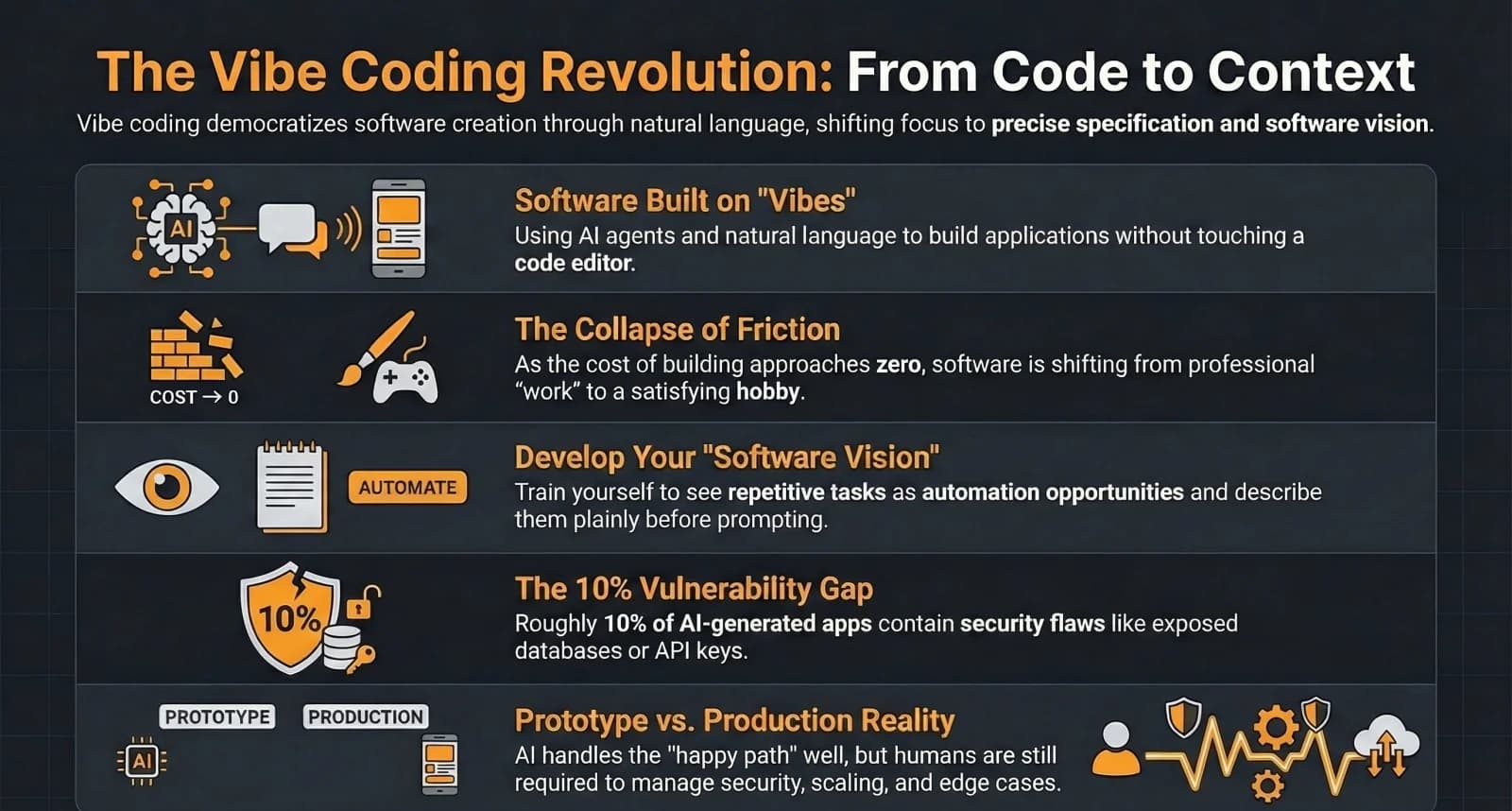
Vibe coding tools like Cursor, Windsurf, and Google AntiGravity can create functional prototypes fast, but they produce security vulnerabilities including prompt injection risks, suffer from context rot beyond a few thousand lines of code, and lack deployment infrastructure. Business-critical applications still need professional architecture and security review.
Key Answers
- What is vibe coding?
- Vibe coding is a software development approach where you describe what you want in natural language and AI builds it. Tools like Cursor, Windsurf, and Google AntiGravity have made this accessible to non-developers.
- What are the security risks of vibe coding?
- Vibe-coded software is vulnerable to prompt injection attacks, SQL injection, cross-site scripting, and authentication edge cases. A single malicious prompt can cause AI-generated APIs to dump their entire configuration.
- What is context rot in AI coding?
- Context rot occurs when a codebase grows beyond the AI context window. The AI can no longer see the entire project, causing duplicated functions, drifting conventions, and inconsistent state management.
- When should you use vibe coding vs professional development?
- Use vibe coding for internal tools, prototypes, and simple automations. Use professional AI-powered development when software handles client data, processes payments, or has financial consequences if it fails.
- What is the difference between vibe coding and professional AI-powered development?
- Professional AI-powered development uses the same tools but adds security review, architectural planning, deployment infrastructure, and monitoring to deliver production-grade reliability.
Key Takeaways
- AI-generated code is vulnerable to prompt injection attacks that can exfiltrate environment variables, API keys, and database credentials stored in .env files.
- Context rot occurs when AI coding tools can no longer see the entire codebase, causing functions to be duplicated, naming conventions to drift, and state management to become inconsistent.
- The five most common vibe coding mistakes are overloading prompts, neglecting safety settings, MCP bloat, treating AI like a chatbot, and skipping deployment planning.
- Vibe coding works well for internal tools, prototypes, simple automations, and personal productivity tools that do not handle sensitive data.
- Professional AI-powered development uses the same tools but adds security review, architectural planning, deployment infrastructure, and monitoring to deliver software 3-5x faster than traditional development with production-grade reliability.
What Is the Promise of Vibe Coding?
Vibe coding lets you describe what you want in natural language and AI builds it. Tools like Cursor, Windsurf, and Google AntiGravity have made it possible for non-developers to create functional applications in hours rather than months.
Vibe coding has become the defining trend in software development for 2026. The concept is simple. Describe what you want in natural language, and AI builds it. Tools like Cursor, Windsurf, Claude Code, Replit Agent, and Google AntiGravity have made it possible for non-developers to create functional applications in hours rather than months. The promise is real. A founder with a clear vision can prototype an MVP in an afternoon. A marketing team can build an internal dashboard without waiting in the engineering queue. The barrier to creating software has never been lower. But there is a significant gap between "it works on my machine" and "my business runs on this." That gap is where the promise breaks down and the problems begin.
What Are the Security Risks of Vibe Coding?
Vibe-coded software is vulnerable to prompt injection attacks, SQL injection, cross-site scripting, and authentication edge cases. AI coding agents generate functional code but often lack fundamental security protections.
The most dangerous problem with vibe-coded software is security. AI coding agents do not inherently understand threat models. They generate code that works functionally but often lacks fundamental protections. Prompt injection attacks can exploit AI-generated endpoints to exfiltrate environment variables, including API keys and database credentials stored in .env files. Server-side code generated without proper input validation is vulnerable to SQL injection and cross-site scripting. Authentication flows built by AI often miss edge cases: session fixation, token expiration, privilege escalation. Security researchers have demonstrated that a single malicious prompt embedded in user input can cause AI-generated APIs to dump their entire configuration, including secrets. For a business application handling client data or processing payments, a single vulnerability could mean a data breach, regulatory penalties, and destroyed trust.
What Is Context Rot and Why Does It Matter?
Context rot occurs when a codebase grows beyond the AI context window. The AI can no longer see the entire project simultaneously, causing duplicated functions, drifting conventions, and inconsistent state management that compounds into architectural decay.
Every AI coding tool operates within a context window. That is a limited amount of information it can hold in memory at once. As a project grows beyond a few thousand lines of code, the AI can no longer see the entire codebase simultaneously. This creates context rot. The AI starts making changes that conflict with code it wrote earlier in the session but can no longer see. Functions get duplicated. Naming conventions drift. State management becomes inconsistent. One module expects data in a format that another module changed three iterations ago. For a small prototype, this is manageable. For a production application with 50,000+ lines of code, context rot compounds into architectural decay that becomes increasingly expensive to fix. Professional developers mitigate this with modular architecture, clear interfaces between components, and systematic code review. These are exactly the practices that vibe coding bypasses.
What Are the 5 Most Common Vibe Coding Mistakes?
The five most common mistakes are overloading prompts, neglecting safety settings, MCP bloat from too many connected servers, treating AI like a chatbot instead of giving structured instructions, and skipping deployment planning.
After reviewing dozens of vibe-coded projects, five mistakes appear repeatedly. First, overloading prompts. Cramming an entire application specification into a single prompt produces incoherent output. Break it into focused, sequential requests. Second, neglecting safety settings. Most AI coding tools offer safety configuration options that users skip because they slow down generation. Those settings exist for a reason. Third, MCP bloat. Connecting too many Model Context Protocol servers to your development environment creates tool conflicts and unpredictable behavior. Use only what you need. Fourth, treating AI like a chatbot. Conversational prompting produces conversational code. Structured, specific instructions produce production-quality output. Fifth, skipping deployment planning. Building locally is easy. Configuring CI/CD pipelines, environment management, database migrations, and monitoring requires infrastructure expertise that AI agents do not reliably provide.
When Does DIY Vibe Coding Work and When Does It Fall Short?
Vibe coding works for internal tools, prototypes, simple automations, and personal productivity tools. It falls short for client-facing apps, payment processing, sensitive data handling, and any system where failure has financial consequences.
Vibe coding is genuinely excellent for certain use cases. Internal tools that only your team uses and do not handle sensitive data. Prototypes to validate an idea before investing in a full build. Simple automations that connect two APIs. Personal productivity tools. Data visualization dashboards for internal reporting. Where DIY vibe coding falls short is anywhere the stakes are high. Client-facing applications. Systems that process payments or personal data. Applications that need to scale beyond a handful of users. Software that must comply with industry regulations. Any system where downtime or data loss has financial consequences. The dividing line is not technical complexity. It is business risk. If the application failing costs you clients, revenue, or reputation, it needs professional oversight.
What Is the Bottom Line?
Vibe coding opened the door to faster software development. Professional AI-powered development walks through it by adding security review, architectural planning, and deployment infrastructure to deliver 3-5x faster with production-grade reliability.
Professional AI-powered development uses the same tools but with the guardrails that production software requires. Security review on every generated component. Architectural planning that prevents context rot before it starts. Deployment infrastructure designed for reliability and scalability. Monitoring and alerting so issues are caught before users experience them. At ManaTech, we use agentic development to accelerate every project we deliver. AI handles the implementation while our team handles the judgment calls. That includes architecture patterns, security boundaries, data model structure, and production deployment. The result is software built 3-5x faster than traditional development, with the reliability and security that business-critical systems demand. Vibe coding opened the door. Professional AI-powered development walks through it.
Research Data
Key strategies and factors based on original research
| Platform or Concept | Metric or Data Point | Value | Status/Comparison |
|---|---|---|---|
| Builder Platforms | Tool Categorization | No-terminal / Chat-based | Includes Lovable, Bolt, and Replit; optimized for speed and prototypes over maintainability |
| CLI Tools | Tool Categorization | Terminal / Code Editor | Includes Claude Code, Cursor, and Windsurf; optimized for control and long-term ownership |
| Vibe Coding Tools | Security Debt / OWASP Vulnerabilities | 45% | Percentage of AI-generated code found to contain an OWASP Top 10 vulnerability |
| AI Coding Assistants | Architectural Flaws (Privilege Escalation) | 300% | Surge in deeper architectural flaws compared to manual coding |
| Developer Productivity | Productivity Gains (Experienced Devs) | 10x | Potential productivity increase for senior developers using AI agents |
| App Development Apps (e.g., Lovable) | Security Vulnerability Rate | 10% | Estimated low estimate of apps with vulnerabilities like exposed databases or API keys |
| Lovable | Web Traffic Decline | 50% | Dropped from 35-12 million users in June to under 20 million in September (speculative data) |
| Vit plug-in component tagger (Lovable) | Package Download Peak | 4,500,000 | Peak weekly downloads compared to approximately 1,500,000 currently |
| Replit AI Agent | Failure Mode / Data Loss | 1,200 | Number of customers whose data was deleted by the AI agent during a code freeze |
| Tea (Dating Review App) | Security Failure Case | 72,000 | Number of user photos stolen due to an improperly secured AI-built database |
Original research by ManaTech
Frequently Asked Questions
What are the security risks of vibe coding?
Vibe-coded software is vulnerable to prompt injection attacks, SQL injection, cross-site scripting, and authentication edge cases like session fixation and privilege escalation. Security researchers have shown that malicious prompts in user input can cause AI-generated APIs to dump their entire configuration including API keys and database credentials.
What is context rot in AI coding?
Context rot occurs when a codebase grows beyond the AI context window, typically a few thousand lines. The AI can no longer see the entire project simultaneously, causing it to make changes that conflict with earlier code. Functions get duplicated, naming conventions drift, and state management becomes inconsistent, compounding into architectural decay.
When is vibe coding appropriate for business use?
Vibe coding works well for internal tools only your team uses, prototypes to validate ideas before full builds, simple automations connecting two APIs, personal productivity tools, and internal data dashboards. It falls short for client-facing applications, payment processing, sensitive data handling, and any system where downtime has financial consequences.
What is the difference between vibe coding and professional AI-powered development?
Professional AI-powered development uses the same AI coding tools but adds security review on every generated component, architectural planning to prevent context rot, deployment infrastructure for reliability, and monitoring to catch issues before users experience them. It delivers software 3-5x faster than traditional development with production-grade security.
What are the most common vibe coding mistakes?
The five most common mistakes are overloading prompts with entire application specs, neglecting safety settings that slow down generation, connecting too many MCP servers causing tool conflicts, using conversational prompting instead of structured instructions, and skipping deployment planning for CI/CD pipelines and environment management.
Think You've Got It?
15 questions to test your understanding — instant feedback on every answer
Question 1 of 15
According to the sources, what is the primary defining characteristic of 'vibe coding'?
Question 2 of 15
What does the 'parkour vision' analogy represent in the context of modern software building?
Question 3 of 15
Why is 'vibe coding' potentially problematic for junior developers' career growth?
Question 4 of 15
What is the primary function of a Model Context Protocol (MCP) server in an AI-assisted development workflow?
Question 5 of 15
The 'Renaissance worker' in software development is defined as someone who:
Question 6 of 15
What is identified as a major risk when moving a vibe-coded project from a prototype to a production-ready system?
Question 7 of 15
How does the 'prediction machine' nature of LLMs lead to coding hallucinations?
Question 8 of 15
In Theo's 'GoPro' comparison, why are some vibe coding platforms seeing a decline in traffic?
Question 9 of 15
What is recommended as a strategy to prevent an AI coding tool from 'degrading' during a long conversation?
Question 10 of 15
True or False: According to 'Logically Answered', researchers found that syntax errors have surged by 300% due to AI coding.
Question 11 of 15
What is the 'graduation problem' mentioned in the context of tools like Lovable or Replit?
Question 12 of 15
Which specific risk is highlighted by the Replit 'agentic' failure involving Jason Lemkin?
Question 13 of 15
In the modern AI-era, which skill is described as 'the one that matters' more than writing syntax?
Question 14 of 15
What does Nate B. Jones suggest as the best way to develop 'vibe coding' intuition?
Question 15 of 15
Why does AI tend to produce more 'bloated' or 'crappier' versions of existing software, according to the Code Report?
Related Content
Building an AI Employee: Custom Applications That Replace Repetitive Tasks
How custom-built AI systems act as digital employees, handling meeting notes, inbox management, analytics, and onboarding so your team can focus on growth.
Read more →blogThe Rise of Agentic Development: How AI Agents Are Replacing Development Teams
The shift from writing code to orchestrating AI agents is redefining software development. What agentic development means for project timelines, costs, and the SMBs who need custom software.
Read more →blogClaude Code for Business Owners: Automate Your Business Without a Dev Team
Claude Code is an agentic coding tool that works autonomously for minutes or hours, not just completing code snippets. Nate Herk says he would teach a 10-year-old to build agentic workflows with it. Here is what business owners need to know.
Read more →blogGoogle AntiGravity: What It Means for Small Businesses
Google AntiGravity lets you build apps by describing what you want. Here is what it actually means for your business and where the limits are.
Read more →blogWhat Is an AI Operating System and Why Does Every SMB Need One?
Most businesses using AI are still bolting on individual tools one at a time. An AI Operating System flips the model: context first, integrations second, automations built on top. The result is a business that runs on AI instead of just using it.
Read more →Want to explore this topic further?
Book a free discovery call to discuss how ManaTech can help your business implement these ideas.
Book a Discovery Call