
Google AntiGravity: What It Means for Small Businesses
Quick Answer
Google AntiGravity is an AI-powered development platform that runs hundreds of parallel agents to build applications from natural language descriptions. It excels at rapid prototyping and simple internal tools, but production-grade business applications still require professional architecture, security review, and deployment expertise.
Key Answers
- What is Google AntiGravity?
- Google AntiGravity is an AI-powered development platform that lets you build applications by describing what you want in plain language, using hundreds of autonomous AI agents working in parallel.
- What can you build with Google AntiGravity?
- AntiGravity excels at simple internal tools like inventory trackers, dashboards, and contact forms. It struggles with multi-system integrations, custom authentication, and regulatory compliance.
- Can Google AntiGravity build production business apps?
- For simple internal tools, yes. For client-facing apps, payment processing, or sensitive data handling, autonomous agents alone do not reliably handle security and compliance requirements.
- What is the gap between prototype and production software?
- A prototype demonstrates that something works. Production software must handle edge cases, scale under load, protect user data, recover from failures, and integrate with existing systems.
Key Takeaways
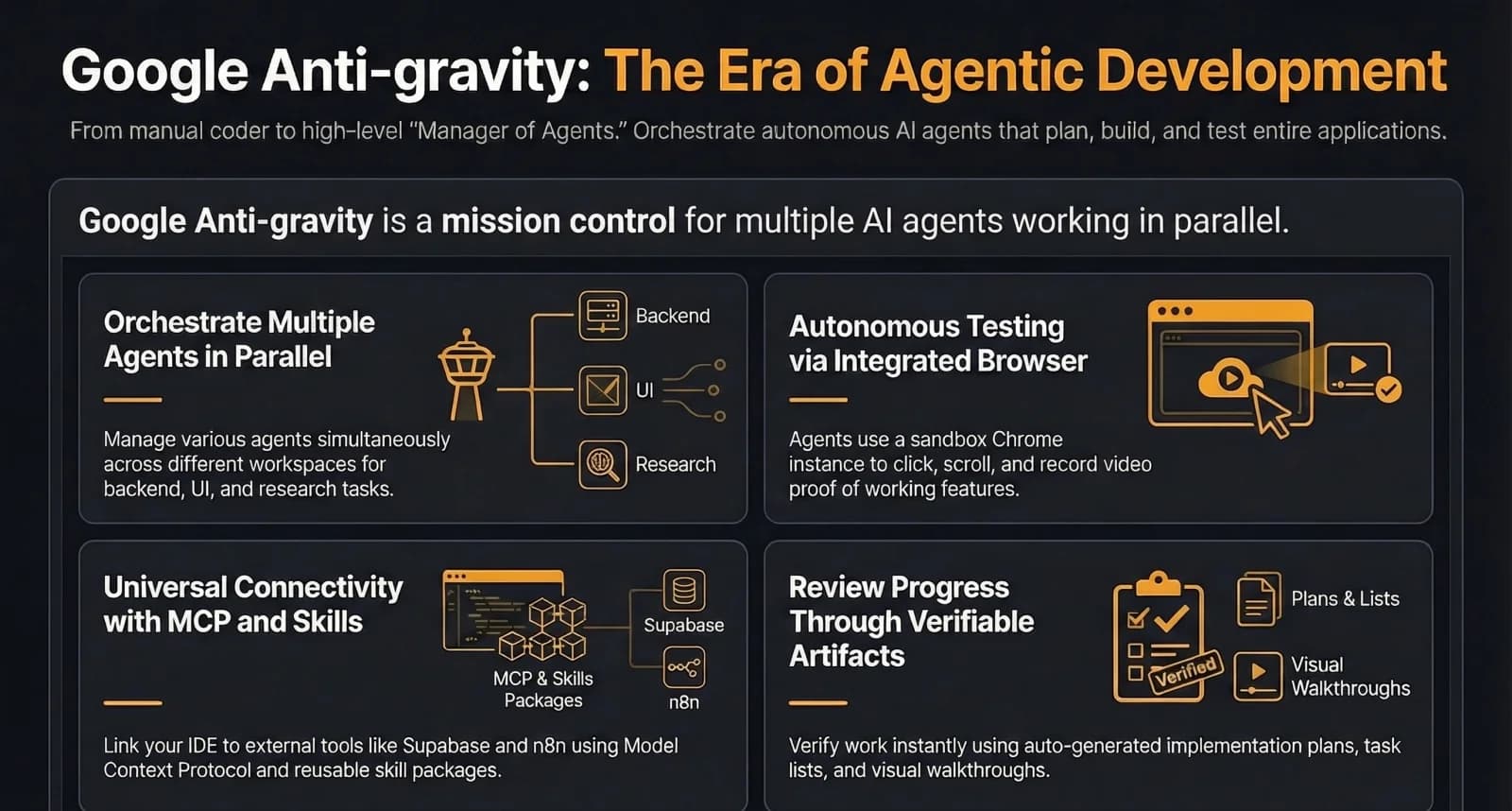
- Google AntiGravity can run hundreds of autonomous AI agents in parallel, each working on different parts of an application simultaneously, building projects in hours that previously took months.
- Autonomous browser testing agents verify their own work by navigating applications like real users and recording video proof of functionality.
- Artifacts are structured documents describing what was built, architectural decisions, and test results that stakeholders can comment on and revise like a Google Doc.
- The platform excels at simple internal tools like inventory trackers, dashboards, and contact forms, but struggles with multi-system integrations, custom authentication, and regulatory compliance.
- The gap between a working prototype and production-grade business software requires professional security review, architectural validation, and operational expertise that autonomous agents do not reliably provide.

What Is Google AntiGravity?
Google AntiGravity is an AI-powered development platform that lets you build applications by describing what you want in plain language. It runs hundreds of autonomous AI agents in parallel and includes autonomous browser testing.
Google AntiGravity is an AI-powered development platform announced in early 2026. It lets you build applications by describing what you want in plain language. Built as a fork of VS Code, it integrates Gemini 3 Pro, Claude, and OpenAI models into a single development environment. The headline feature is the Agent Manager, a breakthrough in agentic development. It can run hundreds of autonomous AI agents in parallel, each working on different parts of your application simultaneously. Google claims that projects which previously took 2-3 months can now be built in hours. It also includes autonomous browser testing. Agents verify their own work by navigating the application like a real user and recording video proof of functionality. For small business owners, the pitch is compelling: describe your app, let AI build it, and deploy it to production without writing a single line of code.
How Does Google AntiGravity Work?
AntiGravity decomposes your natural language request into discrete tasks and assigns each to a specialised agent. Agents build the database, API, frontend, and tests in parallel, then testing agents verify everything in a real browser.
AntiGravity operates through a layered agent system. You describe what you want to build in a natural language prompt. The platform decomposes your request into discrete tasks and assigns each to a specialised agent. One agent handles the database schema. Another builds the API layer. Another creates the frontend components. Another writes tests. The Agent Manager coordinates all of them, resolving conflicts and merging their work. When agents complete their tasks, autonomous browser agents launch the application and test it. They click through workflows, fill out forms, and verify that outputs match expectations. The entire process produces artifacts. These are structured documents that describe what was built, why decisions were made, and what was tested. Artifacts function like a living project brief that you can comment on and revise, similar to collaborating on a Google Doc.
What Can You Build With Google AntiGravity?
AntiGravity excels at simple internal tools like inventory trackers, client intake forms, dashboards, and landing pages. It struggles with multi-system integrations, custom authentication, and regulatory compliance.
For simple internal tools, AntiGravity delivers genuinely impressive results. A basic inventory tracker. A client intake form connected to a database. A dashboard that pulls data from an API. A landing page with a contact form. These kinds of applications can be scaffolded and functional within hours. The platform excels when requirements are straightforward and the application does not need to integrate deeply with existing systems. Where it starts to struggle is with complexity. Multi-system integrations, custom authentication flows, regulatory compliance requirements, and applications handling sensitive financial or health data all push beyond what autonomous agents can reliably deliver without expert oversight.
What Is the Gap Between Prototype and Production?
A prototype demonstrates that something works. A production application must handle edge cases, scale under load, protect user data, recover from failures, and integrate with existing systems without breaking them.
This is the critical distinction that most coverage of AntiGravity overlooks. Building a working prototype and shipping a production-grade business application are fundamentally different challenges. A prototype demonstrates that something works. A production application needs to handle edge cases, scale under load, protect user data, recover from failures gracefully, and integrate with your existing systems without breaking them. Autonomous agents do not inherently understand your security requirements, compliance obligations, or the nuances of your business logic. They generate code that works for the happy path. Production software needs to work for every path, including the ones you did not think to specify. This is why vibe coding is not enough for business-critical software. Professional architecture, security review, and operational expertise become essential.
What Does Google AntiGravity Mean for Your Business?
AntiGravity is transformative for rapid prototyping and simple tool creation. But if your business depends on the software, you need professional architecture, security review, and deployment expertise beyond what autonomous agents provide.
AntiGravity and tools like it are genuinely transformative for rapid prototyping and simple tool creation. If you need a quick internal utility and you are comfortable managing the limitations, these platforms can save you time and money. But if your business depends on the software, the calculus changes. If it handles client data, processes payments, manages inventory, or automates operations, you need more than what an autonomous agent can deliver unsupervised. The smart approach is to use AI-powered development tools as an accelerator, not a replacement for expertise. The businesses getting the best results are the ones pairing AI development platforms with experienced architects who know how to validate, secure, and scale the output.
What Is the Bottom Line?
AI-powered development tools like Google AntiGravity are extraordinary accelerators. The question is not whether to use them. It is whether to use them with or without expert guidance for business-critical software.
At ManaTech, we use AI-powered development tools extensively, including multi-agent orchestration and autonomous testing. The difference is that every line of generated code goes through security review, architectural validation, and production hardening before it reaches a client environment. We use AI agents to handle the repetitive parts of development. That includes scaffolding, boilerplate, test generation, and documentation. Our team focuses on the decisions that require human judgment: architecture, security, integration design, and business logic. This approach lets us deliver projects 3-5x faster than traditional development while maintaining the quality and security standards that business-critical software demands. The tools are extraordinary. The question is not whether to use them. It is whether to use them with or without expert guidance.
Research Data
Key strategies and factors based on original research
| Strategy/Step | Key Tactics | Technical Requirements | Success Metrics | Content Format Priorities | Platform Target | Business Impact (Inferred) |
|---|---|---|---|---|---|---|
| Step 1: Audit & Pattern Recognition | Test top 10-20 money keywords/prompts in private mode; identify cited sources like Reddit or G2; monitor competitor visibility. | Use tools like Profound or Arops to track AI data sources; use private browser settings to prevent bias. | Baseline brand mention frequency; identification of top 20 non-branded prompt performance. | Competitor comparison pages; high-ranking listicles; screenshots of current AI SERP results. | ChatGPT, Perplexity, Google AI Overviews (AIO). | Establishment of a visibility baseline to prevent 'invisibility' in the 25% shift to AI search. |
| Step 2: Restructuring (The Three-Layer System) | Implement direct answer first (50 words); provide context with data/examples; use bottom-of-funnel modifiers (best, top, cheap). | Remove 'mystery and fluff'; align insights with specific customer LLM prompts. | AI confidence in citing the page; improved summarization accuracy by LLMs. | Direct answers (first 50 words); Listicles; Comparison pages; Data tables/charts (first 200 words). | ChatGPT, Gemini, Perplexity. | Increased probability of being cited as the definitive solution by summarizing engines. |
| Step 3: Authority & Schema Markup | Implement JSON-LD schema (Article, FAQ, Q&A); publish original research and surveys; utilize digital PR for third-party mentions. | Google Structured Data Markup Helper; valid JSON-LD code in page headers; schema.org validator. | 3x more citations (via research); 60% of AI responses pulled from FAQ structured content. | FAQ sections; Benchmark reports; Case studies; Original research; Verified author credentials. | Reddit, YouTube, Capterra, Trustpilot, Yelp, Wikipedia. | Builds 'Digital ID card' trust, making AI models prefer your brand over unverified competitors. |
| Step 4: Technical Optimization | Optimize for AI crawlers; ensure mobile-friendliness; maintain content freshness and 'last updated' dates. | Site load speed under 2 seconds; clean URL structures; mobile-responsive layout; alt text for AI accessibility. | Site speed (< 2 seconds); successful indexing by AI discovery-oriented crawlers. | Regularly updated blog posts; clean HTML; mobile-optimized landing pages. | Google AI Overviews, Search Engine crawlers. | Faster indexing and recommendation cycles, ensuring the brand stays in the current 'freshness' window. |
| Step 5: Multi-Platform Authority (Discovery Optimization) | Republish snippets to high-authority platforms; engage in Reddit threads; execute 'Search Everywhere Optimization'. | Consistent brand mentions across disparate domains; use of Reddit Pro for monitoring. | Cross-platform brand associations; referral traffic from non-traditional SEO sources. | Short-form video (YouTube Shorts/TikTok); LinkedIn insights; Reddit comments; Wikipedia edits. | LinkedIn, Reddit, GitHub, YouTube, Quora, Instagram, TikTok. | Captures leads on platform to avoid algorithmic throttling; adapts to the 26% 'no-click' search trend. |
| Tracking & Prioritization (Matrix) | Conduct weekly visibility audits; utilize a Prioritization Matrix (High Value/Low Visibility = Immediate Priority). | Visibility logs/trackers; monitoring high-traffic vs. high-visibility correlations. | Improvement in 'Prioritization Matrix' quadrants; conversion rate from qualified AI leads. | Performance tracking logs; competitive gap analysis reports. | ChatGPT, Perplexity, Google AI Overviews (AIO). | Efficient resource allocation focusing on keywords that drive ROI despite traditional traffic loss. |
Original research by ManaTech
Frequently Asked Questions
What is Google AntiGravity?
Google AntiGravity is an AI-powered development platform announced in early 2026 that lets you build applications by describing what you want in plain language. Built as a fork of VS Code, it integrates Gemini 3 Pro, Claude, and OpenAI models and can run hundreds of autonomous AI agents in parallel on a single project.
What can you build with Google AntiGravity?
AntiGravity works well for simple internal tools like inventory trackers, client intake forms, dashboards, and landing pages. It struggles with multi-system integrations, custom authentication flows, regulatory compliance requirements, and applications handling sensitive financial or health data.
How much does Google AntiGravity cost?
Google AntiGravity uses AI model API calls which have costs based on usage. While the platform reduces development labor costs significantly for simple projects, production-grade applications still require professional oversight for security, architecture, and deployment, which adds to the total cost.
Can I build a production business app with Google AntiGravity alone?
For simple internal tools, yes. But for client-facing applications, systems that process payments, or software that handles sensitive data, autonomous agents alone do not reliably handle security requirements, compliance obligations, edge cases, or integration complexity. Professional architecture and security review are still essential.
What are the limitations of Google AntiGravity?
The main limitations are with complexity: multi-system integrations, custom authentication flows, regulatory compliance, and sensitive data handling push beyond what autonomous agents can reliably deliver without expert oversight. The gap between a working prototype and production-grade software is where professional expertise becomes essential.
Think You've Got It?
10 questions to test your understanding — instant feedback on every answer
Question 1 of 10
What is the primary objective of 'Generative Engine Optimization' (GEO) as described by Ross Simmons?
Question 2 of 10
In the 'three-layer system' for GEO, where should the direct answer to a user's likely prompt be placed?
Question 3 of 10
According to the local SEO panel, why is a high volume of reviews left 'on-site' potentially risky in 2026?
Question 4 of 10
What is a major challenge in measuring the ROI of 'AI mode' or LLM visibility compared to traditional web search?
Question 5 of 10
Neil Patel suggests that future ads in AI platforms like ChatGPT will function more like which existing ad model?
Question 6 of 10
In the context of local SEO for 2026, why might a 'Service Area Business' (SAB) with a hidden address experience lower visibility on Maps?
Question 7 of 10
Exposure Ninja highlights 'Psychographics' as a key strategy for 2026. How does this differ from traditional 'Demographics'?
Question 8 of 10
What is the 'AI slop' problem mentioned in the source material regarding marketing teams?
Question 9 of 10
According to the HubSpot tutorial, why is 'Content Freshness' a critical technical signal for AI engines?
Question 10 of 10
What is the 'Wikipedia Strategy' suggested for advanced GEO?
Related Content
Building an AI Employee: Custom Applications That Replace Repetitive Tasks
How custom-built AI systems act as digital employees, handling meeting notes, inbox management, analytics, and onboarding so your team can focus on growth.
Read more →blogThe Rise of Agentic Development: How AI Agents Are Replacing Development Teams
The shift from writing code to orchestrating AI agents is redefining software development. What agentic development means for project timelines, costs, and the SMBs who need custom software.
Read more →blogWhy Vibe Coding Is Not Enough for Business-Critical Software
Vibe coding tools make software development accessible to everyone. But security vulnerabilities, context rot, and deployment complexity mean business-critical apps still need professional architecture.
Read more →blogClaude Code for Business Owners: Automate Your Business Without a Dev Team
Claude Code is an agentic coding tool that works autonomously for minutes or hours, not just completing code snippets. Nate Herk says he would teach a 10-year-old to build agentic workflows with it. Here is what business owners need to know.
Read more →blogChatGPT vs Claude vs Gemini for Small Business in 2026: A Practical Comparison
Most small business owners pick the first AI tool they try and stick with it. That is the most expensive mistake you can make in 2026. The three leading platforms — ChatGPT, Claude, and Gemini — are not interchangeable. Each one wins decisively for different tasks, and 70% of growing service firms now run all three concurrently for that exact reason.
Read more →Want to explore this topic further?
Book a free discovery call to discuss how ManaTech can help your business implement these ideas.
Book a Discovery Call