
How to Measure the ROI of AI Automation in Your Business
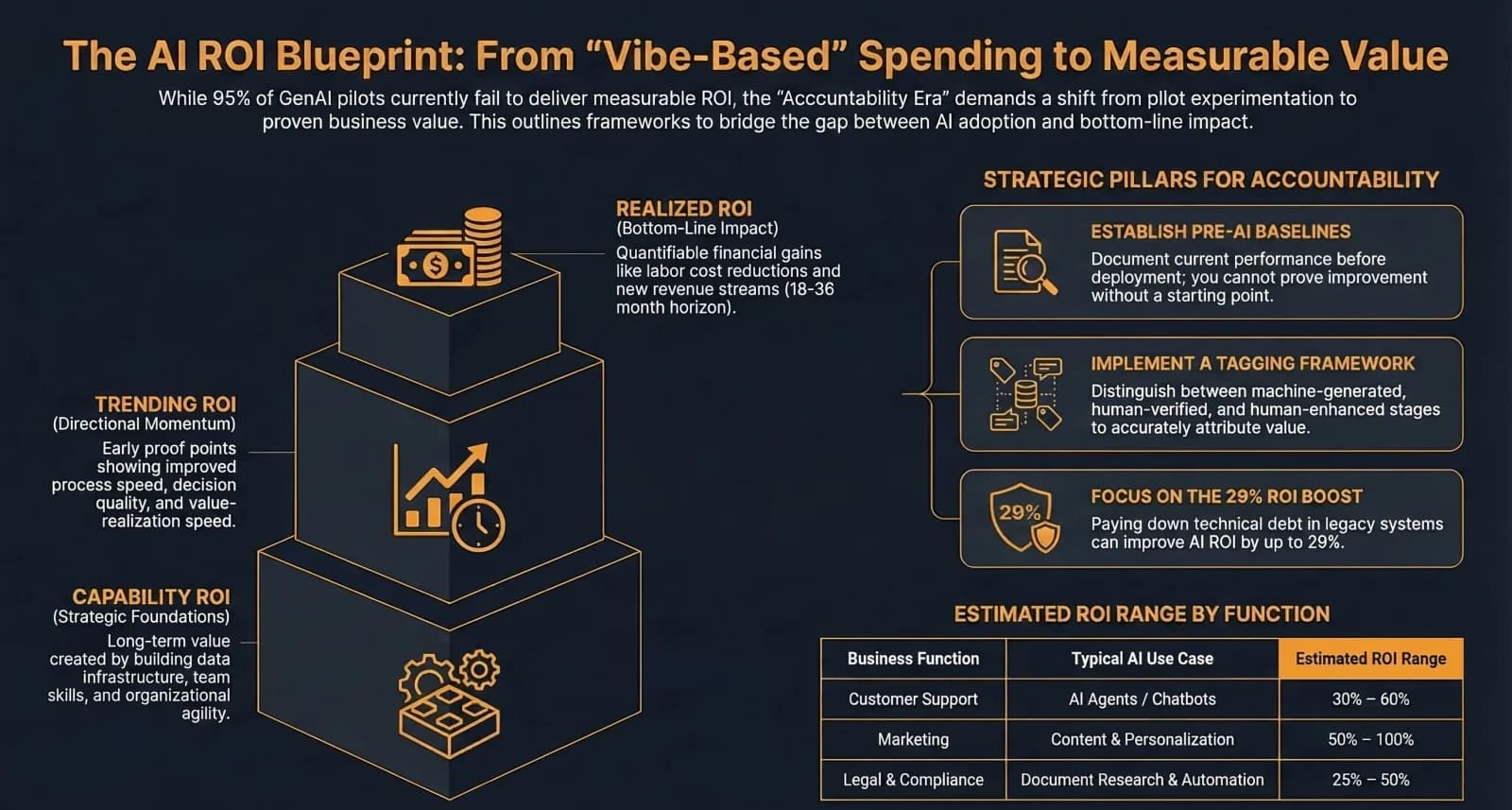
Quick Answer
Measuring AI ROI requires three steps most businesses skip: establishing baselines before implementation, defining specific KPIs tied to business outcomes (not AI metrics), and tracking time-to-value rather than just total return. The most common wins are 25-50% time savings on repetitive tasks, 30% operational cost reduction in customer service and data processing, and 15-20% revenue increases from improved lead conversion and customer retention. The businesses that see returns in 90-180 days are the ones that start with a single high-volume process and measure obsessively.
Key Answers
- How long does it take to see ROI from AI automation?
- Well-scoped AI automation projects deliver measurable ROI in 90-180 days. The key is starting with high-volume, repetitive processes where time savings translate directly to cost reduction — like invoice processing, customer support triage, or data entry.
- What metrics should I track for AI ROI?
- Track three categories: efficiency (hours saved per week, processing time reduction), cost reduction (labour reallocation, error elimination, penalty avoidance), and revenue impact (conversion rate improvement, customer retention, upsell identification). Avoid vanity metrics like model accuracy in isolation.
- Why do 95% of AI projects fail to deliver ROI?
- Most AI projects fail because they lack baseline measurements, chase technology instead of business outcomes, scope too broadly, or skip the change management needed for team adoption. Starting with a single process and clear success metrics eliminates these failure modes.
- How much does AI automation typically save?
- AI automation typically saves 25-50% of time on repetitive tasks, reduces operational costs by 30% in functions like customer service and data processing, and improves revenue by 15-20% through better lead handling and customer retention.
Key Takeaways
- AI automation delivers ROI in 90-180 days when scoped to a single high-volume process with clear baseline measurements.
- 95% of AI projects fail — not because the technology does not work, but because businesses skip baselines, scope too broadly, or chase AI for its own sake.
- The three ROI categories to track are efficiency (time saved), cost reduction (labour and error costs), and revenue impact (conversion and retention improvements).
- Baseline measurement is non-negotiable: document current process times, error rates, and costs for at least 30 days before implementing any AI automation.
- The highest-ROI AI implementations target customer service (30% cost reduction), invoice processing (75% time reduction), and lead qualification (20% conversion improvement).

Why Do 95% of AI Projects Fail to Deliver ROI?
The statistic sounds dramatic, but it is consistent across multiple industry reports: the vast majority of AI projects do not deliver measurable business value. The technology is not the problem. The problem is how businesses approach AI — they chase the technology instead of the outcome.
The most common failure pattern is starting without baselines. A business implements AI-powered customer support, sees that the chatbot resolves some tickets, and declares success — without knowing how many tickets were resolved manually before, at what cost, or with what quality. Without a before picture, there is no way to calculate ROI.
The second failure pattern is scoping too broadly. A business tries to automate everything at once — customer service, sales, operations, reporting — and ends up with a sprawling project that takes 12 months and delivers marginal improvements across too many areas to measure. The businesses that succeed start with a single process and measure obsessively.
What Are the Three Categories of AI ROI?
Every AI automation project delivers value in one or more of three categories: efficiency gains (time saved), cost reduction (expenses eliminated), and revenue impact (income increased). The most successful implementations target all three, but you should measure them separately to understand where the value is coming from.
Efficiency gains are the easiest to measure and the fastest to realise. AI-powered invoice processing reduces handling time by 75%, customer support triage cuts response time by 60%, and document data extraction eliminates 5-10 hours per week of manual entry. Track hours saved per week and multiply by the loaded hourly cost of the employees whose time is freed up.
Cost reduction includes direct savings (eliminated software licenses, reduced staffing needs for routine tasks) and indirect savings (fewer errors leading to less rework, no late payment penalties, reduced customer churn from faster response times). The industry average for AI-driven cost reduction in customer service operations is 30%.
Revenue impact is the hardest to attribute directly but often the most valuable. AI-powered lead scoring improves conversion rates by 15-20%. Automated follow-up sequences recover 10-15% of leads that would otherwise go cold. Personalised customer communication increases retention by 25%. These gains compound over time as the AI system learns from more data.
How Do You Establish Baselines Before Implementing AI?
Baseline measurement is the single most important step in AI ROI — and the one that businesses most commonly skip. Without baselines, you are guessing at the value of your AI investment. Track the following metrics for at least 30 days before implementing any automation.
For time-based processes: average time per task, number of tasks per day or week, peak versus off-peak volumes, and time spent on exceptions versus routine handling. For cost-based processes: labour cost per task (hourly rate times time per task), error rate and cost per error, and any penalty costs from delays. For revenue-related processes: current conversion rate, average response time to leads, customer retention rate, and average deal value.
Document these numbers in a spreadsheet that you will revisit monthly after implementation. The comparison should be apples to apples — same time period, same volume, same team. If your business is seasonal, baseline during a representative period and adjust for seasonality in your ROI calculations.
What Does a 90-Day AI ROI Framework Look Like?
Days 1-30: Baseline and build. Measure current performance while the AI system is being developed. This is not wasted time — it is the foundation for every ROI calculation that follows. During this phase, define your success metrics: what specific numbers need to change, by how much, for this project to be worth the investment.
Days 31-60: Deploy and measure. Launch the AI automation alongside the manual process (parallel running). Track the same metrics for the automated process. Common issues surface during this phase — edge cases the AI handles poorly, integration gaps, team adoption friction. Fix them in real time.
Days 61-90: Optimise and calculate. By now you have 30 days of baseline data and 30 days of automated data. Compare them directly. Calculate: time saved per week times hourly labour cost equals efficiency ROI; errors eliminated times cost per error equals cost reduction ROI; any revenue impact (leads converted, deals closed faster) equals revenue ROI. Total ROI equals the sum of all three categories minus the cost of the AI system.
What Are the Highest-ROI AI Automation Use Cases?
The use cases with the fastest, most measurable ROI share two characteristics: high volume and clear metrics. Customer service automation delivers 30% cost reduction by handling 60-80% of tier-1 queries without human intervention. Invoice and document processing delivers 75% time reduction. Lead qualification and scoring improves conversion by 15-20%.
For SMBs doing $500K-5M annually, the sweet spot is internal operations automation. Report generation, data entry, appointment scheduling, and approval workflows are all processes where AI can save 25-50% of staff time within 90 days. These are not moonshot projects — they are practical, measurable improvements that pay for themselves quickly.
How Should a Small Business Start Measuring AI ROI?
Pick one process. Just one. Choose the process that is highest-volume, most repetitive, and easiest to measure. Document how it works today — every step, every person involved, every minute spent. This is your baseline.
Define success before you build anything. "We want AI to help with customer support" is not a success metric. "We want to reduce average first-response time from 4 hours to 15 minutes and resolve 60% of tier-1 tickets without human involvement within 90 days" is a success metric. The specificity matters because it tells you exactly what to measure and when you have achieved it.
Budget for measurement alongside implementation. Allocate 10-15% of your AI project budget specifically for measurement infrastructure — dashboards, tracking, and the time to analyse results. The businesses that measure obsessively are the ones in the 5% that succeed.
Research Data
Key strategies and factors based on original research
| Business Function | AI Use Case | Baseline Measurement | Hard ROI KPIs | Soft ROI KPIs | Expected Returns (Inferred) | Payback Period |
|---|---|---|---|---|---|---|
| Customer Support | Triage, response automation, and luxury travel chatbots | Human-handled leads and 50,000 tickets/month (12 mins/ticket at $35/hr) | $1.4M annual savings, 40% automated resolution rate, and high-value booking revenue (€70,000) | Improved CSAT, 24/7 availability, and increased agent satisfaction | 30-250% ROI | Less than 12-18 months |
| Sales | AI research tools for deal preparation | Manual research time per week per person prior to tool access | $585,000 annual productivity value and improved win rates | Pipeline qualification accuracy and customer lifetime value | 290% ROI | 3-6 months |
| Marketing | AI-generated copy or keyword clusters | Human-only output performance (A/B testing) | Traffic, engagement, conversions, and cost per qualified outcome | Optimization directional metrics | 20-40% reduction in acquisition costs | Less than 6 months |
| Finance / Accounting | Automated reconciliation and fraud detection | Manual reconciliation time (measured in hours vs. minutes) | Labor cost reduction, error reduction, and fraud prevention savings | Capacity for corporate strategy-sensing and decision speed | 20-35% estimated ROI | Less than 6 months |
| Legal | AI-assisted obligation research | Manual legal research time at average attorney cost per hour | Up to 60% reduction in time spent and labor cost savings | Decision quality, accuracy, and research efficiency | 25-50% estimated ROI | 12-24 months |
| Manufacturing | Predictive maintenance and quality inspection | Historical frequency of machine failure and manual labor hours | Reduced machine failure, extended asset life, and labor reduction | Improved product quality and operational stability | 20-60% estimated ROI | 18-30 months |
| Logistics / Supply Chain | Route optimization and inventory forecasting | Pre-AI fuel/transportation costs and stockout frequency | Lower transportation costs, reduced stockouts, and higher average order value (AOV) | Supply chain resilience and brand enhancement | 35-55% estimated ROI | 18-30 months |
Original research by ManaTech
Frequently Asked Questions
What is the best first AI automation project for measuring ROI?
Start with a process that is high-volume, repetitive, and currently handled manually. Invoice processing, customer support email triage, and data entry from documents are ideal because they have clear before-and-after metrics — processing time, error rate, and cost per transaction. Avoid starting with complex, judgment-heavy processes.
How do I establish baselines before implementing AI?
Track the current process for 30 days minimum. Measure: average time per task, number of tasks per day, error rate, cost per task (labour plus overhead), and any downstream costs from errors (late payment penalties, customer churn, rework). These numbers become your comparison point for ROI calculation.
Should I measure AI ROI differently from other technology investments?
The framework is the same — cost savings plus revenue impact minus investment — but AI has two unique considerations. First, AI systems improve over time as they learn from data, so ROI accelerates after the first 90 days. Second, AI often enables capabilities that were previously impossible (like processing 1,000 invoices per hour), so pure cost comparison understates the value.
What is a realistic AI automation budget for a small business?
For a focused AI automation project (single process), expect $15,000-30,000 for the initial build and $1,000-2,000 per month for maintenance and model updates. A well-scoped project targeting a process that costs $5,000 or more per month in labour typically pays for itself within 4-6 months.
How do I avoid the 95% failure rate for AI projects?
Four rules: (1) Start with a business problem, not an AI solution — define what you want to improve before choosing technology. (2) Measure baselines obsessively. (3) Scope the first project to a single process with a 90-day timeline. (4) Define success as a specific business metric improvement, not model accuracy or technology sophistication.
Think You've Got It?
10 questions to test your understanding — instant feedback on every answer
Question 1 of 10
According to the IBM and MIT reports cited in the text, what percentage of generative AI pilots are reportedly failing to deliver measurable results?
Question 2 of 10
In the Three-Tier AI ROI Framework, which tier is primarily concerned with strategic option value and the development of foundations like data infrastructure?
Question 3 of 10
What does the term 'vibe-based spending' refer to in the context of enterprise AI investment?
Question 4 of 10
According to research from Larridin, which 'Pillar of Risk' describes a situation where high usage rates hide the fact that no actual productivity is being gained?
Question 5 of 10
Which of the following is identified as a primary reason why AI ROI is harder to calculate than traditional IT ROI?
Question 6 of 10
What is 'impact chaining', as described by experts from StarApple AI and Wolters Kluwer?
Question 7 of 10
According to IBM research, paying down technical debt from legacy systems can improve AI ROI by what percentage?
Question 8 of 10
Which specific KPI is suggested for measuring the 'speed' or efficiency of an AI transition from experimental to value-producing?
Question 9 of 10
In the Larridin Measurement Maturity Path, which stage is characterised by the use of automated platforms and real-time dashboards?
Question 10 of 10
According to the CFO's framework, what is the 'Core AI ROI Formula' for evaluating a project?
Related Content
5 AI Quick Wins Any Business Can Implement This Quarter
You do not need a six-figure budget or a data science team to start using AI. These five practical automations can be running inside your business within weeks — saving 15-30 hours per month and paying for themselves in the first quarter.
Read more →blog5 Revenue-Generating AI Automations Every Growing Business Needs
Five high-ROI AI automations that directly impact revenue, from intelligent lead scoring to automated analytics reporting. Each one pays for itself within weeks.
Read more →blogHow AI Skills Are Replacing SOPs for Small Businesses
Most small businesses run on scattered Google Docs and tribal knowledge. AI skills turn your standard operating procedures into executable, version-controlled workflows that improve every time they run.
Read more →blogWhat Is an AI Operating System and Why Does Every SMB Need One?
Most businesses using AI are still bolting on individual tools one at a time. An AI Operating System flips the model: context first, integrations second, automations built on top. The result is a business that runs on AI instead of just using it.
Read more →blogAI for NZ Accountants: The Practitioner’s Guide to 2026
New Zealand accounting practices run on Xero, MYOB, and a 31 March financial year. The AI tools built for US firms ignore those constraints. This is the practical guide for NZ practitioners — what to automate first, which integrations matter, and what an AI-powered practice actually costs to build in 2026.
Read more →Want to explore this topic further?
Book a free discovery call to discuss how ManaTech can help your business implement these ideas.
Book a Discovery Call