
AI for NZ Healthcare Clinics: A Practitioner’s Guide for 2026
Quick Answer
AI in NZ healthcare clinics in 2026 is no longer experimental — it is operational. Ambient AI scribes (Heidi Health, Medtech AI, Dragon Medical Copilot, IntelliTek Health) save NZ clinicians between 3 and 10 minutes per patient, with Heidi formally endorsed by Te Whatu Ora and rolled out across the public hospital system. The right starting point for most private clinics is an AI scribe that integrates natively with their Practice Management Software (Medtech Evolution, Indici), runs human-in-the-loop review of every note, stores data inside New Zealand, and explicitly complies with the Health Information Privacy Code 2020 plus the new IPP3A obligations that took effect on 1 May 2026.
Key Answers
- Is AI legal for use in NZ healthcare clinics in 2026?
- Yes, but conditionally. Te Whatu Ora has formally endorsed four AI scribes for clinical use, and the Health Information Privacy Code 2020 plus the new IPP3A obligation (in force from 1 May 2026) govern how patient data may be processed. Identifiable health information cannot be put into a generic generative AI tool.
- How much time does an AI scribe save an NZ clinician?
- Between 3 and 10 minutes per patient. Hawke’s Bay Hospital reports up to 10 minutes per ED patient using Heidi. Island Bay Medical Centre saves 2 to 5 minutes per consult using IntelliTek Health. Medtech AI users report 6 to 8 minutes per encounter.
- Which AI scribes are endorsed by Te Whatu Ora?
- Four ambient AI scribes are formally endorsed for clinical use in NZ. Heidi Health is the most widely deployed, used in all 16 emergency departments and across private GP clinics. Medtech AI is the option for practices already on Medtech Evolution.
- Does an AI scribe integrate with Medtech Evolution or Indici?
- Yes. Medtech AI integrates natively with Medtech Evolution via Medtech ALEX, posting transcripts, screening measurements, diagnoses, and tasks back into the patient record automatically. Rule-based robots have been trialled with Indici-using GPs.
- What is the biggest mistake NZ clinics make adopting AI in 2026?
- Treating it as a single procurement decision rather than a workflow integration. The clinics seeing the biggest gains start in one high-burden area (mental health, ED, or primary care), train clinicians on the editing workflow, and only expand once the human-in-the-loop discipline is embedded.
Key Takeaways
- Heidi Health is one of four AI scribes formally endorsed by Te Whatu Ora, deployed across all 16 NZ public emergency departments and saving up to 10 minutes per patient in ED settings.
- Medtech Global launched Medtech AI on 23 February 2026 — the first AI scribe natively integrated with Medtech Evolution, with no copy-and-paste workflow required.
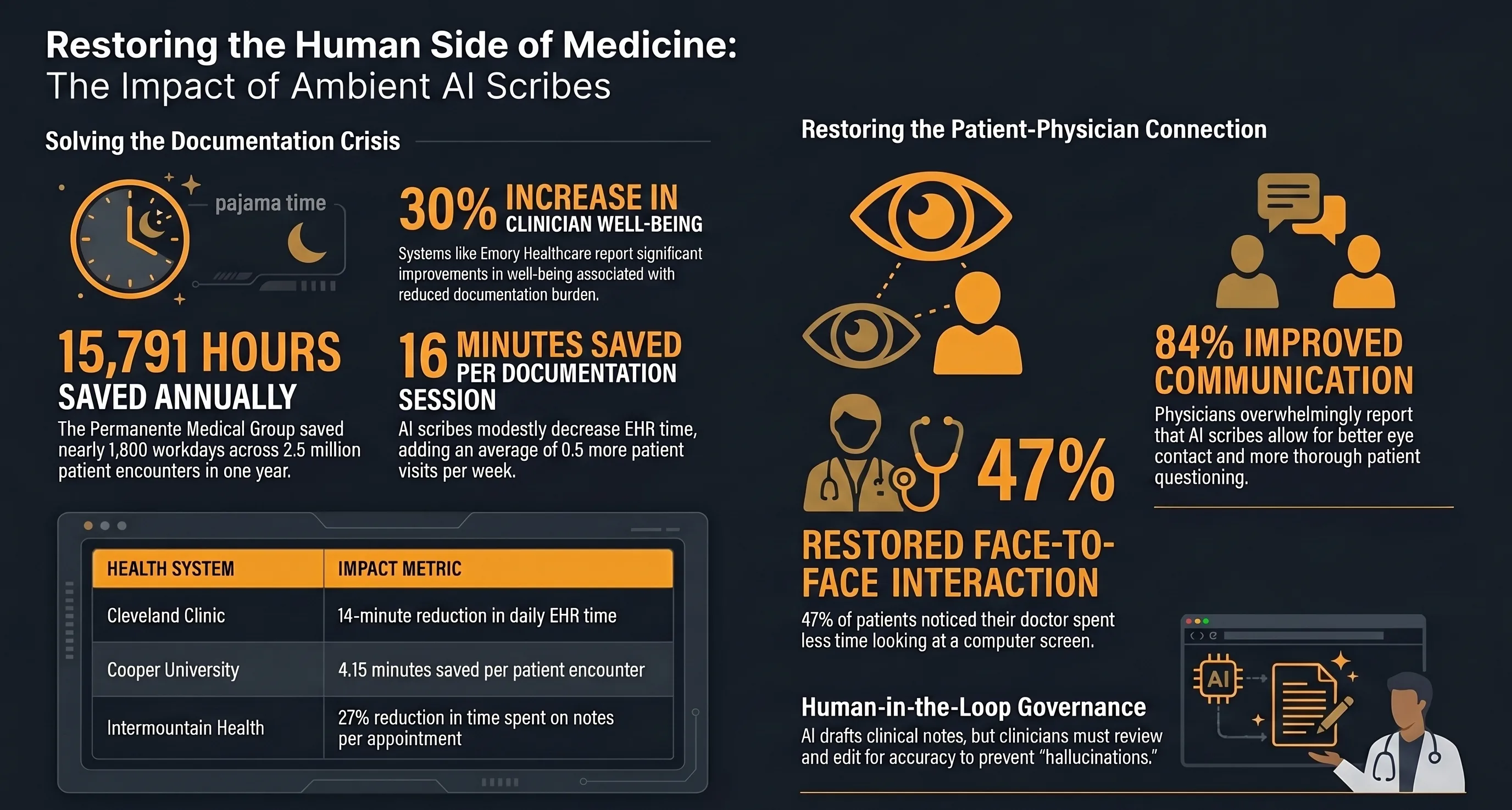
- Mass General Brigham recorded a 21.2% reduction in clinician burnout after 84 days of ambient AI scribe use (JAMA 2025), and TPMG saved 15,791 hours of documentation across 2.5 million patient encounters in a single year.
- The Privacy Amendment Act 2025 introduced IPP3A which came into force on 1 May 2026; using identifiable health information in a generic generative AI tool is now almost certainly a breach of the Health Information Privacy Code 2020.
- About half of NZ GPs are already using some form of AI scribe in 2026 — the question for clinic owners is no longer whether to adopt but which tool, in which workflow, and under which clinical governance policy.
Why Are NZ Healthcare Clinics Adopting AI in 2026?
Because clinical documentation is the single biggest driver of clinician burnout in NZ — and AI scribes have moved from pilot to formally endorsed Te Whatu Ora technology in under twelve months.
NZ healthcare is in the middle of a documentation crisis. The work-after-work phenomenon known internationally as "pajama time" — charting, completing notes, finishing referrals — is the most cited driver of burnout among GPs, specialists, and ED clinicians. Clinicians are leaving the workforce, and the clinics that retain them are the ones removing the documentation overhead. AI scribes are the first AI category that has shown a measurable, repeatable improvement in this exact bottleneck.
The 2026 NZ adoption story is unusually fast. By early 2026 about half of New Zealand GPs reported using some form of AI scribe. Health New Zealand—Te Whatu Ora has formally endorsed Heidi Health for clinical use following a privacy, security, and National AI and Algorithm Expert Advisory Group (NAIAEAG) review, and is rolling Heidi out across all 16 public emergency departments. Medtech Global launched Medtech AI on 23 February 2026 — the first AI scribe natively integrated with Medtech Evolution, the dominant NZ practice management software. Rule-based robots have started appearing inside Indici-using GP clinics. Private healthcare adoption is now leading the public system.
For a clinic owner, the strategic question has shifted. The 2024 question was "should we trial AI?" The 2026 question is "which tool, in which workflow, and under which clinical governance policy?" The answer determines whether AI delivers the documented 3 to 10 minutes per patient that Hawke’s Bay Hospital and Island Bay Medical Centre are reporting, or whether it sits unused on the licence shelf. Most other AI use cases for NZ clinics build on top of the scribe foundation — see our breakdown of AI quick wins any business can implement this quarter for the broader pattern of starting small and stacking outcomes.
What Are AI Scribes and Why Are They the First Wave?
An AI scribe passively listens to the patient consultation and produces a structured clinical note in the format the clinician already uses. The scribe replaces the keyboard — not the clinician.
An ambient AI scribe is fundamentally different from a transcription tool. A transcription tool produces a verbatim record of the conversation that still needs to be read, summarised, and re-typed into the patient record. An ambient AI scribe captures the consultation, identifies the clinically meaningful content, and writes a structured SOAP-format note (Subjective, Objective, Assessment, Plan) in the template the clinician already uses — with screening measurements, ICD-10 codes, and follow-up tasks already populated. The clinician reviews, edits where needed, and signs.
Three things make this the first wave of clinical AI adoption rather than the third or fourth. First, the value is immediate and measurable: minutes per patient saved, with a direct line to clinician retention and revenue. Second, the risk profile is contained: AI is producing documentation that a clinician reviews before it enters the EHR, not making clinical decisions. Third, the technology now integrates natively with NZ practice management software — Medtech AI posts back into Medtech Evolution via the Medtech ALEX interface, which means no copy-and-paste, no parallel system, no "another login." This is the integration step that turned scribes from a curiosity into a workflow.
The international evidence has hardened in the last twelve months. The Permanente Medical Group (TPMG) reported saving 15,791 hours of documentation across 2.5 million patient encounters in a single year, with 82% of clinicians reporting improved work satisfaction. Mass General Brigham recorded a 21.2% reduction in burnout prevalence after 84 days of utilisation (JAMA 2025). Emory Healthcare recorded a 30.7% increase in documentation-related well-being. NZ-specific data is now matching that pattern: Hawke’s Bay Hospital is saving up to 10 minutes per patient using Heidi, and Island Bay Medical Centre is saving 2 to 5 minutes per consult using IntelliTek Health. The compounding effect is significant — in a busy 10-hour ED shift, 10 minutes per patient is 10 to 20 additional patients seen.
Which AI Scribes Are Endorsed for Use in New Zealand?
Four AI scribes are formally endorsed by Te Whatu Ora for clinical use. Heidi Health, Medtech AI, Dragon Medical Copilot, and IntelliTek Health each fit a different clinic profile.
Heidi Health is the most widely deployed AI scribe in NZ as of 2026. It is one of four ambient AI scribes formally endorsed by Health New Zealand—Te Whatu Ora following privacy, security, and NAIAEAG review. The Enterprise version is the endorsed product (not the free version). Heidi is being rolled out across all 16 public emergency departments, with Hawke’s Bay Hospital among the first deployment sites. Health Accelerator has partnered with Heidi to offer exclusive pricing for member clinics, and Heidi launched its "Evidence" feature in 2026 — a citation-backed clinical guidelines lookup that runs inside the consultation workflow rather than requiring a separate UpToDate or BMJ Best Practice search.
Medtech AI is the choice for any clinic already on Medtech Evolution. Launched on 23 February 2026 by Medtech Global, Medtech AI is the first AI scribe natively integrated with the Evolution practice management software — transcripts, screening measurements, diagnoses, and tasks post automatically back into the patient record via the Medtech ALEX interface. Audio is processed in real time and discarded after the transcript is generated, with no audio files retained. For NZ practices on Evolution, this is the lowest-friction adoption path because there is no separate login, no copy-and-paste, and no second system to maintain.
Dragon Medical Copilot, the successor to Nuance DAX, sits at the enterprise end of the market. International deployments include Cooper University Healthcare (4.15 minutes saved per patient, approximately one hour per clinician per day), Mercy (two hours of charting saved per nurse per 12-hour shift), and Intermountain Health (27% reduction in time spent on notes per appointment for high-frequency users). Dragon is typically the choice for hospital systems with existing Microsoft and Epic infrastructure rather than for small private clinics. IntelliTek Health is the lighter-weight alternative being used at Island Bay Medical Centre and other NZ general practices, saving 2 to 5 minutes per consult with a simpler operational footprint.
Beyond the scribe category, NZ clinics are increasingly using general-purpose AI — typically Claude or ChatGPT — for non-clinical administrative work like SOP drafting, reception scripts, and HR documentation. Our breakdown of which AI tool wins for each specific business task is directly applicable to clinic operations — the same hybrid stack pattern that 70% of growing professional services firms now use applies cleanly to a 4-clinician GP practice.
How Much Time Can a NZ Clinic Actually Save With an AI Scribe?
Between 3 and 10 minutes per patient encounter, with the largest gains accruing to high-frequency users in documentation-heavy specialties.
NZ-specific deployments report a tight band of 3 to 10 minutes saved per patient. Hawke’s Bay Hospital reports up to 10 minutes per emergency department patient using Heidi — the highest end of the range, driven by the heavy documentation burden in ED. Island Bay Medical Centre reports 2 to 5 minutes per consult using IntelliTek Health in general practice. Medtech AI users report 6 to 8 minutes per encounter. Dragon Medical Copilot deployments internationally average around 4.15 minutes per patient. The variation is driven by specialty, by individual clinician usage patterns, and by how natively the scribe integrates with the existing note template.
The "dose-response" finding from the 2025 JAMA evidence base is critical for a clinic implementation plan. Time savings are not evenly distributed — the top third of users (those who use the scribe on the majority of their consultations) see roughly double the savings of low-frequency users. The implication for a clinic owner is that training matters more than tooling. A clinic that buys five Heidi licences and gives them out without an editing-workflow training session will see the bottom-third pattern: clinicians find editing the AI output slower than typing from scratch, abandon the tool, and the licence sits unused.
The patient-experience side of the time saving is just as important as the throughput side. In the TPMG study, nearly half of patients reported their doctor spent less time on the computer during the visit, and 56% reported a positive impact on the quality of the visit. Eye contact, active listening, and nuanced questioning all improve when the clinician is not splitting attention between the keyboard and the patient. For a NZ general practice competing on relationship and continuity, this qualitative shift is often a stronger retention argument than the raw minutes saved.
What Does the NZ Health Information Privacy Code Require for AI in Clinics?
Identifiable patient information cannot be put into a generic generative AI tool. The Health Information Privacy Code 2020, plus the new IPP3A obligations from 1 May 2026, govern every AI deployment in a NZ clinic.
The regulatory baseline for AI in NZ healthcare is the Health Information Privacy Code 2020 (HIPC 2020), administered by the Office of the Privacy Commissioner. The Privacy Amendment Act 2025 introduced Information Privacy Principle 3A (IPP3A), which came into force on 1 May 2026, and the Privacy Commissioner amended HIPC 2020 in March 2026 to reflect IPP3A. The practical consequence for a clinic owner is that any AI tool that processes identifiable patient data is now squarely inside the regulatory perimeter — and "we did not realise the AI tool was processing patient information" is not a defensible position.
Te Whatu Ora’s NAIAEAG (National AI and Algorithm Expert Advisory Group) has issued explicit guidance: using identifiable health information in a generic generative AI tool will almost certainly be a breach of privacy unless the patient has authorised the specific use, or the use is "directly related" to the reason the information was originally collected. In plain language: pasting a de-identified case discussion into ChatGPT for a second opinion is a different conversation from pasting a patient’s notes into a generic chatbot. The first may be defensible; the second is not.
The four endorsed AI scribes have been reviewed against this baseline. Heidi uses two-factor authentication, de-identification of data, and high-level encryption. Medtech AI processes audio in real time and discards it immediately after transcript generation, storing no audio files. Both prioritise NZ data residency in their Enterprise contracts. The clinic owner’s job is to confirm the data residency clause, the retention policy, and the audio handling policy before signing — and to maintain a written clinical governance policy that mandates clinician review of every AI-generated note before it enters the EHR. The "human in the loop" is not optional under HIPC 2020; it is the structural protection that makes AI use defensible.
What Comes After AI Scribes — The "AI Care Partner"?
The next wave is AI that handles communications, evidence lookup, and post-visit follow-up — not just documentation. The risk profile is higher and the governance bar rises with it.
Heidi CEO Dr Tom Kelly’s 2026 keynote framed the next wave as the move from "AI Scribe" to "AI Care Partner." The Care Partner concept extends AI from the consultation note to the surrounding workflow: inbound and outbound phone calls, appointment booking, post-visit summaries adjusted for the patient’s health literacy, evidence integration during the consult, and even purpose-built clinical hardware. Heidi’s "Evidence" feature pulls citation-backed clinical guidelines into the workflow without leaving the consult. Heidi Remote is a 360-degree omnidirectional microphone designed to be worn on a lanyard with 14-hour battery life and encrypted offline storage — built specifically for connectivity-dead zones like hospital basements and rural NZ practices where mobile reception fails.
The clinical governance bar rises sharply at this layer. Wellington GP Richard Medlicott has publicly cautioned that "AI scribes sometimes hallucinate terribly, and just get things wrong... that is the next stage, it’s happening now, but it is higher risk than AI scribes." The risk shifts from "the note may have a typo" to "the AI may suggest a treatment path that is wrong." Anglicare Victoria CTO Dean Mills has reported the opposite outcome — caseworkers describing the AI tool as so embedded in their workflow that "my life could be at risk if I take it away" — which underlines how rapidly dependency builds once the tool is integrated. Both ends of that range need to be designed for: high adoption, high dependence, high governance.
Outside the clinical perimeter, the AI Care Partner overlaps with general business AI. Practice management tasks — SOP drafting, front-desk phone scripts, HR documentation, patient communication templates — are increasingly being built using tools like Claude AI, which is well suited to long-document work and the brand-voice consistency a clinic needs across patient communications. Our explainer on how Claude Skills are replacing SOPs for small businesses applies directly to a clinic that wants its reception team, its locum cover, and its night-call triage to all follow the same documented procedures without binders of paperwork.
How Should a NZ Clinic Choose Its First AI Tool?
Pick one high-burden area, one endorsed scribe that integrates natively with the existing PMS, and one written clinical governance policy. Start with a small cohort, train on the editing workflow, and only expand once the dose-response pattern is established.
The decision tree for an NZ clinic in 2026 is narrower than it looks. If the clinic runs Medtech Evolution, Medtech AI is the lowest-friction starting point because of the native ALEX integration. If the clinic does not run Medtech Evolution, Heidi Health Enterprise is the default — the broadest endorsement, the largest deployment footprint, and the most mature feature set. Dragon Medical Copilot is for hospital-scale deployments with existing Microsoft and Epic infrastructure. IntelliTek Health is a viable alternative for general practices wanting a lighter operational footprint than Heidi. The free version of Heidi is not the endorsed version and is not the right starting point for a clinic operating under HIPC 2020.
Pick one starting area, not five. The international evidence is consistent: the clinics with the cleanest AI adoption stories started with a small cohort — typically 100 clinicians, or in a small-clinic NZ context, two or three GPs in a single practice — in a documentation-heavy specialty (mental health, primary care, emergency medicine). Train on the editing workflow before measuring time savings. Establish a written clinical governance policy that mandates clinician review and forbids the input of identifiable patient information into any non-endorsed AI tool. Only expand to additional clinicians once the high-frequency-user pattern is established. Skipping the training step is the single most common reason an AI scribe rollout fails.
A final thought on procurement. AI scribes are licensed per clinician per month, in a market where every clinic is already paying multiple PMS, billing, and digital health subscriptions. Adding a new tool needs to be measured against the whole stack, not just against zero — our piece on the hidden cost of SaaS sprawl applies to clinics as much as to any other small business. The right question is not "can we afford another subscription?" but "which existing subscription does the AI replace, and is the time saved worth the integration overhead?"
What Is the Bottom Line?
AI for NZ healthcare clinics in 2026 is operational, regulated, and fast-moving. Pick one endorsed scribe, integrate it natively with your PMS, train on the editing workflow, and govern it under HIPC 2020. The 3 to 10 minutes per patient is real — but only for the clinics that treat AI as a workflow change, not a software purchase.
The story for NZ clinics in 2026 is not whether AI works — the Te Whatu Ora endorsement, the Hawke’s Bay deployment, the Medtech Evolution integration, and the JAMA evidence base have closed that question. The story is which clinics will get the dose-response benefit and which will not. The clinics that win in the next twelve months are the ones that pick one endorsed scribe, integrate it natively with their existing practice management software, train clinicians on the editing workflow before counting minutes saved, and write a clinical governance policy that satisfies HIPC 2020 and the new IPP3A obligations from 1 May 2026. The clinics that do not will watch their burnout numbers stay flat while a competitor down the road runs an extra two patients an hour.
Research Data
Key strategies and factors based on original research
| tool name | primary use case | NZ availability | integration with PMS | pricing model | Te Whatu Ora endorsement status | time-saved per patient |
|---|---|---|---|---|---|---|
| Heidi Health | Ambient AI clinical documentation and AI care partner (transcription, summaries, and communications automation) | Available nationwide; rolled out across all public hospitals and used by private clinicians | Integrated via copy and paste; also integrates with various medical records | Freemium (Free version or Enterprise-funded) | Formally endorsed by Health New Zealand (Te Whatu Ora) | 3 to 10 minutes |
| Medtech AI | Ambient AI clinical documentation, patient summaries, and referral letter generation | Available for New Zealand practices using Medtech Evolution | Natively integrated with Medtech Evolution via Medtech ALEX | Subscription-based (requires Medtech Evolution) | Not in source | 6 to 8 minutes |
| Dragon Medical Copilot | Ambient AI clinical documentation (ambient scribe) | Used in various health systems; successor to Nuance DAX | Integrates with EHR systems such as Epic | Enterprise-funded / Subscription-based | Not in source | 4.15 minutes |
Original research by ManaTech
Frequently Asked Questions
What is an ambient AI scribe and how is it different from a normal transcription tool?
An ambient AI scribe passively listens to the entire patient consultation and produces a structured clinical note (history, examination, assessment, plan) in the format the clinician already uses. A traditional transcription tool produces a verbatim transcript that still needs to be read, summarised, and re-typed into the note template. Ambient scribes also handle screening measurements, diagnoses codes, and task creation — not just text.
Can NZ patients refuse to be recorded by an AI scribe?
Yes, and they must be given that choice. The Privacy Commissioner’s expectation under the Health Information Privacy Code 2020 is that patients are informed AI is being used, that consent is sought before recording, and that opting out does not affect the standard of care. Heidi and Medtech AI both process audio in real time and discard it after the transcript is generated, which materially reduces the consent and storage risk.
How accurate are AI scribes — do they hallucinate clinical content?
They can. Wellington GP Richard Medlicott has publicly noted that AI scribes "sometimes hallucinate terribly, and just get things wrong" — errors are infrequent but real, which is why the standard NZ requirement is that the clinician reviews, edits, and approves every AI-generated note before it is signed into the EHR. AI is a documentation assistant, not a clinical decision-maker. The risk profile climbs sharply when AI outputs move from documentation to advice.
Where is the patient data stored — inside NZ or offshore?
It depends on the vendor and the contract. Te Whatu Ora’s endorsement process explicitly considers data sovereignty, and there is growing demand for "sovereign" storage that keeps NZ patient data inside NZ borders. Heidi’s Enterprise version (the one endorsed by Te Whatu Ora) prioritises this; the free version does not. Medtech AI processes audio in-flight and stores no audio files. Always confirm the data residency clause and the retention policy in the contract before signing.
What does AI for an NZ clinic cost in 2026?
Heidi Health is freemium with an Enterprise tier that Te Whatu Ora has negotiated exclusive pricing on through Health Accelerator for member clinics. Medtech AI is subscription-based and bundled into the Medtech Evolution licence. Dragon Medical Copilot is enterprise-priced and typically negotiated per-seat. For a small private GP clinic of 4–6 clinicians, expect total AI scribe spend in the NZD 200–800 per clinician per month range, which pays back inside the first month on time saved alone.
Beyond AI scribes, what else can a NZ clinic actually use AI for in 2026?
Practice management is the next layer up. Tools like Claude AI are being used for non-clinical administrative work — drafting Standard Operating Procedures, front-desk phone scripts, HR documentation, and patient communication templates. Heidi’s "Evidence" feature pulls citation-backed clinical guidelines into the consult workflow. AI-driven appointment booking, post-visit summaries adjusted for health literacy, and inbound call triage are all in active deployment in NZ private healthcare.
Think You've Got It?
10 questions to test your understanding — instant feedback on every answer
Question 1 of 10
According to reports from emergency physicians in New Zealand, how much time can the AI scribe 'Heidi' save per patient consultation?
Question 2 of 10
Which specific interface is used to natively integrate Medtech AI with the Medtech Evolution Practice Management Software in New Zealand?
Question 3 of 10
Under the New Zealand Health Information Privacy Code, what is a mandatory requirement for clinicians before using an ambient AI scribe to record a consultation?
Question 4 of 10
The Permanente Medical Group's analysis of AI scribe implementation found that 'high users' experienced which of the following outcomes?
Question 5 of 10
What is a common pitfall when implementing AI tools like Claude in a healthcare practice according to operational experts?
Question 6 of 10
Which factor was identified as the primary driver for Health New Zealand (Te Whatu Ora) endorsing the national rollout of AI scribes like Heidi?
Question 7 of 10
What technological advantage does Medtech AI claim regarding its impact on clinic network infrastructure compared to some competitors?
Question 8 of 10
How does the 'Heidi Remote' hardware solve common issues associated with using mobile phones for ambient scribing?
Question 9 of 10
What phenomenon in AI, as mentioned by Dr John Bonning, describes the generation of false or illogical information in clinical notes?
Question 10 of 10
According to the study at Cleveland Clinic, AI scribes from Ambience reduced the average time clinicians spent writing and reviewing notes by how much each day?
Related Content
Your Website Is Invisible to AI Search — Here Is How to Fix It
AI search engines like ChatGPT, Perplexity, and Gemini cannot read most business websites. If your site relies on client-side JavaScript rendering, you are invisible to the fastest-growing traffic source on the web.
Read more →blogAI Search Sends Businesses 10x More Revenue Per Click
AI-driven traffic accounts for less than 1% of visits but generates up to 11.4% of revenue. The data shows that every AI click is worth dramatically more than a traditional search click.
Read more →blogHow to Get Your Business Cited by ChatGPT
AI citations are the new backlinks. Branded web mentions correlate more strongly with AI visibility than traditional SEO signals. Here are 7 practical steps to get your business into AI answers.
Read more →Want to explore this topic further?
Book a free discovery call to discuss how ManaTech can help your business implement these ideas.
Book a Discovery Call