
What Every Business Needs to Know About llms.txt
Quick Answer
The llms.txt file is a structured plain-text file placed at your root domain that gives AI search engines a concise summary of your business, services, and key pages. Early adopters report a 30% increase in AI-referred traffic and 25% higher click-through rates from AI citations.
Key Answers
- What is llms.txt?
- A structured plain-text file placed at your root domain that gives AI search engines a concise summary of your business, services, and key pages in a format optimized for AI context windows.
- How does llms.txt differ from robots.txt?
- Robots.txt tells crawlers what pages to index or ignore. The llms.txt file provides AI systems with a structured overview of who you are, what you do, and your most important content.
- Does llms.txt actually increase AI search traffic?
- Yes. Early data shows sites with llms.txt report a 30% increase in AI-referred traffic within three months and 25% higher click-through rates from AI citations.
- How long does it take to create an llms.txt file?
- Less than an hour. Start with a markdown H1 heading, add a business description, then list your 10-20 most important pages with one-line summaries organized by category.
Key Takeaways
- Sites with llms.txt files report an average 30% increase in AI-referred traffic within three months and 25% higher click-through rates from AI citations compared to sites without one.
- The llms.txt file uses a simple markdown format with a title, description, and categorized list of key pages with one-line summaries, and takes less than an hour to create.
- Major companies including Stripe, Zapier, and Cloudflare have adopted llms.txt to help AI models accurately represent their products and services in search answers.
- Industry analysts predict llms.txt will influence 40% of AI search results by the end of 2026 as adoption spreads, making early implementation a competitive advantage.
- The companion llms-full.txt file provides complete site content in a single markdown file for documentation-heavy sites, and both files can coexist on the same domain.

What Is llms.txt?
The llms.txt file is a structured plain-text file at your root domain that gives AI models a concise overview of your business, services, and key pages in a single read.
Think of robots.txt as instructions for traditional search crawlers: what to index, what to ignore. The llms.txt file serves a similar purpose for AI systems, but provides a structured summary instead of crawling instructions. Placed at your root domain, this plain-text file gives AI models a concise overview of who you are, what you do, and where to find your most important content. Without it, your site may be invisible to AI search engines that cannot parse JavaScript-rendered pages. The format is intentionally simple: a title, a brief description, and a categorized list of your key pages with short summaries.
How Does llms.txt Work?
When an AI model needs information about your business, it fetches your llms.txt file as a navigation map, then retrieves specific pages for detailed information to include in its answer.
When an AI model encounters a question about a topic your site covers, it can fetch your llms.txt file to quickly understand your site structure. Instead of crawling your entire site, the AI reads a single, compact file that maps your content landscape. The format uses markdown-style headers and bullet points. You list your primary pages under categories like "About," "Services," "Blog," or "Documentation," each with a one-line description. The AI uses this as a navigation map, then fetches specific pages when it needs detailed information. This two-step process mirrors how a human researcher would approach your site. It dramatically increases the chance that the AI will cite your business accurately.
Which Companies Are Already Using llms.txt?
Stripe, Zapier, and Cloudflare have adopted llms.txt for their documentation. Early adopters span tech, e-commerce, professional services, and SaaS companies.
The llms.txt standard has gained rapid adoption among technology companies. Stripe uses llms.txt to help AI models navigate its extensive API documentation. Zapier implemented llms.txt to surface its 7,000+ app integrations to AI search engines. Cloudflare adopted it across its developer documentation. These are infrastructure companies betting that AI-mediated discovery will be a primary channel for their users. Beyond tech, early adopters span e-commerce, professional services firms, and SaaS companies. Businesses with complex product offerings or technically sophisticated customers are leading adoption because the value of accurate AI representation is highest for them.
What Do the Numbers Say About llms.txt Performance?
Sites with llms.txt report a 30% increase in AI-referred traffic within three months and 25% higher click-through rates. Analysts predict it will influence 40% of AI search results by end of 2026.
Early data from businesses that have implemented llms.txt is compelling. Sites with llms.txt files report an average 30% increase in AI-referred traffic within the first three months. Click-through rates from AI citations are 25% higher for sites with llms.txt. This is likely because the AI can point users to the most relevant page rather than a generic homepage. Industry analysts predict that llms.txt will influence 40% of AI search results by the end of 2026. The standard is still early, which means implementing it now puts you ahead of the vast majority of your competitors. In a market where AI citations follow a winner-takes-most pattern, being early is a meaningful advantage.
How Do You Create Your Own llms.txt File?
Creating an llms.txt file takes less than an hour. Start with your company name as an H1 heading, add a description, then list your 10-20 most important pages with one-line summaries.
Creating an llms.txt file takes less than an hour. Start with a title line using a markdown H1 heading with your company name. Follow it with a one-paragraph description of what your business does. Then list your key pages organized by category. Each entry should include the page URL, a greater-than symbol, and a one-sentence description. For example: "- [Custom Software Development](/services/custom-software) > We build tailored business applications using AI-powered development for SMBs in Australia and New Zealand." Focus on your 10-20 most important pages. Keep descriptions factual and specific. AI models respond to precision, not marketing language.
What Is the Difference Between llms.txt and llms-full.txt?
The llms.txt file is a concise summary that fits within an AI context window. The llms-full.txt file contains your complete site content in a single markdown file for documentation-heavy sites.
The standard also supports an extended version called llms-full.txt. The llms.txt file provides a concise summary designed to fit within a typical AI context window. The llms-full.txt file contains your complete site content in a single markdown file. This is useful for documentation-heavy sites where AI models need access to every detail. For most businesses, llms.txt is sufficient. Use llms-full.txt if you have extensive product documentation, API references, or knowledge base content. Both files can coexist on your site, giving AI models the choice between a quick overview and a comprehensive deep dive.
What Is the Bottom Line?
Adding an llms.txt file is one of the simplest and highest-impact steps to make your business visible to AI search engines. It takes less than an hour and early adopters see measurable traffic gains.
At ManaTech, we include llms.txt as a standard component in every website and application we build. It is part of our AI-ready development approach alongside server-side rendering, structured data markup, and optimized robots.txt configurations. We also maintain and update the llms.txt file as part of our ongoing retainer services. If you are ready to make your business visible to the next generation of search, adding llms.txt is one of the simplest and highest-impact steps you can take today.
Research Data
Key strategies and factors based on original research
| Entity | Adoption Status | Implementation Method | Stated Purpose | Effectiveness (Inferred) | Recommended Strategy |
|---|---|---|---|---|---|
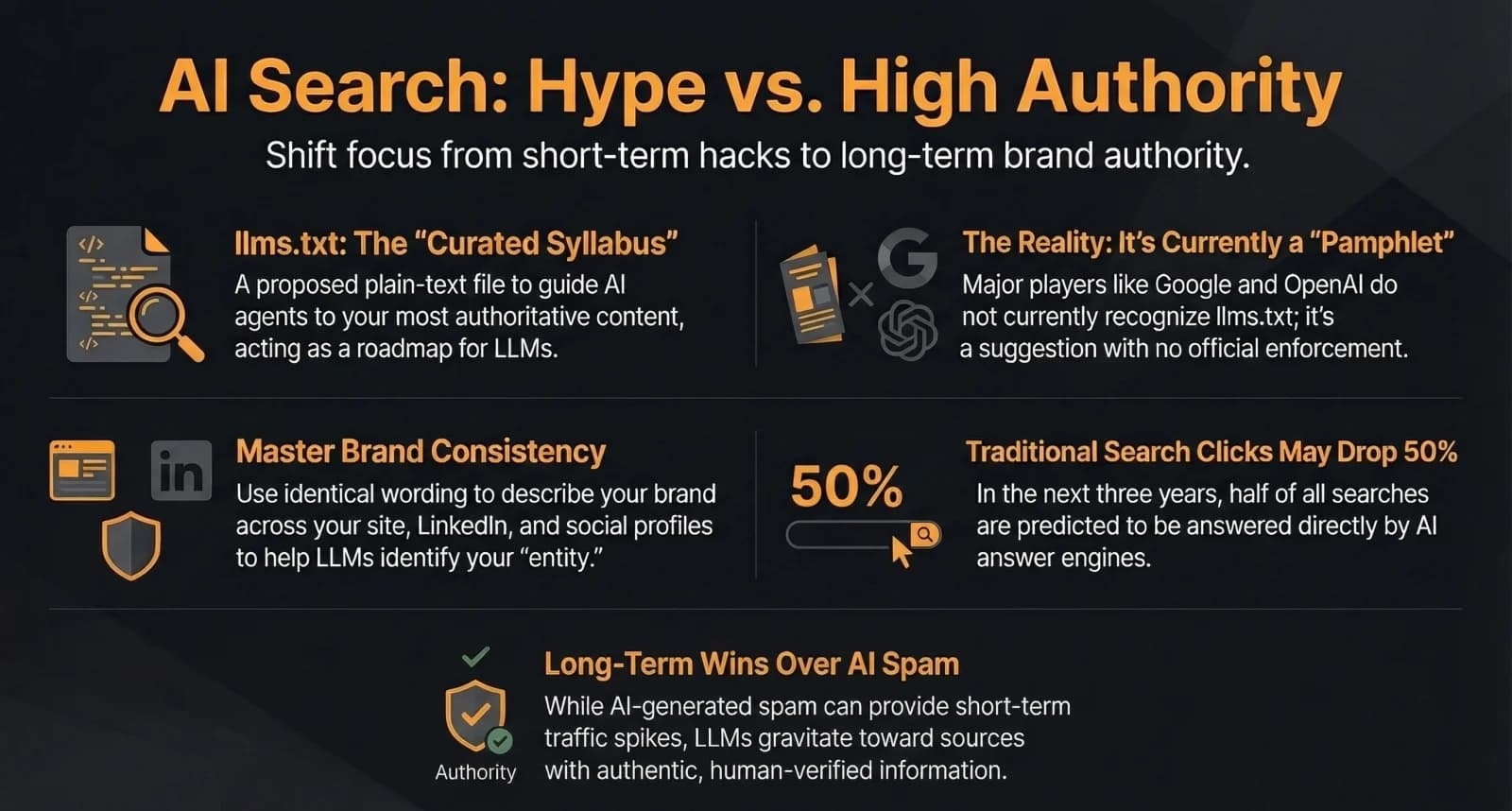
| Not Adopted / Not Supported | Not in source | Not in source | None; official documentation and John Mueller state no AI system currently uses it and it is treated as a plain text file. | Focus on traditional SEO, ranking well in standard search, and using structured data/schema instead. | |
| OpenAI / ChatGPT | Not Adopted / No official stance | Not in source | Not in source | Low to none; the company has not mentioned support in official documentation. | Prioritize high-quality content and brand consistency across the web to influence LLM grounding. |
| State of Maryland | Adopted | Manual file creation on root directory | Provide authoritative index for AI agents; warn that AI should not infer legal/policy eligibility beyond published text. | High interest; reported nearly 12 million requests from AI crawlers in a single month after launching. | Use for clear machine-readable guidance for government/legal entities to reduce hallucinations. |
| Anthropic, Cloudflare, Stripe | Adopted | llms.txt file on root directory | Provide clean machine-readable documentation, specifically for developer/API docs. | Effective for developer-centric use cases and coding agents (VIP tools) rather than general search ranking. | Adopt if the site contains complex API or technical documentation meant for AI coding agents. |
| Yoast SEO (WordPress Plugin) | Implemented as a feature | Automatic or Manual page selection in site features settings | Help AI models understand the website; future-proof site for AI search traffic. | Mechanical effectiveness for file generation; impact on ranking is debated and likely minimal given lack of bot requests. | Enable 'Automatic' mode to easily provide a machine-readable index without manual maintenance. |
| RankMath (WordPress Plugin) | Implemented as a feature | Dashboard toggle for llms.txt generation | Guide AI to valuable high-quality content rather than blocking or controlling it. | Low; the company promotes the feature but reportedly does not use it on their own site. | Enable to point bots to simple text-only versions to potentially reduce server load and help with clean info retrieval. |
| SEO Experts (General Analysis) | Skeptical / Mixed | Strategic Implementation | Attempt to mitigate hallucinations and manage crawl budgets for AI agents. | Low for SEO; viewed as 'meta keywords' for AI that bots currently ignore in favor of traditional indexing. | Focus on 'Compact Keywords' (transactional-intent pages of \sim415-500 words) and brand consistency for long-term AI readiness. |
| Robots.txt (Comparison Standard) | Universally Adopted | Standardized protocol (REP) | Act as a gatekeeper to tell web crawlers which parts of a site they are allowed to index. | Very High; standard protocol followed by all reputable search and AI crawlers. | Always maintain a robust robots.txt; do not expect llms.txt to replace its enforcement capabilities. |
Original research by ManaTech
Frequently Asked Questions
What is llms.txt and how does it differ from robots.txt?
The llms.txt file is a structured plain-text file placed at your root domain that provides AI language models with a concise summary of your site. While robots.txt tells search crawlers what pages to index or ignore, llms.txt gives AI systems a structured overview of who you are, what you do, and where to find your most important content, optimized for AI context windows.
How do I create an llms.txt file for my website?
Start with a markdown H1 heading with your company name, followed by a one-paragraph description of your business. Then list your 10-20 most important pages organized by category, with each entry containing the page URL, a greater-than symbol, and a one-sentence description. Keep descriptions factual and specific. The entire process takes less than an hour.
What is the difference between llms.txt and llms-full.txt?
The llms.txt file provides a concise summary designed to fit within a typical AI context window, acting as a navigation map for your site. The llms-full.txt file contains your complete site content in a single markdown file, useful for documentation-heavy sites. Both files can coexist on your domain, giving AI models the choice between a quick overview and a comprehensive deep dive.
Which companies are using llms.txt?
Stripe uses llms.txt for its API documentation, Zapier uses it to surface 7,000+ integrations, and Cloudflare has adopted it across its developer docs. Beyond tech, early adopters span e-commerce, professional services, and SaaS companies. Businesses with complex product offerings or technically sophisticated customers are leading adoption.
Does llms.txt actually increase AI search traffic?
Yes. Early data shows sites with llms.txt files report an average 30% increase in AI-referred traffic within the first three months. Click-through rates from AI citations are 25% higher for sites with llms.txt, likely because AI models can point users to the most relevant page rather than a generic homepage.
Think You've Got It?
15 questions to test your understanding — instant feedback on every answer
Question 1 of 15
According to the transcript from MarketUS, what is the primary structural function of an `llms.txt` file?
Question 2 of 15
How does the MarketUS source distinguish `llms.txt` from the established `robots.txt` file?
Question 3 of 15
According to the Starsky Robinson source, what did Google's John Mueller state regarding the current adoption of `llms.txt`?
Question 4 of 15
In the Edward Sturm podcast, what is described as a 'short-term' spammy technique for LLM SEO?
Question 5 of 15
What is the primary risk associated with AI 'hallucinations' that `llms.txt` advocates hope to mitigate?
Question 6 of 15
According to the Edward Sturm source, which platform is Perplexity noted to have a bias towards in its search results?
Question 7 of 15
What does the term 'compact keywords' refer to in the context of Edward Sturm's SEO strategy?
Question 8 of 15
Why does the guest in the Edward Sturm podcast argue that many SEOs are promoting `llms.txt` despite limited evidence of its effectiveness?
Question 9 of 15
What is the guest's view on Cloudflare's decision to block AI crawlers by default?
Question 10 of 15
In the context of the Edward Sturm podcast, what does 'query fanout' mean for AI agents?
Question 11 of 15
According to the WordPress tutorial source, which SEO plugin allows users to enable `llms.txt` with a single toggle?
Question 12 of 15
What is a 'long-term win' strategy for brand consistency mentioned in the Edward Sturm podcast?
Question 13 of 15
Which specific government was the first to adopt the `llms.txt` standard, according to Michael Price?
Question 14 of 15
The Starsky Robinson source compares `llms.txt` to a specific type of offline document to highlight its lack of enforcement. What is it?
Question 15 of 15
What does Edward Sturm believe will happen to the 'total cake' of SEO traffic over the next three years?
Related Content
Your Website Is Invisible to AI Search — Here Is How to Fix It
AI search engines like ChatGPT, Perplexity, and Gemini cannot read most business websites. If your site relies on client-side JavaScript rendering, you are invisible to the fastest-growing traffic source on the web.
Read more →blogAI Search Sends Businesses 10x More Revenue Per Click
AI-driven traffic accounts for less than 1% of visits but generates up to 11.4% of revenue. The data shows that every AI click is worth dramatically more than a traditional search click.
Read more →blogHow to Get Your Business Cited by ChatGPT
AI citations are the new backlinks. Branded web mentions correlate more strongly with AI visibility than traditional SEO signals. Here are 7 practical steps to get your business into AI answers.
Read more →Want to explore this topic further?
Book a free discovery call to discuss how ManaTech can help your business implement these ideas.
Book a Discovery Call