
Perplexity AI for Beginners: The Complete Guide for Business Owners
Quick Answer
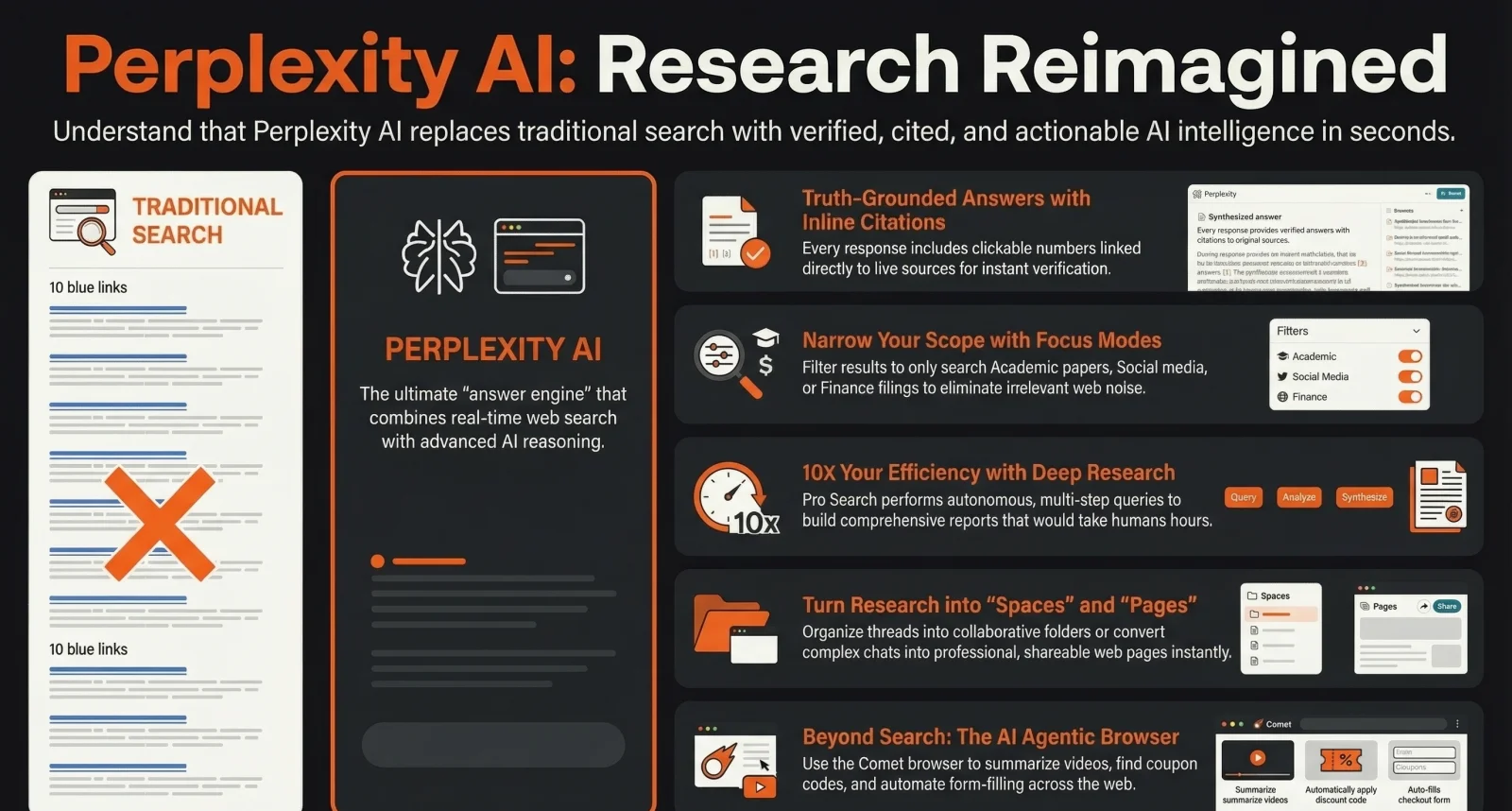
Perplexity AI is an AI-powered answer engine that searches the web in real time and synthesises answers with inline source citations. Unlike ChatGPT, every response includes numbered references to original sources so you can verify claims. The free plan gives you unlimited quick searches and 3 Pro Searches per day, while the $20/month Pro plan unlocks 300+ Pro Searches, advanced AI models, and file uploads.
Key Answers
- What is Perplexity AI?
- Perplexity AI is an AI-powered search engine that retrieves live web data and synthesises answers with inline source citations, sitting at the intersection of Google and ChatGPT.
- How much does Perplexity cost?
- Perplexity is free for unlimited quick searches with 3 Pro Searches per day. The Pro plan costs $20 per month and unlocks 300+ Pro Searches, advanced AI models, and unlimited file uploads.
- How is Perplexity different from ChatGPT?
- Perplexity cites every claim with numbered source links so you can verify information. ChatGPT is better for creative writing and coding but does not consistently cite sources.
- What is Perplexity Pro Search?
- Pro Search is a multi-step reasoning engine that breaks complex questions into sub-queries, searches multiple sources in parallel, and cross-references findings for thorough research.
- Can small businesses use Perplexity effectively?
- Yes. Perplexity excels at competitive research, lead briefings, content ideation, vendor evaluation, and strategic decision support, saving hours of manual research per week.
Key Takeaways
- Perplexity AI processes 30 million queries daily with 45 million monthly active users, growing 800% year over year and making it the fastest-growing AI search platform.
- Every Perplexity response includes numbered inline citations linking to original sources, making it fundamentally more trustworthy for business research than ChatGPT or Gemini.
- Pro Search breaks complex questions into 10-25 sub-queries and cross-references multiple sources, producing research-grade answers in seconds that would take manual research hours.
- Deep Research mode spends 2-4 minutes conducting iterative research across dozens of sources, producing comprehensive reports with executive summaries and recommendations.
- Spaces allow teams to organise research by project or client, set custom AI instructions per Space, and collaborate on ongoing research without losing context.
What Is Perplexity AI and Why Should Business Owners Care?
Perplexity AI is an AI-powered search engine that gives you cited, synthesised answers instead of a list of blue links. It processes 30 million queries daily and has 45 million monthly active users.
Traditional search engines return a list of links and leave you to read, compare, and synthesise the information yourself. Perplexity does that work for you. When you ask a question, it searches the live web, reads multiple sources, and delivers a clear answer with numbered citations linking to every source it used. Founded by Aravind Srinivas, a former Google AI and DeepMind researcher, Perplexity has grown from 3,000 queries per day in 2022 to 30 million daily queries in 2025. That is a 10,000x increase. AI search traffic generates 10x more revenue per click than traditional search, and Perplexity is one of the primary platforms driving that shift. For business owners, Perplexity replaces hours of manual research with verified, structured answers in seconds.
How Does Perplexity Differ from ChatGPT, Google, and Gemini?
Perplexity sits between a search engine and a chatbot. It searches the live web like Google but synthesises answers like ChatGPT, and unlike both, it cites every claim with numbered source links.
Google gives you links. ChatGPT gives you answers but does not consistently cite sources. Perplexity gives you answers with every claim backed by a numbered source you can click and verify. This makes it fundamentally more trustworthy for business decisions. ChatGPT is stronger for creative writing, code generation, and brainstorming. Google is better for local search, shopping, and broad web discovery. Perplexity excels at research, fact-checking, competitive analysis, and any question where you need a verified answer quickly. Each AI platform prefers different sources, so understanding where Perplexity fits in your workflow is essential. Use it as your research engine. Use ChatGPT or Claude for content creation.
What Are the Key Features Every Beginner Should Know?
The five features that matter most are Quick Search for fast answers, Pro Search for deep analysis, Deep Research for comprehensive reports, Focus Modes for filtering sources, and Spaces for organising team research.
Quick Search handles simple factual questions in seconds. Pro Search is where the real power lives. It breaks complex questions into 10-25 sub-queries, searches multiple sources in parallel, and cross-references findings. For example, asking "What CRM should a 5-person real estate agency use in New Zealand?" triggers Pro Search to evaluate pricing, features, local support, and integration options across multiple platforms simultaneously. Deep Research goes further. It spends 2-4 minutes conducting iterative research that would take a human expert hours. It formulates a research plan, runs dozens of parallel searches, reads full documents, and produces comprehensive reports with executive summaries, key insights, timelines, and recommendations. Focus Modes let you filter results by source type. Academic Mode prioritises scholarly articles. Writing Mode helps with content drafts. Video Mode surfaces video results. Spaces let you organise all of this by project or client, with custom AI instructions and team collaboration.
How Can Business Owners Use Perplexity Day to Day?
Business owners use Perplexity for competitive research, sales call preparation, content ideation, vendor evaluation, compliance research, and strategic decision support, all with verified sources.
Before a sales call, ask Perplexity to brief you on a prospect: their recent news, funding rounds, tech stack, and industry challenges. You get a structured briefing with sources in under a minute. For content creation, ask Perplexity to research a blog topic and identify the specific questions your audience is asking. It will surface data points, statistics, and trends you can use as the foundation for articles. When evaluating vendors or tools, ask it to compare options with specific criteria. It will produce a structured comparison backed by current web data. For strategic decisions like entering a new market or adjusting pricing, Deep Research mode produces multi-page reports with multiple perspectives. Combined with AI-powered lead scoring and automation tools, Perplexity becomes a core part of a business intelligence stack that would have cost thousands per month just two years ago.
What Are the 7 Mistakes Beginners Make with Perplexity?
The most common mistakes are writing vague queries, ignoring Pro Search for complex questions, not using Focus Modes, failing to follow up on answers, and treating Perplexity like a replacement for ChatGPT instead of using both.
First, being too vague. Typing "marketing" gives you generic results. Typing "What are the most effective digital marketing channels for B2B SaaS companies with under $1M ARR in 2026?" gives you actionable intelligence. Second, using Quick Search for everything. Toggle on Pro Search for anything that requires comparison, analysis, or multi-step reasoning. Third, not using Focus Modes. If you need academic research, switch to Academic Mode. Fourth, not following up. Perplexity maintains conversation context. Ask follow-up questions to refine and deepen your research. Fifth, ignoring Spaces. After 20+ research sessions, everything becomes an unorganised mess. Create dedicated Spaces for each client or project from the start. Sixth, not uploading documents. Drag and drop PDFs, reports, or contracts for instant analysis instead of manually copying text. Seventh, treating it as a replacement for all AI tools. Perplexity excels at research. Use ChatGPT or Claude for creative writing, coding, and content generation.
What Is the Bottom Line?
Perplexity AI is the best AI-powered research tool available for business owners. It delivers verified, cited answers in seconds and replaces hours of manual research per week.
Perplexity AI is growing faster than any other AI search platform. With 45 million monthly active users and $148 million in annual recurring revenue, it is not a niche experiment. Start with the free plan. Use Quick Search for simple questions and Pro Search for anything that matters. Create Spaces to organise your research by project. As AI search visibility becomes critical for business, understanding how these platforms work is not just useful, it is essential. At ManaTech, we help businesses integrate AI tools like Perplexity into their workflows and build custom applications that leverage AI search for competitive advantage.
Research Data
Key strategies and factors based on original research
| Pricing Tier | Monthly Cost (USD) | Key Features | Model Access | Best Use Cases | Search & Research Limits |
|---|---|---|---|---|---|
| Free | $0 | Basic search, collection creation, mobile app access, and file uploads (converted to PDF). | Standard Perplexity model (Sonar); no choice of advanced models. | Casual users, basic fact-finding, and individuals testing the platform. | Unlimited basic searches; 5 Pro searches per day. |
| Pro | $20 | Unlimited Pro searches, 20 research queries/day, 50 Labs queries/month, 10x citation density, 50 file uploads (50MB each), team collaboration (up to 5 users), and $5/mo API credit. | GPT-4o, GPT-5.1, Claude 3.5 Sonnet, Claude Opus 4.1, Gemini 1.5 Pro, Grok, and Seedream 4.5. | Students, analysts, content creators, professional researchers, and digital marketing agencies. | 300 Pro searches daily; 20 Deep Research queries per day. |
| Max | $200 | Unlimited research queries, Labs projects, and file uploads; 15 video generations/month with audio, Comet browser early access, and priority support. | Advanced models including GPT-5.1 Thinking, Claude Opus 4.5, and o3-pro. | Power users, professional researchers requiring unlimited capacity, and advanced technical workflows. | Unlimited Pro and Deep Research queries. |
| Enterprise Pro | $40 per seat | All Pro features plus team governance, internal knowledge search, audit logs, and SOC 2 Type II compliance. | Advanced models (as per Pro tier) with enhanced security and no training on user data. | Small to medium teams (5-50 people) requiring shared research and security compliance. | Unlimited capacity for team-based research tasks. |
| Enterprise Max | $325 per seat | All Enterprise Pro features plus unlimited capacity, Comet Max assistant for advanced workflows, and a dedicated account manager. | Full access to all advanced models with enterprise-grade priority. | Large enterprises (50+ people) with heavy research automation needs. | Unlimited capacity across all features. |
Original research by ManaTech
Frequently Asked Questions
What is Perplexity AI and how does it work?
Perplexity AI is an AI-powered answer engine that searches the web in real time when you ask a question. It retrieves content from multiple sources, synthesises a clear answer, and provides numbered inline citations linking to every source used. Unlike traditional search engines that return a list of links, Perplexity gives you a direct, verified answer.
Is Perplexity AI free to use?
Yes. The free plan includes unlimited quick searches and 3 Pro Searches per day. The Pro plan costs $20 per month or $200 per year and includes 300+ Pro Searches per day, access to advanced AI models like GPT-4 and Claude, unlimited file uploads, and API access.
How is Perplexity AI different from ChatGPT?
Perplexity focuses on factual research with source citations. Every answer includes numbered references to original sources so you can verify claims. ChatGPT is stronger for creative writing, coding, and brainstorming but does not consistently cite sources and is more prone to hallucination when stating facts. Use Perplexity for research and fact-checking, ChatGPT for creation and coding.
What is the difference between Quick Search and Pro Search?
Quick Search gives you a fast, single-pass answer suitable for simple factual questions. Pro Search is a multi-step reasoning engine that breaks complex questions into sub-queries, searches multiple sources in parallel, cross-references findings, and produces a more thorough, nuanced answer. Use Pro Search for competitive analysis, detailed comparisons, and important business decisions.
What are Perplexity Spaces and how do I use them?
Spaces are dedicated research environments for organising work by project, client, or topic. Each Space maintains its own conversation history and can have custom AI instructions. You can invite team members to collaborate within a Space. Use Spaces to keep client research separate, build shared knowledge bases, and maintain context across multiple research sessions.
Think You've Got It?
12 questions to test your understanding — instant feedback on every answer
Question 1 of 12
Which search operator should be used if you want Perplexity to limit its search specifically to one website, such as quickbooks.com?
Question 2 of 12
What is the primary difference between Perplexity's 'Search' mode and 'Research' mode?
Question 3 of 12
Which Perplexity feature is best suited for storing persistent documents and custom instructions for a specific ongoing project, such as 'Company Data' or 'Trip Planning'?
Question 4 of 12
What is a unique capability of the Comet browser compared to using the Perplexity website in a standard browser?
Question 5 of 12
In Perplexity's Focus mode, which setting is specifically designed to search through SEC filings and market data?
Question 6 of 12
Which of the following describes a limitation of the 'Shortcuts' (slash commands) feature mentioned in the sources?
Question 7 of 12
What does Perplexity 'Labs' allow a user to create that distinguishes it from a standard text response?
Question 8 of 12
True or False: Perplexity Pro users can switch between different AI models like GPT-4, Claude, and Gemini for the same query to compare results.
Question 9 of 12
What happens when you connect Perplexity to WhatsApp?
Question 10 of 12
How does the 'after:YYYY-MM-DD' search operator help improve result accuracy?
Question 11 of 12
What is the maximum number of 'Recurring Tasks' a Pro plan subscriber can have running on autopilot?
Question 12 of 12
Which feature in the Comet browser allows you to identify a specific landmark or object seen in a YouTube video?
Related Content
Your Website Is Invisible to AI Search — Here Is How to Fix It
AI search engines like ChatGPT, Perplexity, and Gemini cannot read most business websites. If your site relies on client-side JavaScript rendering, you are invisible to the fastest-growing traffic source on the web.
Read more →blogAI Search Sends Businesses 10x More Revenue Per Click
AI-driven traffic accounts for less than 1% of visits but generates up to 11.4% of revenue. The data shows that every AI click is worth dramatically more than a traditional search click.
Read more →blogHow to Get Your Business Cited by ChatGPT
AI citations are the new backlinks. Branded web mentions correlate more strongly with AI visibility than traditional SEO signals. Here are 7 practical steps to get your business into AI answers.
Read more →Want to explore this topic further?
Book a free discovery call to discuss how ManaTech can help your business implement these ideas.
Book a Discovery Call